
One of the more painful traps to fall into is when we realize we’ve lulled ourselves into the belief that we’re above using the checklist.
No false bravado
Erling Haaland is one of the best football/soccer strikers in the world, and by the time he’s done with his career, he’ll be remembered as one of the greatest to ever play the game. What I’ve loved about him at this World Cup, though, has nothing to do with his goals.
It was his refusal to carry any pressure.
Ahead of facing France in their group game, when people asked if France would win, he shrugged: “They’ll probably beat us and go on and win the whole tournament.” (And they did win 4-1 with Haaland rested).
Then Norway went and stunned Brazil to reach their first-ever quarterfinal. Asked about their chances against England, he called them “really low” — his belief was that other teams are far more likely to lift the trophy, and England is one of them.
None of this was humility for show. Norway genuinely weren’t favorites. But it would have been easy to lead with false bravado. Instead, Haaland choose self-deprecating humor to keep expectations low and to keep focus on just doing their best.
In keeping the pressure low, he quietly freed his whole team to finish in the top 8.
In the end, they were beaten by a better English team but walked out of the world cup as one of the winners for the way they approached the game.
Zion National Park
#OurWorldIsAwesome – Edition 22 | Context on this series – we live in a beautiful world and National Parks are akin to the crown jewels of this planet. These landscapes remind us of the fine balance and complexity woven into the fabric of the world around us. Every time I spend a while inside one of these places, I’m reminded of how precious that balance is, and how much it matters that we try to understand the complexity and our own small role within it.
I think that’s what awe really is. We reach for the word “awesome” in the moments something helps us see our own insignificance — and windows into nature do that for me every time. So this is my small way of sharing it, and passing it along.
The first thing that hits you at Zion is the red. The canyon walls rise straight up in deep, saturated rust and rose, and the whole place takes on an otherworldly glow.
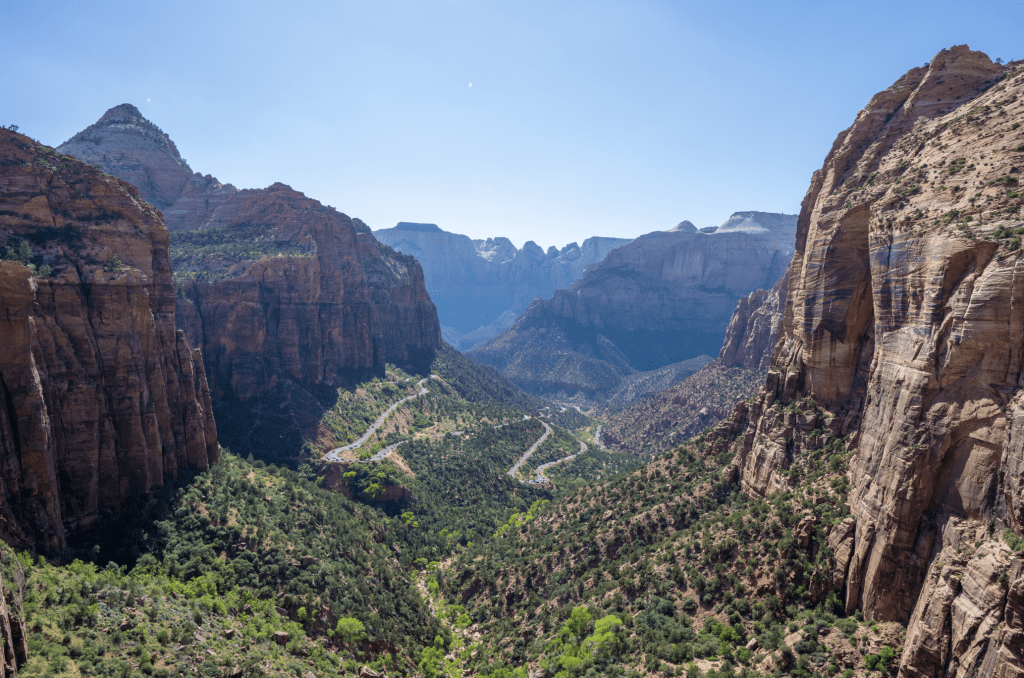
The walls kept reminding me of two other places at once. Their sheer vertical scale — sandstone rising thousands of feet straight off the canyon floor — took me back to standing beneath the granite faces of Yosemite. But the color, those layered bands of red and cream stacked across the rock, belonged to the Grand Canyon.
That double echo isn’t a coincidence. Zion, Bryce, and the Grand Canyon are all part of a single formation called the “Grand Staircase” — one continuous stack of rock where the bottom layer at Bryce is the top layer at Zion, and the bottom layer at Zion is the top layer at the Grand Canyon. So, standing in Zion, you’re standing in the middle chapter of this beautiful story.
Interestingly, Zion’s canyon was carved by the relatively tiny Virgin river. However, the river’s gradient drops somewhere between 50 and 80 feet of drop per mile, one of the steepest stream gradients in North America. A steep, fast river carries far more rock than a lazy one. And most of the cutting doesn’t happen gradually — it happens in short, violent bursts during flash floods that rip out huge volumes of debris at once. This process continues today, these magnificent canyons are still a work in progress.
There’s plenty to do within Zion. You can wade straight up the Virgin River into the “Narrows” surrounded by sky-high canyon walls with “hanging gardens” on the walls. The water can be chilly in the morning and cool and inviting on a summer afternoon. There are many opportunities to hike. And it is also a wonderfully bike-friendly park with electric bike rentals available aplenty in nearby Springdale (a gorgeous town).
One of my favorite memories from the park was this single enormous tree near the heart of the park.
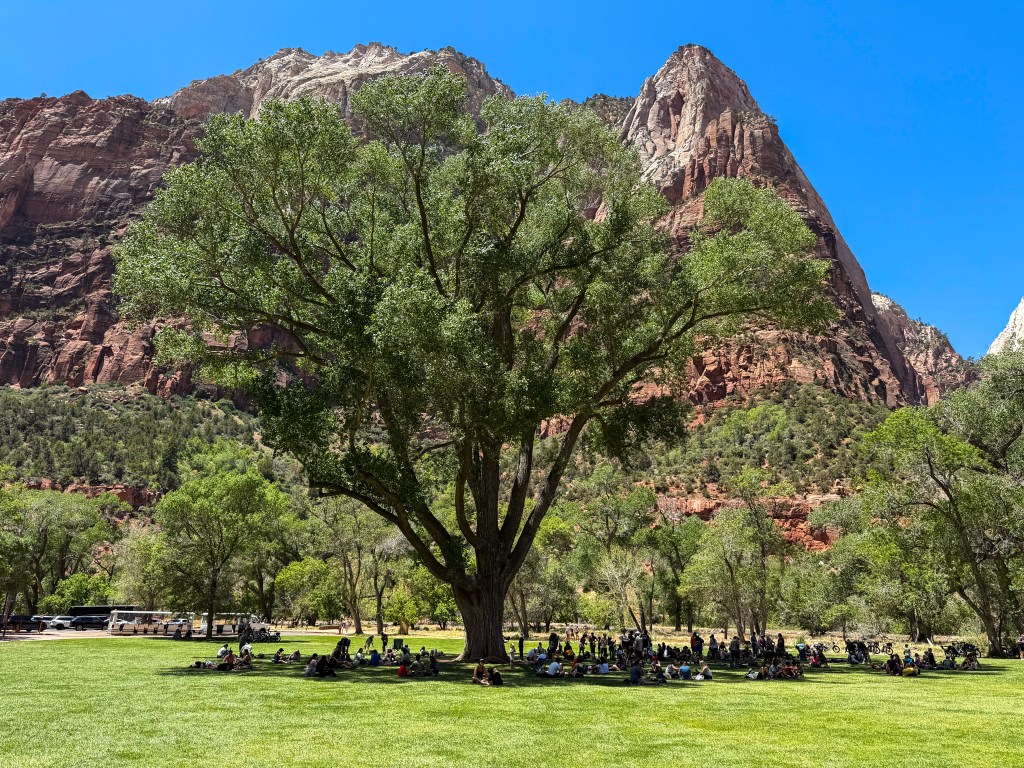
Its canopy shades at least a hundred and fifty people at once. Sitting under it, I found myself thinking about all the shade it has thrown over a lifetime — the countless strangers who rested beneath it and moved on while the tree listened quietly to their stories.
The saddest evolution
There’s a breed of human you meet when you’re out in the midst of an awe-inspiring vista -> The annoying photo taker.
This person refuses to take in anything with their own eyes. Every view has to be seen through the phone. Every viewpoint has to be snapped — fifty clicks, ten videos. Nothing counts if it isn’t on the phone. People get pushed aside, rude comments get made, all to make space for the perfect Instagram reel.
It might be the saddest evolution of our species — the people who travel somewhere beautiful and never actually see it.
Master in the art of living
“A master in the art of living draws no sharp distinction between work and play; labor and leisure; mind and body; education and recreation. He hardly knows which is which. He simply pursues his vision of excellence through whatever he is doing, and leaves others to determine whether he is working or playing. To himself, he always appears to be doing both.”
Minister and philosopher Lawrence Pearsall Jacks, on living an aligned life (Education Through Recreation, 1932 — via James Clear’s newsletter)
The fluidity implied in this quote hit me hard.
We spend so much energy negotiating the work-life trade-off, drawing the line in the right place, when the master that Lawrence Pearsall Jacks describes simply stops drawing the line.
It is one I’ll be thinking about and writing about for a while.
Job Lock and Victor Fuchs – American Healthcare Chronicles
I recently started building products focused on healthcare affordability in the US. As I was ramping up on a new space, the biggest question that sparked my curiosity was: how did we get here? This question is the inspiration for this weekly series chronicling the decisions, accidents, and breakthroughs that built the US healthcare system
Two questions have run through this series without a clean answer.
The first appeared in Edition 1: what happens when you leave your job? The employer-based system was built for a world where people stayed at companies for life. Nobody asked what happened when they didn’t.
The second appeared in Edition 5: what happens when costs have no ceiling? Medicare passed with no price controls — physicians and insurers set their own fees, and the federal government paid whatever was charged.
By the 1990s, both questions were arriving as lived reality for millions of Americans.
As healthcare costs rose through the 1980s and 1990s — driven partly by uncapped Medicare incentives, partly by the tax exclusion that rewarded ever-richer benefit packages — employer insurance became more valuable. And more dangerous to lose.
Each stakeholder was responding rationally to their own incentives.
Insurers, operating in a market where pre-existing conditions could be excluded, charged more for individual coverage and less for group plans. The math heavily favored staying with an employer.
Employers, benefiting from the tax exclusion, offered richer plans to attract talent. The more generous the plan, the harder it was to leave.
Patients faced a calculation that had nothing to do with job satisfaction or productivity. Before the Affordable Care Act, roughly 27% of non-elderly adults had a condition that would likely cause them to be turned down for individual coverage. For those people, leaving an employer wasn’t inconvenient. It was a genuine financial risk.
So, workers with employer-sponsored insurance were 25% less likely to voluntarily change jobs. They stayed on the job 16% longer and were 60% less likely to leave voluntarily. “Job lock” showed up three ways.
Workers stayed in jobs they disliked because switching employers meant losing coverage or facing exclusions for pre-existing conditions. Entrepreneurs didn’t start companies. Imagine you are a software engineer with a diabetic child or a designer whose spouse had MS — the individual insurance market was expensive, unreliable, and hostile to anyone with a medical history.
Finally, workers delayed retirement. Too young for Medicare at 62 or 63, they kept working because three years without coverage could wipe out a lifetime of savings.
A Gallup study found one in six American workers with employer-based insurance staying in jobs they wanted to leave, purely out of fear of losing coverage. The effect was strongest among lower-income workers — the people with the least ability to absorb the risk.
This takes us right back to the Victor Fuchs quote I keep coming back to:“Part of the problem is that we have not decided what we want our healthcare system to do.”
Job lock is a precise illustration of what that means. The system was never asked to preserve labor mobility. It was never asked to encourage entrepreneurship, or allow early retirement, or enable career changes. It was asked to cover employees — and it did that. Everything else was a side effect nobody counted.
The productivity lost to mismatched workers, the companies never started, the innovations never pursued — none of it showed up in a healthcare spending report. It was the cost of a system built for one era, running in a different one.
Good vs. great product strategy
A good product strategy is a well-articulated sequence of steps explaining how a team will achieve a goal. The logic is sound — it goes after goals that are valuable, leans into the organization’s superpowers, and leverages unique strengths. Something customers want, that the team can uniquely deliver, that builds on what they already do well.
But a good product strategy is still just something on paper.
It becomes great only when it meets the market. When it’s tested with customers, sharpened by reality, and forced to confront what’s actually true versus what was assumed. That contact is what brings it to life.
Until then, it’s a thesis. A good thesis is a good thing — but it does not a strategy make.
Ask the person directly
Quick tip: when you send an email to a group with a specific ask, address it directly to the person who needs to take action. Skip the generic “hi team” or “hi all” — it maximizes the chances people will ignore it or assume someone else will handle it.
Clarity is kindness.
Be careful what you manifest
I knew of a team whose leaders had it in their heads that the executive team had no trust in them.
A negative thought like that ascribes negative intent. And in every action the executive team took subsequently, they found confirmation.
Over time, the team started playing more defense as every action involved worrying about criticism and exec reactions. They stopped playing offense. They got less funding — which further cemented this belief. The spiral continued till the exec team ended up losing trust. A self-fulfilling prophecy.
I also know of a team who were objectively in a worse situation than this team. However, they turned it around simply through the absence of that limiting belief.
You see this with people too. Start with a negative assumption, ascribe negative intent, play more defense, spiral. The original thought manifests itself.
Optimism and pessimism are both self-fulfilling prophecies. What we think about, dwell on, and give our attention to has a way of becoming real.
Be careful what you manifest.
Bryce Canyon National Park
#OurWorldIsAwesome – Edition 21 | Context on this series – we live in a beautiful world and National Parks are akin to the crown jewels of this planet. These landscapes remind us of the fine balance and complexity woven into the fabric of the world around us. Every time I spend a while inside one of these places, I’m reminded of how precious that balance is, and how much it matters that we try to understand the complexity and our own small role within it.
I think that’s what awe really is. We reach for the word “awesome” in the moments something helps us see our own insignificance — and windows into nature do that for me every time. So this is my small way of sharing it, and passing it along.
There’s a tree at Bryce Canyon whose roots hang a foot or two above the ground, gripping nothing but air. The soil that once held them has eroded. In a way, the tree is standing on the memory of a floor that no longer exists.

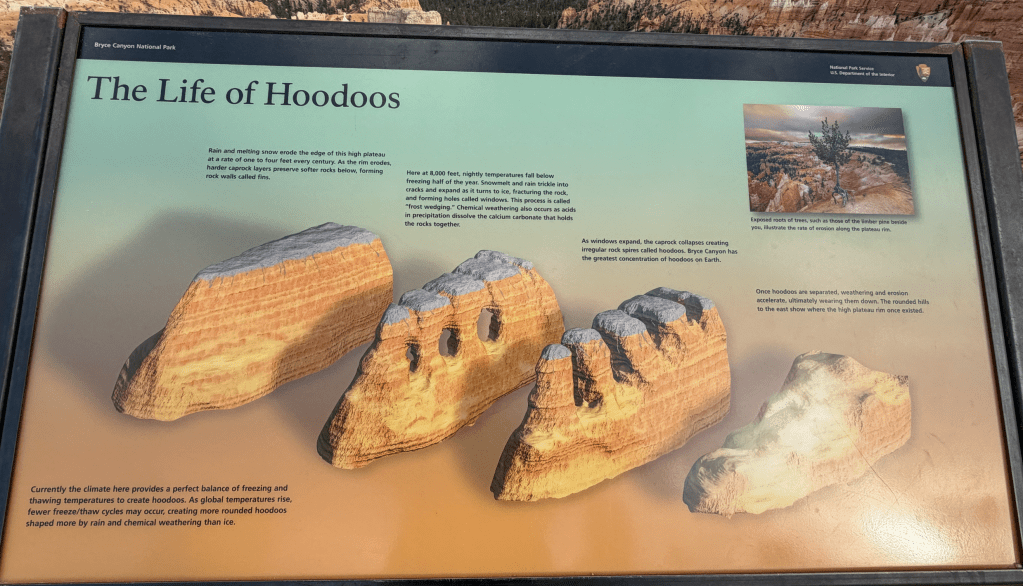
The whole landscape was made this way — by rain, snow, and ice patiently working the rock, freezing and thawing close to two hundred times a year, carving a plateau into a forest of stone spires over millions of years.
These stone spires are called “hoodoos” and their life tells a fascinating tale.
The most striking stretch is a dense maze of hoodoos called the “Silent City.” Standing above it, you really do feel like you’re looking down at a city — streets, towers, walls — except nothing moves and nothing makes a sound.
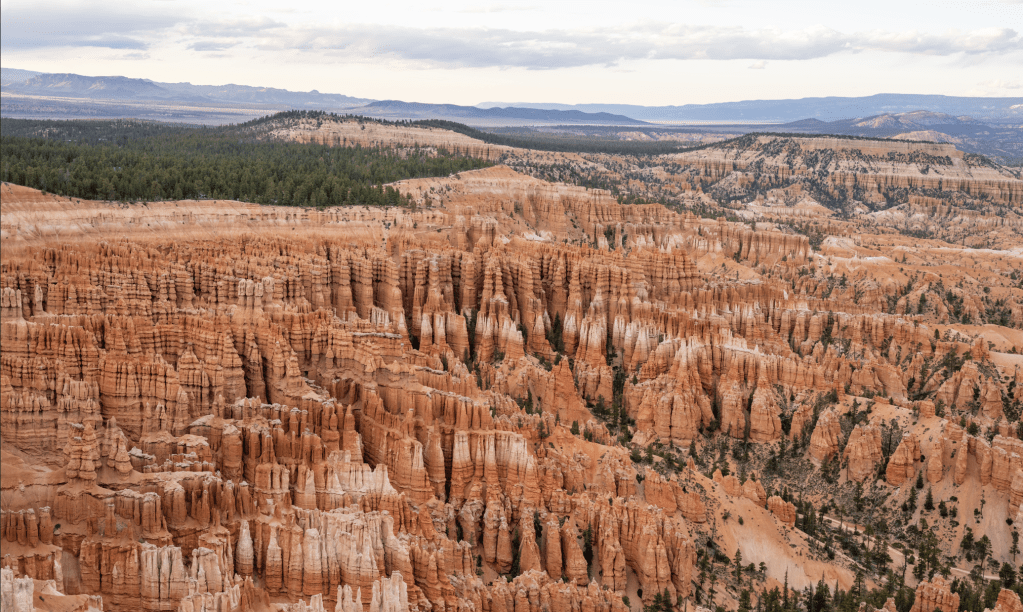
The name, to me, was symbolic of the quiet beauty of Bryce Canyon National Park. A reminder that everything that shaped this beautiful place happened quietly.
Just water and time patiently working away, day in and day out over many centuries.

