
Economies of scale and cautionary tales

Leading car manufacturers in the past few decades have been concentrated among manufacturers from a few countries like Germany (Volkswagen et al), Japan (Toyota), and the United States (Ford, General Motors). The biggest challenge any incumbents faces is moving quickly when new technology arrives.

Tesla’s success has been a great example of the incumbents’ failure to respond. In 2023, the Model Y was the best selling car in the world – beating the Toyota Corolla. Tesla reimagined a great driving experience and reaped the results as the undisputed leader in electric vehicles for the past decade.
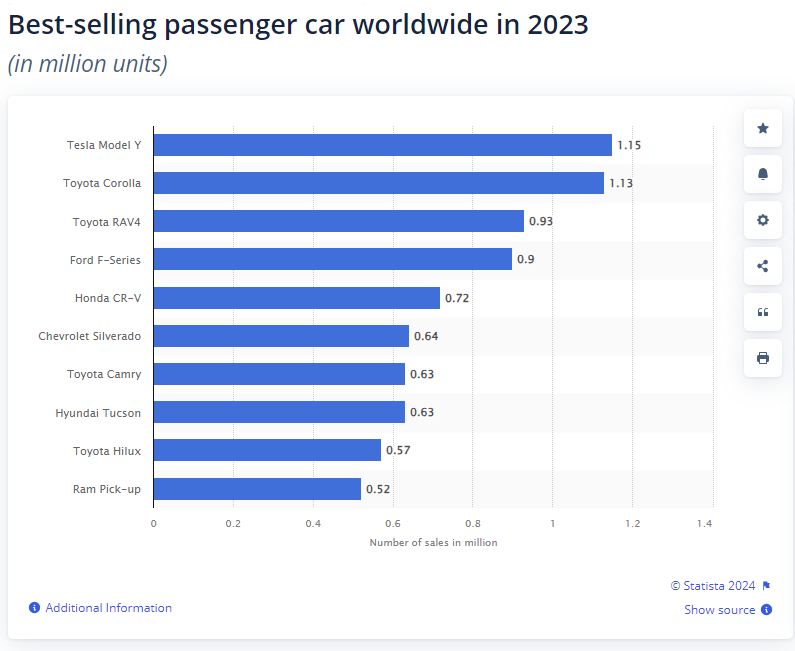
All this while, we’ve seen the incumbents takes a few steps forward with a few steps back. Call it hubris or a lack of conviction or some mix of both – but they’ve taken their time. So, reading this excerpt in the Exponential View about the progress in China was eye-opening.

China has reduced vehicle costs through economies of scale in manufacturing, allowing prices as low as $10,000 per vehicle. In addition, wages are likely to have increased fivefold since 2008¹. These factors have made vehicles more affordable for China’s middle class. Last year, China registered 8.1 million new EVs. With 120 million factory workers, unlocking domestic demand will create a virtuous cycle of learning and growth for manufacturers.

Chinese cost leadership in EVs is already challenging US and German companies. The Tesla Model 2, cancelled in April, was going to cost $25,000 and the cheapest Volkswagen EV is €36,900 – both well above BYD’s $10,000 Seagull. Tariffs of 100% in the US and potentially of at least 50% in the EU are designed to buy time for incumbent carmakers, but the pressure is on to compete. These companies bear some responsibility for their situation, having defended ICE vehicles rather than embracing the exponential trajectory of battery pricing and EV demand.

The tariffs won’t mean much to China – there are plenty of markets for their cheap vehicles, Brazil, Asia, Africa (and Ethiopia, of course). Even in the UK, I just saw my first BYD in a local neighbourhood in London last week.

The lesson is a cautionary tale of hubris, for Western car makers who doubted the exponential trend sweeping electric vehicles and stepped in too timidly and, possibly, too late.

As fascinating as this case study is, this post isn’t about the car industry.

Instead, it got me reflecting on my own decision making. We all are dealing with versions of this story – in our personal lives, in our career, and in decisions we make at work.

It is so easy to get attached to the status quo – especially when it feels comfortable in the moment. It is best to anticipate the change and move toward it on your own terms rather than get caught reacting to it.

Amateurs react, professionals respond, masters anticipate.

Stress and ignoring things

I saw an insightful post/clip from a Jeff Bezos interview where he shared his perspective on stress. He said – “Stress comes from ignoring things that you shouldn’t be ignoring”

“If I find that some particular thing is causing me stress, that’s a warning flag for me. What it means is there’s something that I haven’t completely identified – perhaps in my conscious mind – that is bothering me and I haven’t yet taken any action on it.”

“I find as soon as I identify it and make the first phone call or send off the first email message… Even if it’s not solved, the mere fact that we’re addressing it dramatically reduces any stress that might come from it.”

”People get stress wrong all the time in my opinion. Stress doesn’t come from hard work, for example. You can be working incredibly hard and loving it. And likewise, you can be out of work and incredibly stressed over that.”

I hadn’t thought of stress this way.

It resonated.


Demons

“People who are driven by demons get shit done.” | Walter Isaacson, describing Elon Musk

This quote illustrates a fascinating paradox. Much of our path to happiness and peace is exorcising our demons and insecurities.

However, on the flip side, those very demons often provide the fuel for the drive toward our accomplishments.

Two sides of the same coin.

Widening roads

The highway closest to our place has been under construction over the past year. Large stretches of the highway are getting wider. This has meant periods of significant disruption and slower traffic in the past months.

And, while I hope this is all for the greater good, widening roads tend to have a fascinating side-effect.

While widened roads see lower traffic at first, they often go back to seeing just as much congestion as they did before. This is because people change behavior to take the “faster routes” and congestion is back on the table.

It is an illustration of supply and demand in real life. When you reduce the cost of driving (time is a big component), drivers will consume more of it.

It is also an example of how actions can sometimes have counter intuitive consequences. So, it helps to be clear about what our goals are. Widening roads are helpful if we want to increase the volume of road-usage.

But if we’re seeking to reduce traffic congestion, we’re better off pursuing a different strategy.

The true cost of something isn’t just on the price tag

When you buy a good camera, you don’t just buy the camera. You buy lenses, a slew of accessories, a camera bag, and a subscription to Adobe Lightroom.

When you buy a home, you don’t just pay for the home. You pay for property taxes, maintenance and upkeep. The more the square footage, the more the maintenance.

Similarly, you don’t just pay for a car. You pay for the occasional nail in the tire, the service, and the insurance.

This doesn’t mean any of the above are bad purchases. Each of these could be a great purchase – depending on your circumstances.

It is just worth remembering that the true cost of something isn’t just on the price tag.

6 photographers, 1 man

Canon conducted a fascinating experiment recently. They asked 6 photographers to shoot a portrait of one man. The twist was that each photographer was told something different about the man’s background – he was a fisherman, an alcoholic, a millionaire, a convict, a lifesaver, and a psychic.

Michael, of course, was none of these things. He was just an actor who played his part. These were the photos that the photographers took.

Fisherman

Alcoholic

Millionaire

Convict

Lifesaver

Psychic

“A photograph is shaped more by the person behind the camera than by what’s in front of it” was Canon’s note to creatives.

To me, it simply highlights the incredible power of perspective.