
It takes time to do things well.
Do fewer things. Do them well.
It takes time to do things well.
Do fewer things. Do them well.
I recently wrote about an analogy of how people are like lakes. The color of a lake changes based on the sun and atmospheric conditions.
The takeaway was that the external atmosphere in which people find themselves changes their behavior.
Another angle from which to think about the atmosphere is to think about the internal weather – this came up in a conversation recently.
The person I spoke to shared that they went through an extended period of not feeling like themselves – it lasted four years.
Four years.
It’s crazy to think how long internal weather can sometimes be off.
There were a series of factors that drove this. But they expressed their relief at being able to get out of this funk (with help from a coach) and go back to the better version of themselves from before.
Weather – both internal and external – matters.
We all use our phones a lot and battery life goes a long way. Here are three things I’ve learned.
(1) Heat is the biggest killer – especially heat combined with a full charge. Leaving your phone in a hot car or using intensive apps while charging accelerates permanent capacity loss faster than almost anything else.
This also means avoiding fast charging or wireless charging where possible.
(2) Use optimized charging. The charge from 20-80% advice is technically correct but often impractical. All you need to do is to enable optimized charging (max at 80% or 85%) when you charge overnight.
(3) Deep discharges stress batteries. While occasional full discharges aren’t catastrophic, they’re best avoided.
The practical takeaway: Avoid heat, use optimized charging, and aim to charge when you’re around 20%.
We’ve made it a habit to look up at the sky and appreciate the stars most nights now.
It reminds me of a few things all at once.
The first is how crazy the physics of this universe is. The night sky we are looking at is really the night sky from four years ago. That fact always blows my mind.
The second is that you see more of them once your eyes get used to the dark. We see more when we pay attention.
Third, stars are so beautiful. And yet it is so easy to not look up and notice them.
And finally, they always have a way of reminding me and giving me perspective of just how big the universe is. And how insignificant I am in the grand scheme of things.
A year ago, I wrote about the sit-and-rise test.
All the correlations with longevity aside, the sit-and-rise test is intriguing. It feels straightforward but it is anything but.
As part of my mobility work, I do the sit-and-rise test once every week.
This was challenging at first. I felt unstable when getting up. I could do it way better with my left leg. And I used to feel a muscle between my thigh and my groin hurt.
In the first months, out of every 10 sit-and-rises, 1 or 2 would be good quality. That number gradually went up to 3-4. Then to 6-7.
Ten months in, that uncomfortable muscle finally stopped acting up. And good quality is approaching 10. It is a lot easier to do.
Two lessons –
One is that it’s sometimes tempting to say, “I’m sore, I shouldn’t be doing this.” But muscle soreness is such a key part of their growth. There’s a beautiful parallel to learning as well – some things make us mentally sore, but that means they’re probably worth doing.
The second lesson is that it is important to stick with things that matter for a while. In this case, meaningful improvement took weekly practice over twelve movements.
Small improvements compound. It happens gradually, then suddenly.
Notes on LLM RecSys Product – Edition 3 of a newsletter focused on building LLM powered products.
Eval-first product building is having a moment. We all know we should run evals, ship evals, and just do more evals.
But evals are just snapshots – moments in time when you check if something works. The real breakthrough isn’t running evaluations. It’s building the evaluation loop – the end-to-end system that diagnoses continuously, improves deliberately, and makes probabilistic systems governable.
In the last post, I wrote about teacher models giving us painful self-awareness – you can evaluate millions of outputs and know what’s broken at scale. The eval loop is what you DO with that awareness: a continuous diagnostic and improvement system that makes LLM-powered products actually improvable.
In deterministic products, the process used to be: Ship → Monitor engagement → Small-batch human reviews when something breaks. Feedback was slow and sparse. In LLM recsys products, the eval loop runs continuously.
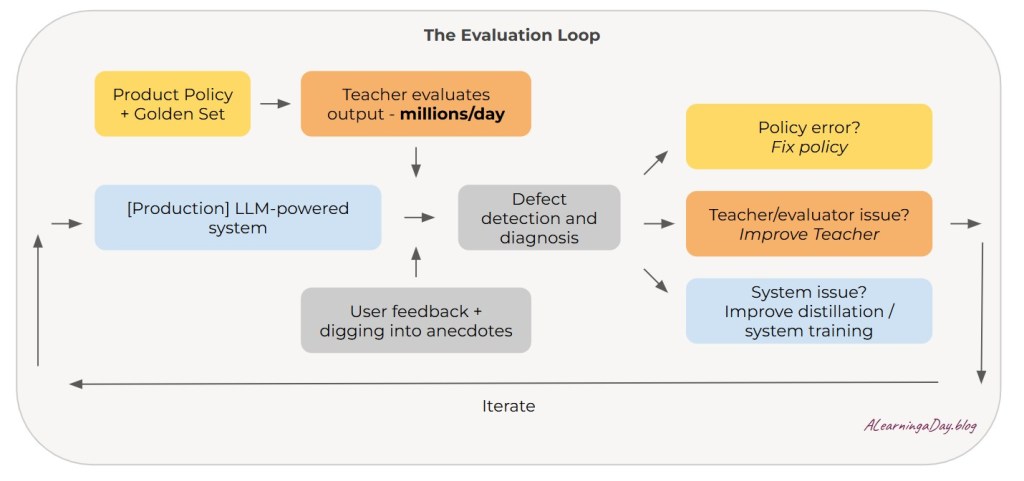
Here’s how it works:
This surfacing of defects at scale leads to Diagnosis where failure points to one of three places:
The fix flows back into the system – refine policy, improve the teacher, update training data – and the loop continues.
The loop unlocks velocity by operating on two planes simultaneously:
In deterministic products, we measured outcome metrics: clicks, retention, revenue. In LLM recsys products, these are lagging indicators. The eval loop runs on quality metrics – leading indicators judged by your teacher.
Quality metrics thus guide daily improvement. Outcome metrics tell you if that improvement matters.
In deterministic products, you improved by changing code. You wrote a new feature, shipped it, measured engagement.
In LLM recsys products, you improve by running the evaluation loop first. You can’t fully specify the system’s behavior upfront – it’s probabilistic. The loop is how you systematically improve something you can’t completely control.
Once again, adding an LLM into your system isn’t a panacea. You’ll be limited in production by latency and cost – so, the eval loop is the only way to build products around models that are powerful but imperfect, capable but costly, impressive in demos but messy at scale.
Next: The eval loop only works if your teacher knows what “good” looks like. That’s where we’re going next.
PS: A quick note on eval suites: As your product matures, you’ll likely move from one teacher to multiple – separate evaluators for various dimensions of the product. The same principle scales. Each evaluator judges a specific dimension, all feeding into the same diagnostic loop.
We had the incredible privilege of visiting New Zealand recently. We spent most our time in National Parks – so you’ll see posts on those parks (and perhaps a couple of other experiences) coming soon to a blog near you. That aside, I had a few reflections –
(1) New Zealand is among the most beautiful countries we’ve had the privilege to visit. The landscapes are incredible – both in their diversity and beauty. Once we set this aside, there were a few other things I noticed that stayed with me.
(2) The AirBnB experience in New Zealand felt closer to what the AirBnB founders intended. Owners seemed personally invested – a couple of them even came over to say hello. They’re far from the hotel-like experiences we see so often these days in the US.
(3) I appreciated that New Zealanders take a very pragmatic approach to road signs and road rules.
For example, despite most highways being single lane, they all had a speed limit of 100 km/h (roughly 65 miles/h).
You’d be lucky to see that speed limit on a 6 lane highway in the US.
I loved the 100 km/h speed limit because it felt reasonable. So, it felt like a limit that everyone tried to abide by.
Reasonable is a word I found myself associating with New Zealand’s rules.
(3) I loved the high crash area sign. It felt data-driven. Once again, reasonable.

(4) I was struck by how strong the influence of Māori culture is on New Zealand. It is unlike any country where settlers took over the lands of native people. It felt like they took a very thoughtful and, wait for it, reasonable approach.
(5) New Zealand’s heroes also have characteristically reasonable traits. I loved how Sir Edmund Hillary ensured he shared the credit for his climbing of Mount Everest with his sherpa, Tenzing Norgay.
He went on to care deeply about helping the local Sherpa communities – even after tragically losing his wife and daughter in a plane crash in Nepal.
(6) I loved a story about Sir Peter Jackson, another local hero. He was filming a scene where Frodo sees the Shire being burnt. That scene was originally going to involve just a burning building. However, while the scene was supposed to happen at 9pm, it got delayed to 4am and the firefighter crew who were on duty (in case something happened) were understandably tired.
So, Sir Peter Jackson just had them get dressed as orcs and shot the scene with them in it. Once again, a reasonable decision in the circumstances.
More to come on New Zealand in the coming weeks – suffice to say, I hope to have the good fortune to go back.
A few thoughts on energy.
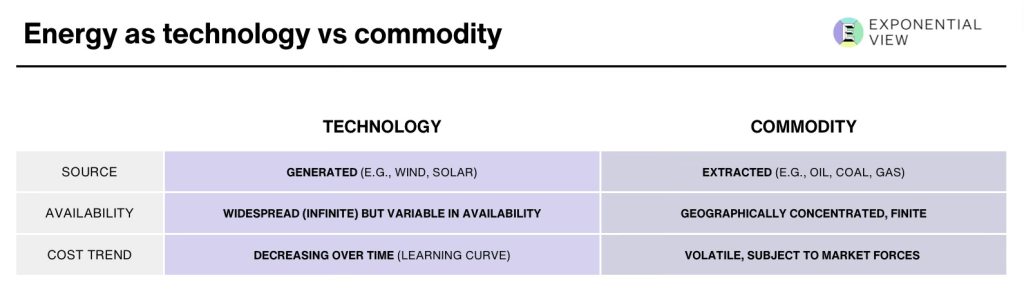
(1) One of my favorite Exponential View articles is about how energy has gone from commodity to technology. This table tells the story beautifully.
(2) The cost trend is clear – batteries and solar cost curve continue to make their way downward.
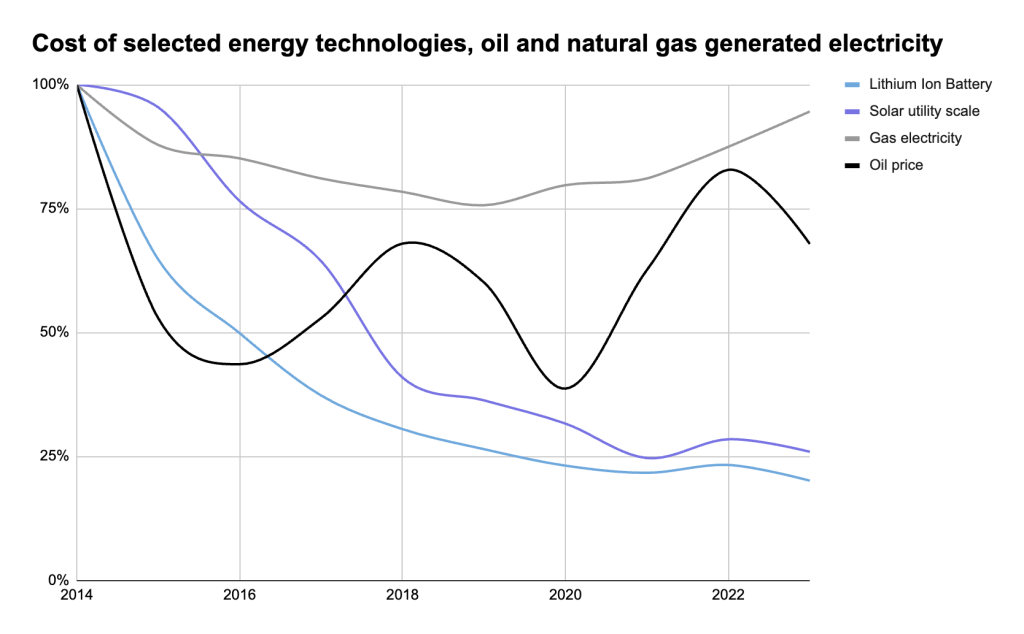
This is the case on every front.
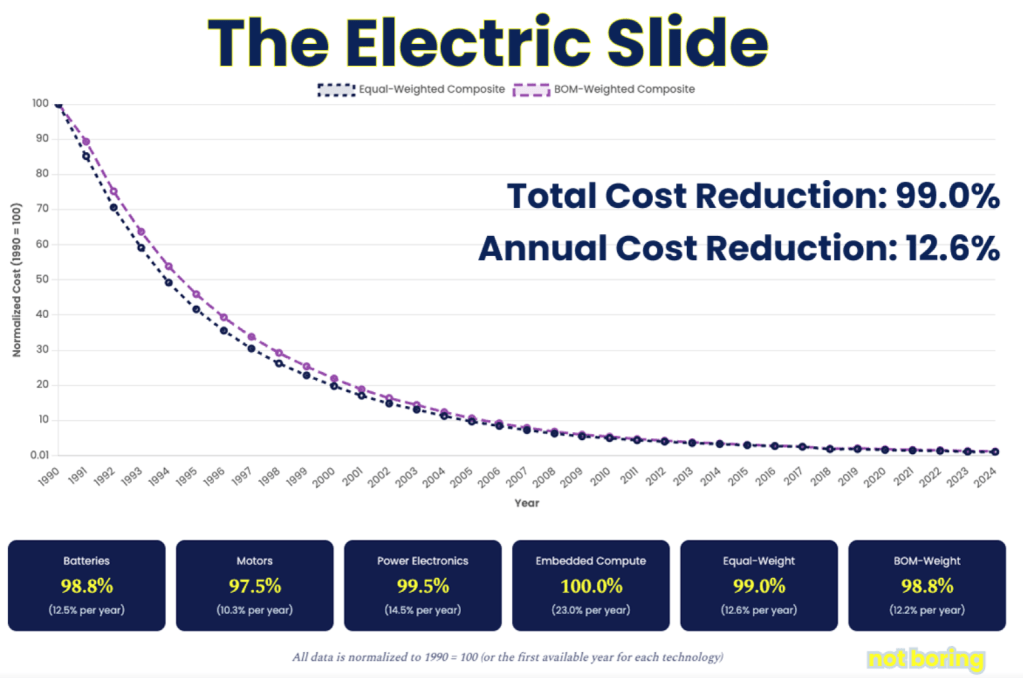
(3) We’re already beginning to see the consequences of a world with abundant energy. Australian households in 3 states are getting 3 hours of free solar generated power this summer.
(4) This means the no brainer strategy here is electrification. And the country that has most gotten that memo is China.
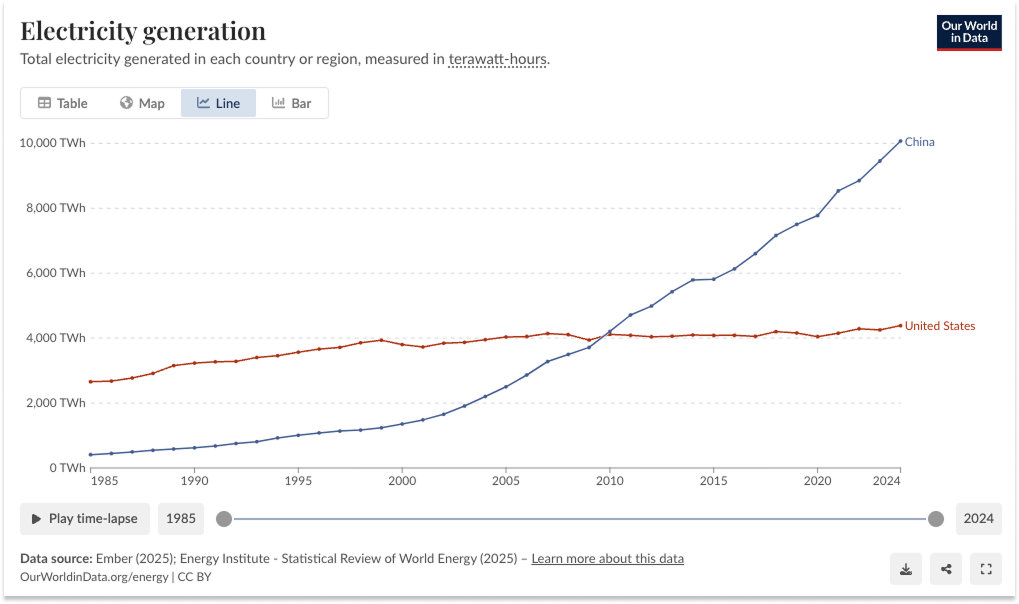
From the article – Today, China produces 75% of lithium-ion batteries globally and manufactures 90% of the neodymium magnets that make motors spin. That means that China controls the means of producing electric vehicles (EVs), drones, robots, and all of the other electric products that are replacing the combustion-driven machines on which America built its might.
Everything is going to be electric.
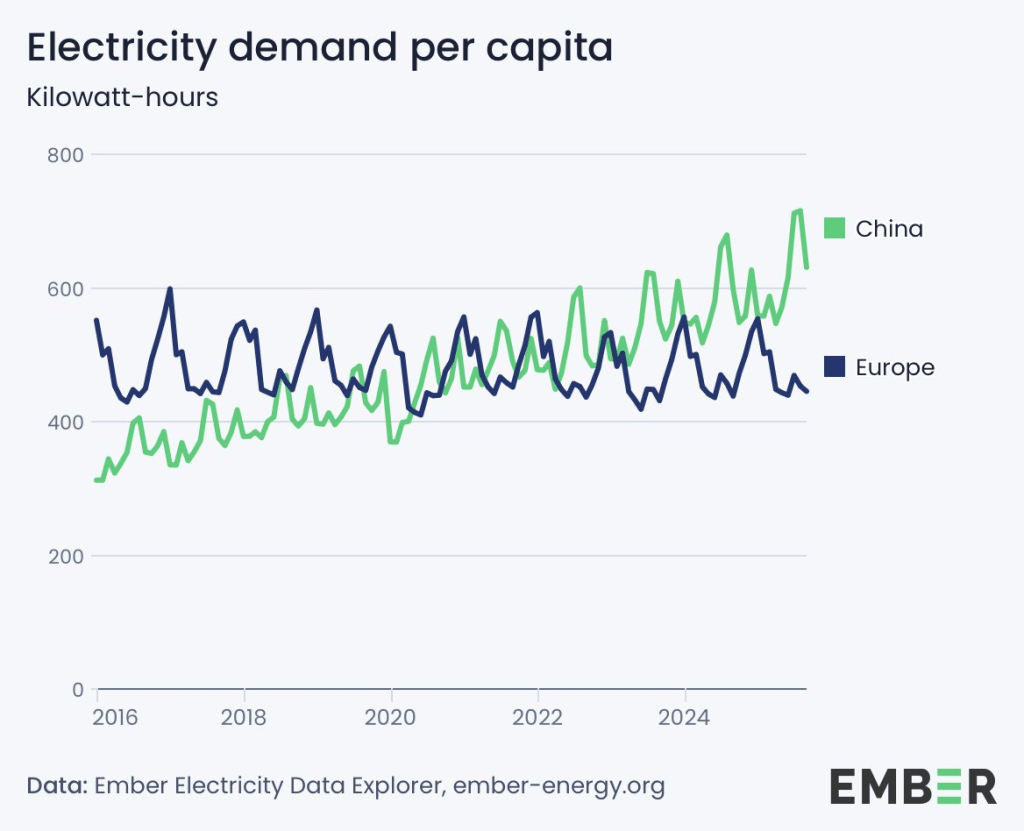
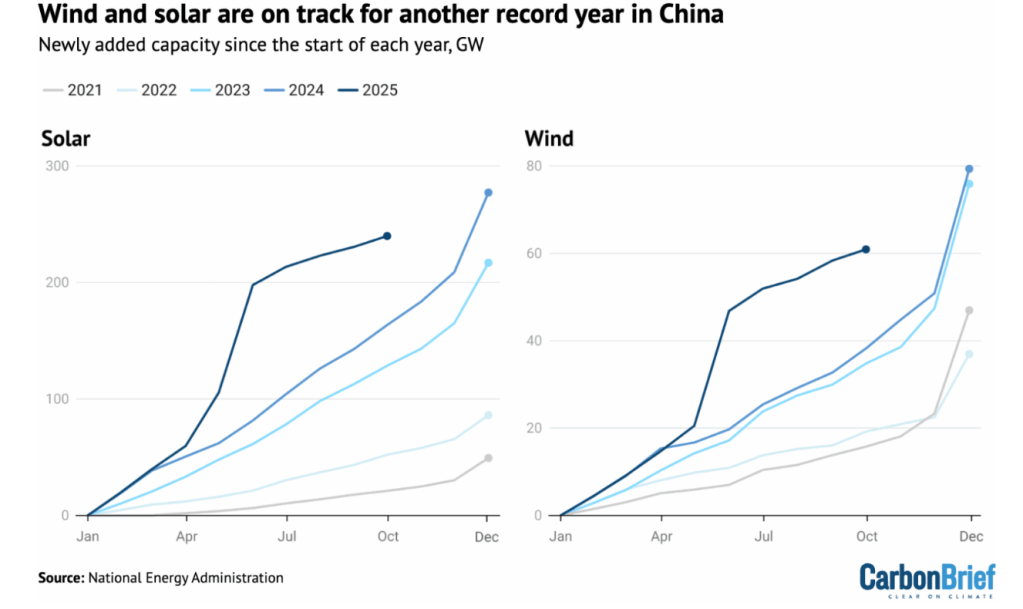
(5) China is electrifying so rapidly that it has passed Europe in per capita consumption.
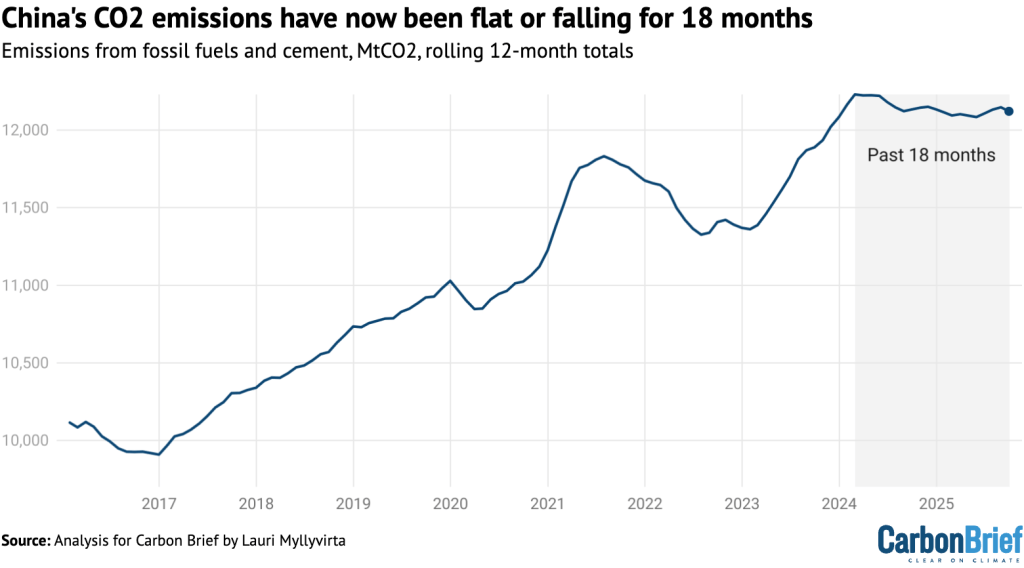
But, despite this rapid increase, CO2 emissions from China are flat or declining because new capacity is all renewable.
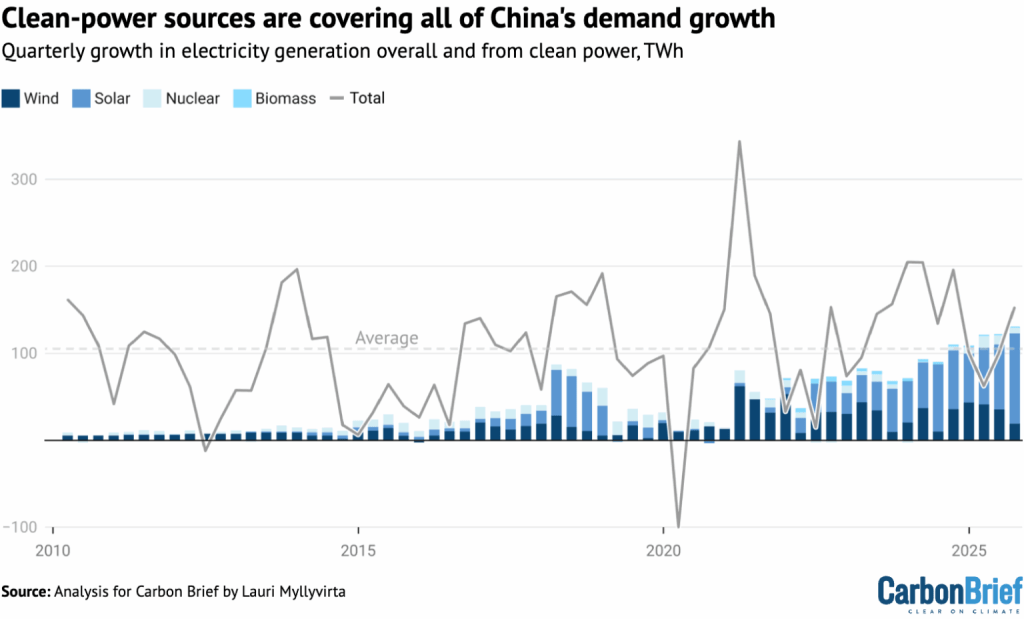
The bulk of the addition is solar.
Every year, they increase their investment in renewable technologies
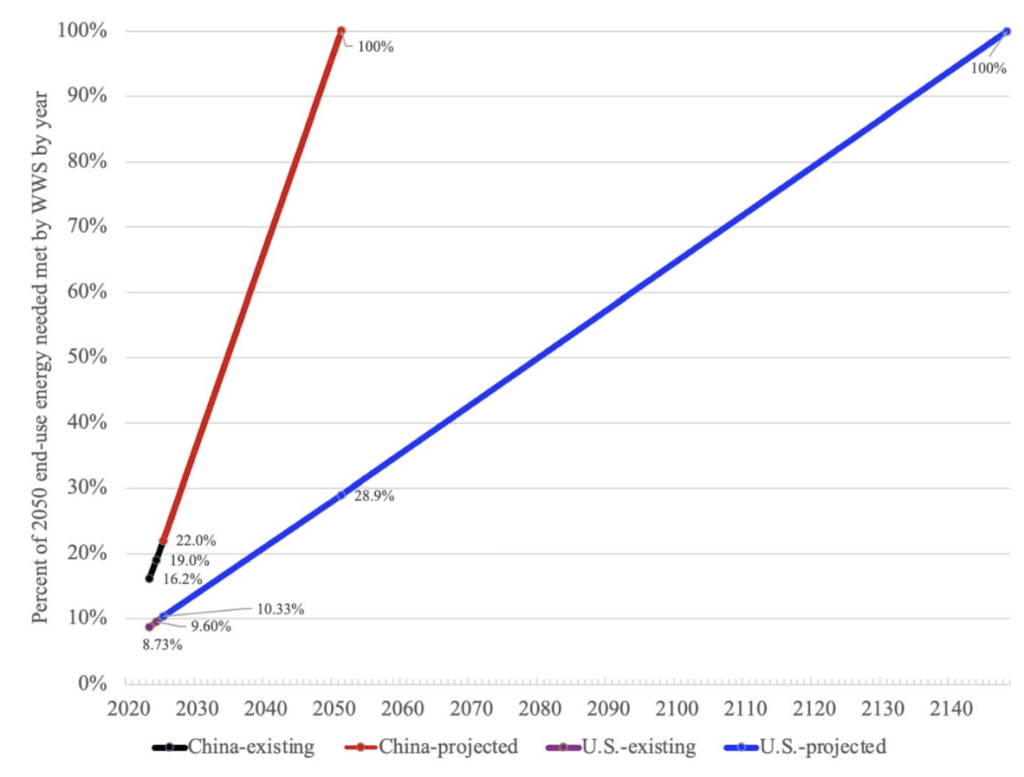
(6) China’s investments are so rapid that it is on track to be 100% renewable by 2051. At current rate, the US will get there in 2148.
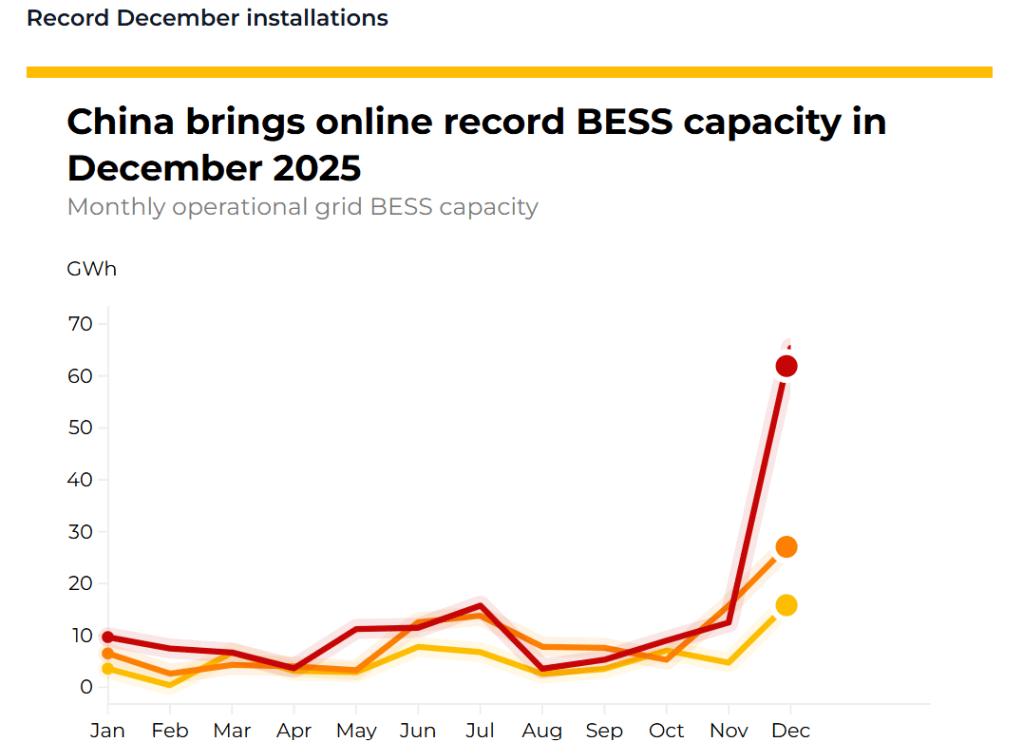
In December alone, China installed more battery capacity than the US had in all of 2025.
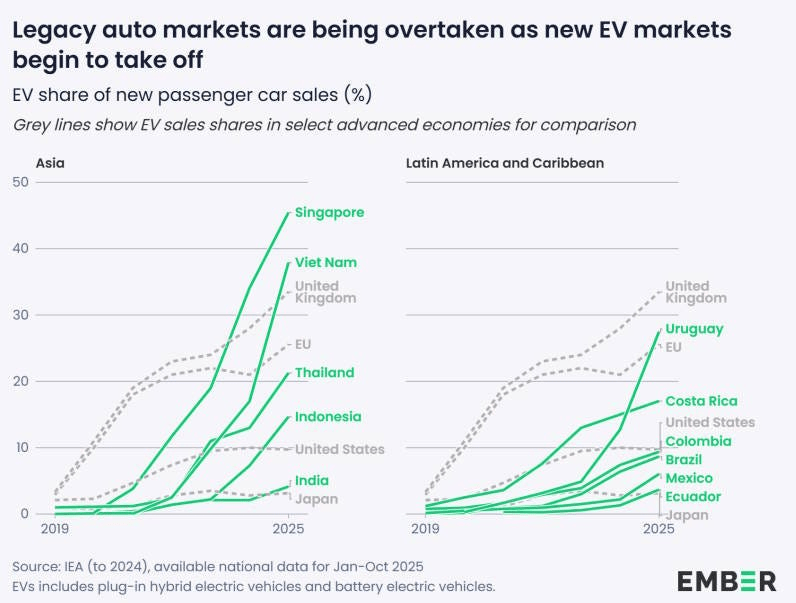
(7) All of transportation will be electric before we know it. EV markets are accelerating quickly.
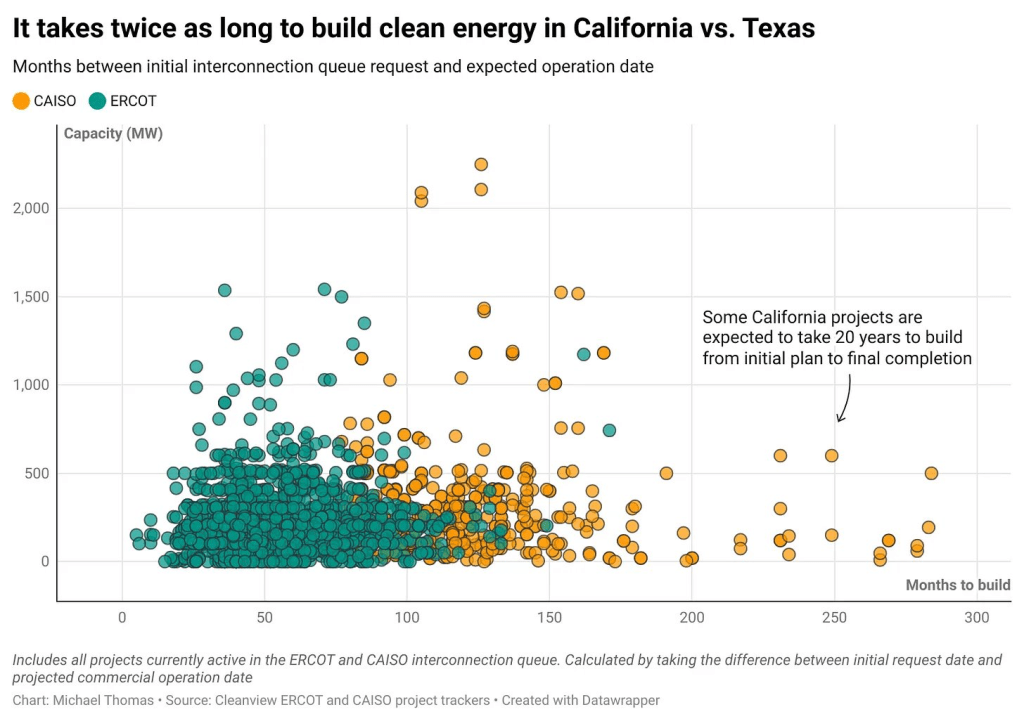
(8) Meanwhile, some clean energy projects in California can take up to 20 years.
Private energy markets in Texas, meanwhile, are leading the way. So much so that solar has already overtaken coal on the Texas grid.
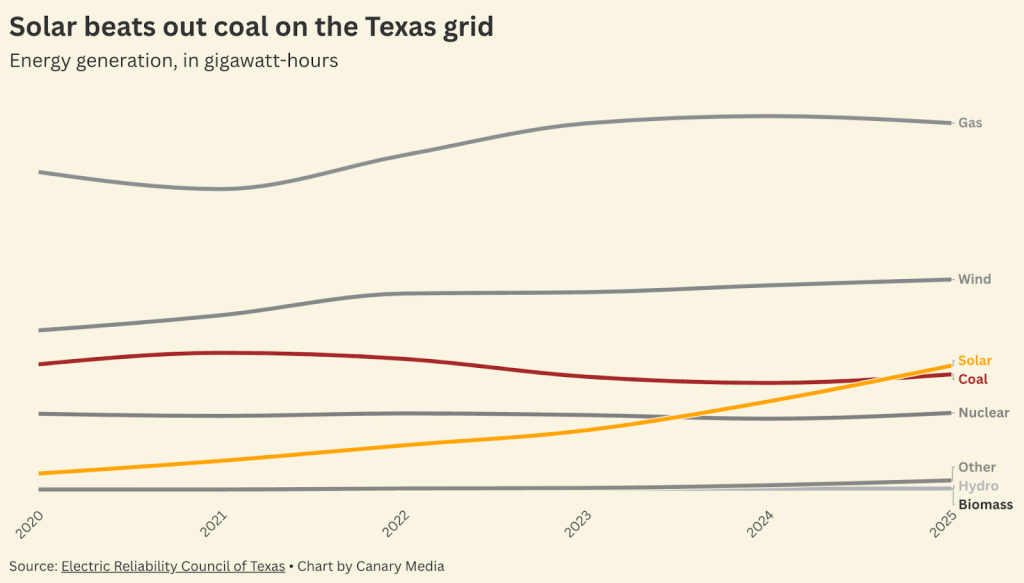
The trend lines are obvious – the future is electric and renewable. Energy is now technology.
Any economy that wastes time attempting to prop up fossil fuels and attempt to keep the status quo is going to left behind.
William Meijer shared an insightful post – An extreme commitment to the truth makes relationships acutely dysfunctional but systems chronically functional (think Elon Musk).
An extreme commitment to kindness makes relationships acutely functional but systems chronically dysfunctional (think Sweden, UK)
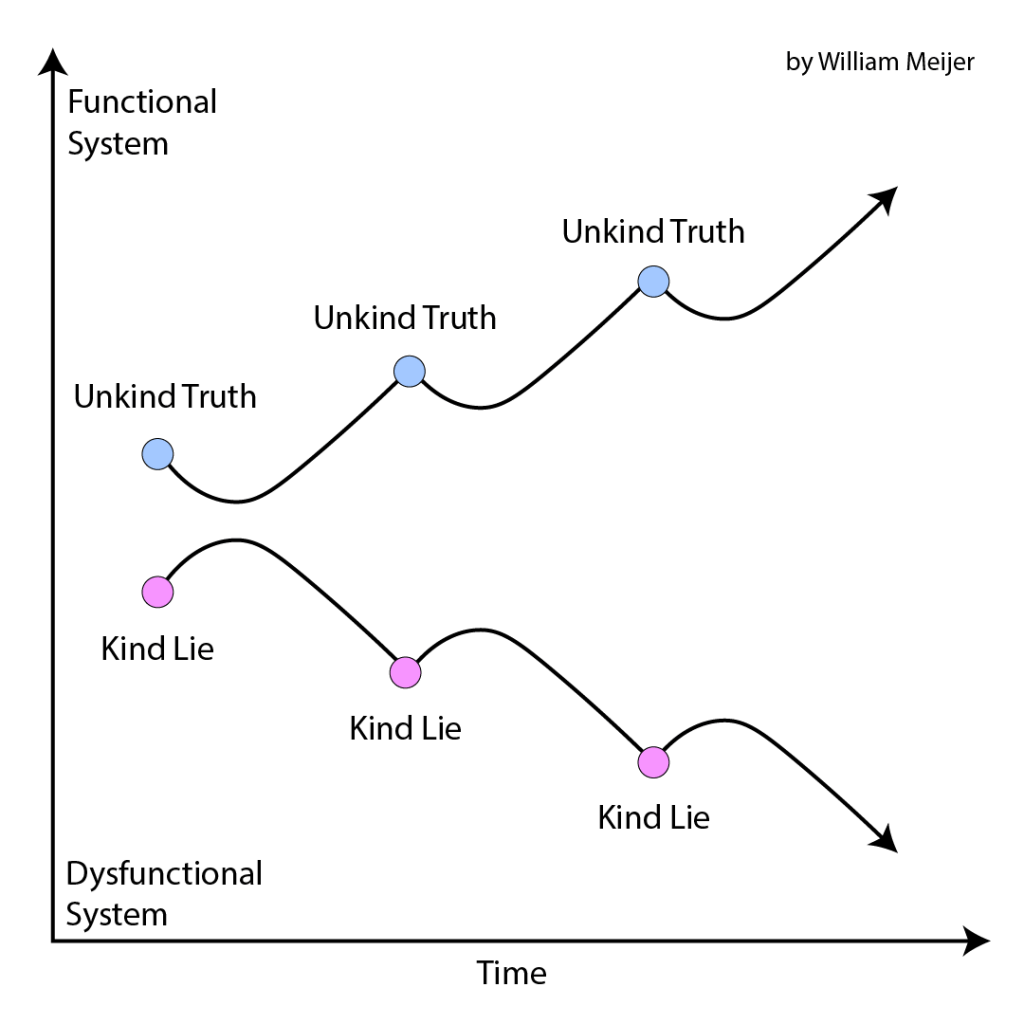
It resonated.
“You are unique, Elio of Earth, and unique can sometimes feel like alone, but you are not alone”. | Ambassador Questa in the movie Elio
Unique can sometimes feel like alone indeed.
Well said.
 A Learning a Day