Make two lists – Seth Godin

I rarely do two posts a day and very rarely do any reblogs. Seth’s blog is a happy exception to these general rules. His post today was so good that I just had to share it with all of you. I realize it’ll be a second read for many of you but I think it is worth it.


One list highlights the lucky breaks, the advantages, the good feedback, your trusted network. It talks about the accident of being born in the right time and the right place, your health, your freedom. It features your education, your connection to the marketplace and just about every nice thing someone has said about you in the last week or month.

The other list is the flipside. It contains the obstacles you’ve got to deal with regularly, the defects in your family situation, the criticisms your work has received lately. It is a list of people who have better luck than you and moments you’ve been shafted and misunderstood.
The thing is, at every juncture, during every crisis, in every moment of doubt, you have a choice. You will pull out one (virtual) list or the other. You’ll read and reread it, and rely on it to decide how to proceed.

Up to you.

Designing training wheel systems

I love the idea of training wheels. They ease first-time bikers/cyclists into learning biking/cycling and the riders and save their parents a lot of stress.

We see training wheel systems in our life as well – in school, regular tests and assignments are the equivalent of training wheels before exams and, at work, check-ins and 1-to-1’s are the equivalent of training wheels before the big presentations. Folks who do generally do well in tests and assignments generally end up doing well in exams and the same goes for work.

We can proactively create training wheel systems for our life too. An example training wheel system I ran for almost 2 years was to keep my phone time 5 minutes ahead of local time. I had discovered a worrying trend a couple of years back – I seemed to be a minute or two late to meetings a tad too frequently. I don’t like to be kept waiting. So, I used to wait till the very last minute before wrapping up and heading to the meeting. This, in turn, was always stressful. I’d wrap up in a hurry and rush to get to the meeting on time. To stop it, I just decided to try a small brain hack and add 5 minutes to local time. It worked like a charm. A few days ago, I realized that the Google Authenticator app (for two-factor authentication) doesn’t function unless you’re on local time. So, with great trepidation, I decided to take my training wheels off and switch back to local time. This is one of the difficulties of training wheels – you do tend to find it hard to take them off.

The results? I’ve been on time to all my meetings in the past week – so they worked well. I’m enjoying biking without them now.

Another training wheel system is one I mentioned in yesterday’s post – the idea of reading news and email as a way of making sure I wake up when my alarm goes around 530am. Waking up early is important to me and I’ve struggled with the snooze button for nearly 2 years. Cue – a training wheel. I don’t want to be reading news and email first thing in the morning for the rest of my life. But, I’d like to get to a point when I just stop using the snooze button.

Here’s to more training wheel systems!

Key productive time

There is one time in the day that is critical to your productivity. If you are lucky, there might be two. This is the time when you get a lot done without any interruptions. And, you know what time I’m talking about. If you don’t, find your key productive time!

I find that, for most people, this time falls early in the morning. Some of the most successful people I know go to great lengths to protect this time because the rest of the day can just whiz by quickly with meetings and other urgent interruptions.

It is is worth thinking intentionally about your schedule so you get this time for yourself. Sleep early. Resist the temptation to work late at the end of a long day as you’ll get all that you need to get done in half the time when you wake up fresh. Avoid snoozing your alarm – instead, do something that wakes you up – I look through my news feeds and email as a way of making sure my brain wakes up (I tried not doing that but ended up going right back to sleep – I guess I still don’t have the discipline to just wake up and get to work).

It is one of those simple ideas that is hard to execute consistently – find the time in the day when you are most productive and likely to be interrupted least. Construct a schedule around it. And, make sure you get that time for yourself every day. Little habits like this make a big difference over the course of a long period of time.

The more we get done, the happier we are. We owe it to ourselves for our own happiness..

Ask the customer – MBA Learnings

When we encounter a situation or problem, we always have an intuitive response to it. And, one of the biggest learnings in the first 2 weeks of our marketing management class has been to remind ourselves that we are weird and just “ask the customer.” This is because many of the decisions we make involve other people as our customer – e.g., decisions we make within our companies that impacts our customers, consulting advice we give to clients, and other help/advice we offer to friends or family. “Ask the customer” doesn’t always translate literally to asking the customer what they might want. It involves really understanding the person/organization we’re creating a solution for.

The best illustration of this is from an excellent TED talk by Rory Sutherland

“Here is one example. This is a train which goes from London to Paris. The question was given to a bunch of engineers, about 15 years ago, “How do we make the journey to Paris better?” And they came up with a very good engineering solution, which was to spend six billion pounds building completely new tracks from London to the coast, and knocking about 40 minutes off a three-and-half-hour journey time. Now, call me Mister Picky. I’m just an ad man … … but it strikes me as a slightly unimaginative way of improving a train journey merely to make it shorter. Now what is the hedonic opportunity cost on spending six billion pounds on those railway tracks?

Here is my naive advertising man’s suggestion. What you should in fact do is employ all of the world’s top male and female supermodels, pay them to walk the length of the train, handing out free Chateau Petrus for the entire duration of the journey. Now, you’ll still have about three billion pounds left in change, and people will ask for the trains to be slowed down. ”

We’re wired to think of situations from a point-of-view that is recently available to us. I hesitate to even call it our point of view because, sometimes, we take advice we receive too literally and forget to filter it to suit our own style. In short, our intuitive responses make us inadequate givers or takers of advice.

So, the next time you’re making a decision that influences a customer, take a moment to reject the intuitive response. Take a moment to think about how the customer behaves – ignore what they say and listen what they do. It is likely you will be closer to an answer that will work within that context.

Success, failure, laziness, learning

I’m sure you’ve heard about or asked that famous question – do we learn more from success or failure?

Let’s put that question on hold for a moment for a quick question – I had submitted two assignments recently. I scored well on one and didn’t score well on the other. Guess which one I wanted to review?

This isn’t uncommon – the issue with debriefing after success is that there is almost no patience to make them meaningful. A debrief after a failure feels like a necessary post-mortem. A debrief after success feels like attempts to delay the party. Success, in short, makes us lazy and complacent. It makes us want to celebrate and then come back and get the next success (sometimes without putting in the work). Reflections after success can be as rich as those from failure. Just because failure makes learning seem more important doesn’t mean that it is. Perhaps that is why discipline is often cited as a key success ingredient – it takes discipline to overcome the resistance and get on with the reflection and learning.

And, of course, we can avoid the whole discussion by learning to ignore the result and focus hard on the process. Good decisions and a good process => good results in the long run. Reflecting on the process is an easier habit to instill and your process can almost always get a bit better. That’s when it stops being about winning and losing. A process focus is all about the playing.

Welcome to the infinite game.

Not choosing is choosing – a few thoughts about choices

1. The early men believed that everything in this life was in controlled by unknown powers. They didn’t have any reason to believe choice existed. The thinking around this changed over time and it was the free-thinkers in the ancient Greek society who asked interesting questions about the choices we have.

2. But, even the enlightened Greeks didn’t get close to thinking about the implications of choice. Over time, owing largely to expert gamblers, the theory of probability came to being. Probability represented an interesting intellectual and theological question as prediction was generally interpreted as a godly act. Could we actually have a say in our own future?

3. Probability soon lead to risk analysis. A group of insurers at the Lloyd’s coffee house in the city of London began using their understanding of risk and probability  and became the world’s first insurance group.

4. Thanks to these pioneers, we all intuitively understand the concept of choice and probability. We also understand the link between choice and consequences.

5. We don’t control everything that happens in this life. Far from it. We probably only have choices regarding about 10% of what happens. But, what we choose undeniably affects our experience of the rest. For example, exercising the choice to be happy not only changes the way we view a day. It could help us see opportunity at a time when others around us only see unhappiness and disappointment.

6. While it seems like a simple intuitive concept in theory, it has a few interesting nuances. For example, the number of choices we see is proportional to our mental maturity. The wiser we are, the more responses we see to a given situation. E.g.,  a child may react to a disappointment with tears but a wise adult always knows better. Hence, a person’s response to tough situations is a great measure of their wisdom / mental maturity. Wisdom brings with it an openness to new ideas and a willingness to adapt; these traits are critical in seeing more options in a situation.

7. Even if we have the maturity to see different choices in a situation, it is very hard to follow through. That’s because execution requires strength of character. Strength of character is what made Viktor Frankl special.

8. We are always making choices. Saying no is a choice. And, not choosing is another form of choosing. Economists call this opportunity cost – a brilliant concept.

9. So, when we choose not to think about the difficult questions that we know we must think about to be happy (what are my values? how can I live a life consistent with my values?), we are, in fact, choosing a less fulfilling path.

10. The most essential choices are those that are important but not urgent. For example, it is critical we choose to be healthy while we are healthy. If we’ve allowed the situation to get to “urgent,” we’ve just left ourselves a mountain to climb.

11. Leaving ourselves mountains to climb from time to time is a sure sign of poor choices. The best work isn’t done at the last minute. The best studying isn’t done the night before the exam.

12. It is easy to keep “learning by doing.” There are times when learning by doing is called for. But, most of the time, it is inefficient. It is a sign that we’re suckers of the activity illusion. Doing is not learning. Learning happens when we pause, reflect and think. This takes intention, time, and effort. Not choosing to do so means we’re shooting ourselves in the foot.

13. So, figure out how to deal with what is urgent quickly. Start spending more time on what’s important.

14. Abolish the phrase – “I have no choice.” You do. You just don’t choose to see them often enough.

The Endymion – The 200 words project

Here’s this week’s 200 word idea from the Mastery by Robert Greene..

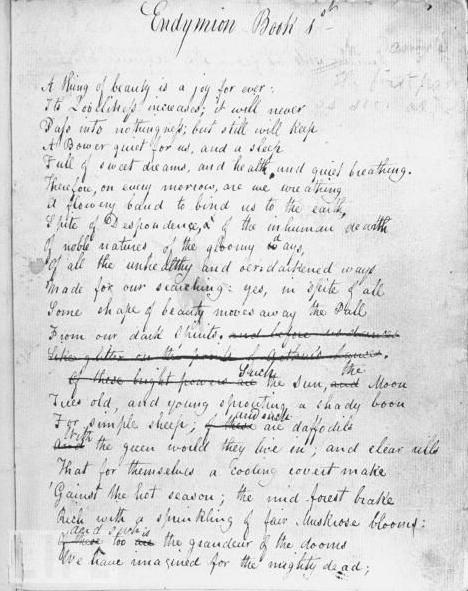
John Keats was 15 when both his parents passed away. He was taken out of school and enrolled to apprentice for a surgeon. Keats, however, had developed a love for poetry. So, he read as many great poems as possible during his off hours at the school library. Soon, he began writing poems in the style of these greats until he decided to quit medicine and write his own poetry.

To compete his self-apprenticeship, he decided he would write a 4000 line poem on the Greek legend Endymion. He committed to writing 50 lines a day. 75% of the way, he came to hate the poem, his flowery language, and overwriting. But, by the end of The Endymion, he had learnt to write and edit at great speed and he had hit upon a style that suited him and met his own high standards. Also, he had overcome writer’s block forever.

With these lessons, Keats went on to produce some of the finest poems in the English language in 1818 and 1819 until he took gravely ill. It was perhaps the most productive 2 years of writing in the history of western literature – all thanks to the Endymion leap..

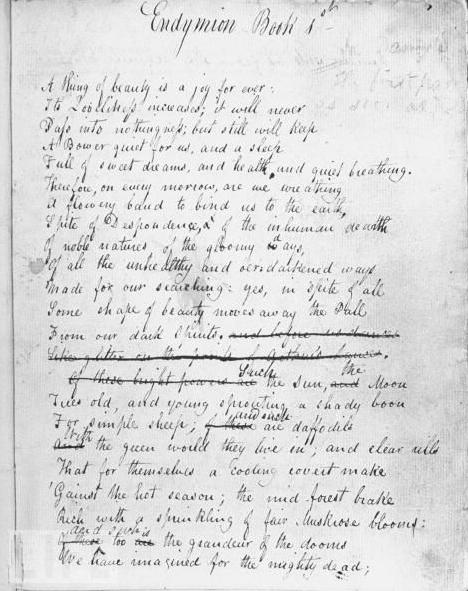
EndymionJohn Keats’ original draft of The Endymion – source and thanks to: Wikipedia, Time.com

‘In Endymion, I leaped headlong into the sea and became better acquainted with the soundings, the quick-sands and the rocks than if I had stayed upon the green shore and took tea and comfortable advice.’ | John Keats

Things that will never “end” vs. things that will

Things that will never “end”
– Cleaning vessels
– Failure
– Ironing your clothes
– The pain of growth
– Doing your dishes
– Organizing yourself and your work
– Hard work to get what you want
– The need for tough questions
– The effort needed to be happy

Things that you will not experience again
– This special moment in this place at this time – you grow up, your friends and family grow up, some leave, some stay, you leave, you stay, feelings change, relationships change, and time definitely moves on.

For things that never end – there is no point wasting even a single breath wishing they’d go away. There’s only more pain there. Embrace them. Love them. They’re integral parts of life.

For things that you will not experience again like these special moments – smile a lot, hug a lot, tell people how much they mean to you, have fun, learn and make them count. All we’ve got in this life is a collection of memories. And, like all great things, they are what we make of them.

Have a great weekend.

Omitted variable bias – MBA Learnings

One of the nicest things about being in graduate management school is that the classes have a lot to do with many of the things I have been reading about over the past few years. So, I’m excited to share some of my favorite learnings from classes under the “MBA Learnings” series. I don’t have a defined schedule for them yet but you should see these learnings pop up every once a while.

Today’s learning is a concept called “Omitted variable bias.” The origin of this idea lies in statistics but we all see this nearly every day of our lives. Most of the false claims we hear fall prey to omitted variable bias. And, let’s face it, we hear many false claims.

Here’s an example of a claim – “People who eat _____ (insert healthy product) have low cholestrol/better health in some other way.” That might be true on the surface but the equation misses variables like existing health of people who eat healthy food and amount of exercise done by people who eat healthy food. Without considering the entire picture, the claim is false. Badly conducted studies see one event frequently connected to another and incorrectly assume one event causes the other.

The omitted variable bias, thus, points to our tendency to frequently miss the entire picture. An application that comes straight to mind is when we interview for a new job/role. If things go well, we feel really pleased with ourselves (“I prepared really well”) and, when things go bad, we feel demoralized. There are a couple of important variables we often neglect –

1. The biases of our interviewers. Companies and interviewers select people they “get.” If your interviewers are strait-laced suit-wearing types, the chances that you’ll get a job you are well qualified for in jeans and a t-shirt is low. You only really influence one part of the outcome of an interview. A lot lies in the hands of your interviewers.

2. The culture of the firm. The interview process beautifully illustrates the power of culture. If a firm has a fairly homogeneous culture and, let’s face it, most great firms do. Then, being on the right side of the culture line puts you in great stead. If you have a “Googliness” rating of 9/10, you are likely going to be a hit with most of your interviewers at Google.

3. The dynamics within the firm. There’s a lot going on within the firm – internal candidates are being pushed for the job, your hiring manager is feeling the pressure because of a failed quarter, the company’s earnings call didn’t go great, etc. All of this stuff adds up.

So, what happens when we take omitted variable bias into consideration? First, we learn not to overstate or understate our contribution. Yes, our contribution matters. But, only so much. There’s a lot that lies beyond our control and there’s no need for the manic high or the depressive low.

Second, we learn that to distinguish between actions and outcomes. There is a saying that life is 10% action and 90% reaction. Perhaps interviews aren’t any different. Now that we’ve realized that people’s reaction to our actions is a large part of what happens to us, it helps to just direct our focus to that important 10%. By being the best we can be, we give ourselves a shot at maximizing the impact of that 10%. That’s all we can do. Once it’s done, focus on the next action as any time spent worrying about outcomes is time taken away from that next action.

From omitted variable bias to interview learnings to philosophy – you’ve got to love statistics!

Deep Nishar’s 2 hour story

A friend at Linkedin shared a story yesterday that Deep Nishar, soon-to-be former SVP of Products and User Experience, shared at his farewell.

Deep came from humble beginnings in India. When Deep was in secondary school, he learnt that a graduate from the school had been admitted at the Indian Institute of Technology. He understood it was rare and prestigious but didn’t know much beyond that. So, he asked this student if he could spend time telling him more about this. The student obliged and spent 2 hours with Deep explaining what the institutes were and how he might prepare to make it in. Deep took his advice seriously and secured admission when he graduated.

He went on to explain that that changed his life. It put him on a trajectory that saw him go to the University of Illinois Urbana Champagne, to Harvard Business School, lead Google’s efforts in the Asia Pacific and then play a key role in Linkedin’s growth over the past few years. All it took was 2 hours from a person who probably knew he would get nothing in return.

Deep’s advice to the Linkedin community was – if someone asks for a small amount of your time that could end up making a big difference to them, just do it. Don’t over think it. It might not mean much to you but it could mean a lot to the other person. And, who knows, it might even change the trajectory of their lives.

I loved this story. While we do occasionally get the opportunity to do big things, we get lots of opportunities to do the little things. We always have the choice to do the little things meaningfully.

It is stories like this that remind us how special this life is and how lucky we are to be here. Here’s to the little things… and here’s to giving small bits of our time to those who might benefit from it…