There’s always something

I was preparing for an important meeting and a collection of things seemed to be falling off the rails. And, I found myself wondering what my output might have been if all the conditions had been perfect.

That’s when I thought about some of the other important presentations I’ve had to do in the past – and, you know what, there was always… something. Just looking at the last 3-4 months – I was sick with a bad throat during my final exams in my spring quarter and rushing to travel back home in my finals in the winter quarter (all student examples – sorry :-)).

There’s always something. We can dream about striking that perfect balance all we want. But, for the most part, we spend all our time in the “balancing.” The only trustworthy indicator of our performance level is our performance on a bad day.

So, if you get that opportunity to perform on your best day with perfect conditions, revel in it. It doesn’t happen often. But, when it does, it is magical.

On the other hand, if you feel most things are going wrong as you enter that important presentation, welcome to life. This is how we get made.

3 happiness principles – a synthesis of 50+ books

A wiser friend asked me an intriguing question – based on everything you’ve read, what are some tips you’d suggest for someone to lead a happier life?

I asked him for some time as I wanted to make sure I gave it thought. Any psychology hobbyist understands that you don’t throw around happiness tips lightly. I then asked myself 1 question – if I had to synthesize everything I’ve learnt about happiness from my readings (60+ relevant books) and experiments over these years, what are 3 principles that I would share? I was keen about 3 principles because I don’t think our mind retains more than 3 principles. Additionally, I was keen on principles over tips because tips are akin to specific advice. I prefer frameworks that we can all apply to our individual context.

So, here goes –

1. Optimize your energy over everything else. It is energy we must care about and not time. Spend your time on things and people that give you good energy. The same applies to resources – spend your money either on experiences or in areas where you spend a lot of your time. Great experiences, e.g.  a legendary trek up Kilimanjaro, give us positive energy that last us a long while. Similarly, if you spend a lot of time on your desk, investing in a standing desk might provide a ton of energy on a daily basis.

A key part of this principles is focusing on “your” energy, i.e., taking care of yourself before you attempt to take care of the world. If you’re burning yourself out in your attempts to do good, your energy is not going to last long. Once our own needs are met, most of us naturally begin to focus our energies on giving back.

This principle has far reaching implications – for example, it is impossible to keep good energy if you don’t work in an environment that suits your personality. You can’t hang out with people who just take energy from you and give little back. You can’t work with co-workers who you don’t learn from. All your decisions soon become decisions that either give you better energy or don’t. The only way to do this well in the long run is to treat yourself as a research subject and keep tabs on what it takes for you to have good energy. The better your energy, the happier you’ll be.

There are very few blanket rules that apply to everyone. However, there are a couple of things that generally work – sleeping enough, eating well, exercising regularly and counting your blessings are as close as you get to blanket “good energy” rules. But, to each their own.

2. Use your willpower to build good habits like exercising, reading, keeping a journal/meditating, and building meaningful relationships with people you care about. If you fight yourself every time you try to do something that you think is good for you, it is a losing cause. The best use of willpower is to use it to build habits. Habits are the infrastructure of your life experience. There’s a reason every developing economy focuses heavily on infrastructure. The better the infrastructure, the more good stuff can thrive. If you’re consistently having power outages (e.g. sickness), for example, you can’t do much with your life.

So, the question then becomes, what infrastructure should you build? A more involved, and, in my opinion, better way to build this infrastructure is to really ask yourself that tough question – how will you measure your life? If you are a person who’ll measure yourself by the number of people you’ll mentor, then part of your infrastructure needs to be include creating consistent space for mentorship. If you aren’t sure of where to start, exercise, reading and meditation are a great place to start.

Once you’ve identified this, there are plenty of great resources on how to hack your brain to do this. There are no generic principles, though – if you feel it is helpful, I’m happy to suggest ideas that’ll help make it easier to break the resistance on these habits. But, before anyone dives into brain hacking, I’d suggest getting really clear on why you want to do something. A lack of clarity is a recipe for internal resistance.

Finally, the best resulting outcome of this is the sort of discipline that inspires integrity. Integrity is simply making and keeping commitments. As we use our willpower to build good habits, it brings with it a tremendous level of confidence in our own word. There are few better things in life than the ability to face ourselves in the mirror.

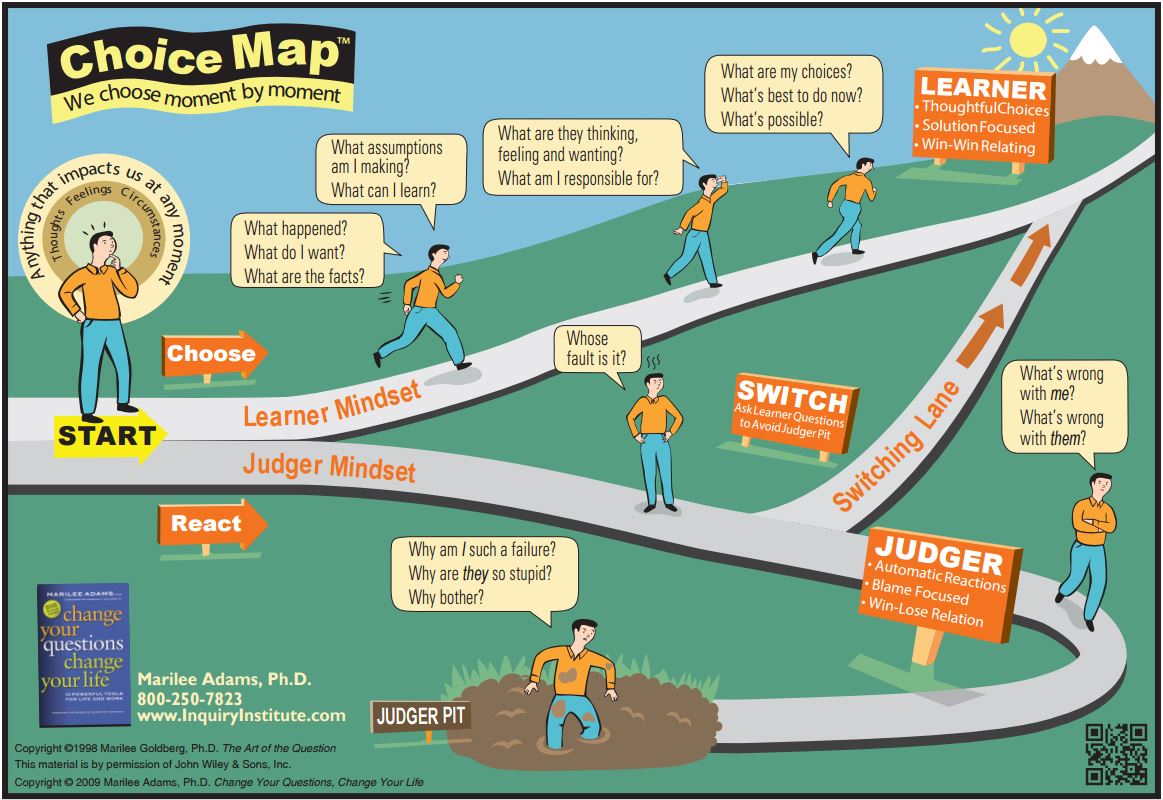
3. Choose learner questions over judger question. At every moment in our life, we ask ourselves questions. Every decision we make is a product of questions we ask ourselves. For example, we probably asked ourselves – what will make me look good today? And, the result of that is the clothes we wear. Over time, many of these questions become subconscious. And, without realizing it, we default to certain kinds of questions that may or may not have a net positive effect on our lives.

There are two kinds of questions – learning questions or judging questions. When you ask learning questions, you spend more time in learning mode and judging questions means time spent in judging mode. There are many psychology terms that illustrate the same idea – fixed vs. growth mindset, “be good” goals vs. “get better” goals. They all say the same thing. The best illustration I’ve seen is a concept called the choice map (thanks to Marilee Adams’ Inquiry Institute).

Choice Map

Here’s why it is incredibly powerful – people who ask learning questions focus on learning (duh) while those who spend time asking judging questions focus on performance. As a result, learning questions force us to focus on process vs. results. And, that, in turn, means we spend most of our time focusing on situations that are in our control. It also means we put in effort without attaching ourselves to the outcomes. Outcomes and results are the judger’s way of life. Interacting with the world with non-attachment is the one of the most tell tale signs of happiness. It enables us to give our heart, mind and soul into the projects we work on without worrying about short term pay offs. It is all about the long game. It is all about the process. In the long run, good results follow good processes.

So, that’s that – energy, habits and learning questions sum up the three principles that I’ve gleaned from all my readings and experiments.

If you’re wondering about common threads among the three (I was), the thread I spotted was that they require us to make our daily decisions based on consistent and constant self awareness. Self awareness drives the production of data that helps us make better decisions (that’s why meditation/journaling are key habits).

So, if there’s a ‘one last thing’ idea here, it is that all this data is useless if we don’t use it to make better decisions. The Latin root of decision translates into ‘to cut’ or ‘to kill’. So, learning to say no, and in the process, deciding what we effectively say ‘yes’ to may be the single most important skill that affects our happiness. The quality of our lives are directly proportional to the quality of our daily decisions.

And, as we live our days, so we live our lives.

3 things I’ve learned about problems

1. They’re present no matter which path you take. There is no problem-free or pain-free path. The paths we take just change the nature of the problems we face.

2. There are two kinds of problems – tiny issues and systemic problems. Tiny issues constitute all the small, unexpected and annoying things that happen to us – e.g., losing a wallet, getting sick, etc. These insert themselves in our lives every once a while and there’s not much we can do about them. Tiny issues are regular tests of our character – we can either choose to moan and complain or move on by giving them the attention they need but not letting them dictate our experience.

Systemic problems, on the other hand, are those that affect our entire system. These sorts of problems arise when we’re feeling stuck, negative or unclear about whether we’re doing the right thing. They come with big failures and big disappointments. Systemic problems are usually blessings-in-disguise as the only way to solve them is by taking the time to reflect, to be aware of what’s going on, evaluating our options and choosing a path that feels most right. They’re tougher problems to solve and generally stay for longer. And, the hardest part about systemic problems is discerning which portions of the solution are within our influence and then focusing entirely on them.

3. All our problems are first world problems. If you are reading this on a laptop/mobile phone wherever you are, it is highly likely that you, like me, are living what I term a first world life. All the basics – food, shelter, and physical security – have largely been taken care of. We work for happiness, not for survival. And, the problems we face largely emerge from the choices we make. All these problems are good problems. They remind us that we’re vulnerable and make our journey interesting.

And, one last thing, there’s a wonderful truth that applies to all sorts of phases in our lives, both tough and easy – ‘even this will pass.’

True that.

1 line checkouts are much better than multiple line checkouts – MBA Learnings

A few weeks ago, I wrote about why queues form. The one line answer is that they form because of statistical fluctuations and dependent events. The concept is simple – if your presence at a meeting is dependent on the previous meeting and the average time in the meeting is variable, it is likely that you’ll have people waiting for you, on average.

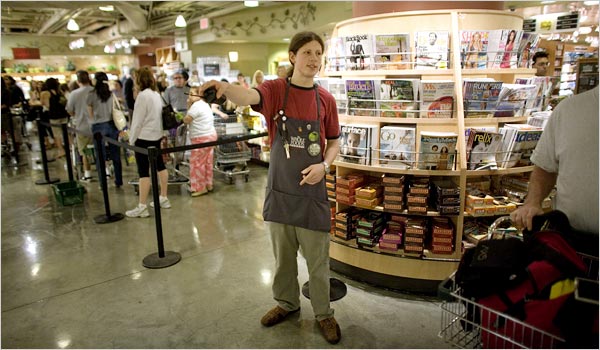
There’s a really cool application of this principle when it comes to checkout lines in stores and supermarkets. Multiple line checkouts are woefully inefficient.

So, if the supermarket next door replaced multiple checkout lines and replaced it with 1 line, it could reduce your waiting time to approximately 1/3rd your normal waiting time. Why? Because longer lines minimize variability. If you are stuck in a short queue with 2 coupon sharks who take forever to pay, your average waiting time becomes very long. Such variability is minimized in a single queue as it is unlikely you have a coupon shark at every checkout counter.

The beauty about 1 line queue systems is that it also feels fair. We all hate it when we see that other queue go much faster. The downside, however, is that single queues can look and “feel” really long. So, the conventional wisdom is to have multiple queues because long lines can turn off customers.

Whole Foods in Manhattan, however, decided to just ignore the conventional wisdom ten years ago and implement the more efficient single queue checkout. It has worked fantastically well for them. And, now you know why.

Whole Foods Manhattan(a line manager at Whole Foods Manhattan who makes sure people move quickly to the nearest open register)


Inside out

There’s a lot to like in Pixar’s new movie. It is a lovely course in how the brain works – not a 100% scientific but enough to paint the picture. It also speaks to the tension between the various emotions in our minds as we make our way through this journey.

My favorite lesson was the central lesson in the movie – joy and sadness work best when they move together. One wouldn’t exist without the other.

We all go through bumps in the road. It feels easier to avoid the difficult, suppress emotions and move on. It takes courage to put ourselves out there, let ourselves feel the sadness and then move onto recovery.

What we learn from that movie is that that courage is essential. Making sure we let ourselves feel that sadness/disappointment/anger when things don’t go our way is an important step in the recovery and “bounce forward” process.

Or, in fewer words, don’t avoid pain. It is part of this rich life experience. Besides, joy wouldn’t be good if it wasn’t for pain.

Assertive communication and passive teams – The 200 words project

Volunteers were brought into a study and separated into teams to fold shirts. Half the team leaders were instructed to speak assertively/powerfully (“Do this!”) and the other half to speak tentatively/powerlessly (“Do you think doing this would be a good idea?”).

It was found that teams with proactive team members had 22% higher output under leaders who spoke tentatively. Proactive team members viewed them as open and receptive while they viewed leaders who made an effort to be assertive to be afraid of new ideas. The same study showed to be true in pizza delivery teams.

This behavior was found to be reversed in passive teams with less interested and less proactive team members. The more proactive the team, the less the need for an assertive leader and vice versa.

So, an Adam Grant leadership tenet – identify how proactive your team is and adjust your assertiveness accordingly.

When people think you’re trying to influence them, they put their guard up. But when they feel you’re trying to help them, or to muse your way to the right answer, or to be honest about your own imperfections, they open up to you. – Susan Cain (she was clearly talking about proactive people :-))

Source and thanks to Give and Take by Adam Grant.

George Ezra

Young musician George Ezra grew up in a family of avid singers. His siblings, however, had better voices growing up. One day, he stumbled onto a label by American folk singer William Ledbetter “Lead Belly.” On the back of the CD, it said – “his voice was so big that you had to turn the record down.”

So, George, in a moment of inspiration, decided to try out a big voice.

It worked. And he never looked back. One small leap and his life changed for ever.

There’s no guarantee that we’ll have our George Ezra moment when we leap next. But, leap enough, and it’ll likely show up.

I, for one, am glad he took that leap and gave it a go. We wouldn’t have had “Budapest” if he didn’t.. :-)

Surviving Pune

I love swimming when I have the opportunity. But, every time I walk to the pool to swim and first touch the water, the resistance shows up and exaggerates the feeling of discomfort. Even though I’ve learnt that I’ll get comfortable within 10 seconds of actually swimming, I’m amazed as to how my mind does such a poor job of predicting my eventual happiness. This is especially hard if the pool isn’t deep – it works much easier if I can just jump in.

But, a tactic that works incredibly well is to remember my experience jumping into much colder water in much cooler weather when I was on a 3 month project in Pune, India. Having survived Pune (and learnt a few lessons in the process), it becomes much easier to sign up for the ride. After all, if I’ve survived worse, how bad can this be?

The lesson I’ve learnt from this is the sheer value of hard knocks, failures and bad experiences. When you put yourself out there and attempt to do/change things, you inevitably go through difficult experiences. And, these experiences, especially the really difficult ones, greatly improve your ability to persist and persevere through other experiences. They also make it easier to keep perspective when things go wrong – you survived “Pune” after all.

We aren’t born with grit and happiness written on our birth certificate. The good stuff is always hard earned.

Chevron Pump – Product Review 2

Chevron Gas Pump

I had a product moment when I was refueling over the weekend. As is often the case with refueling, my mind was on auto-pilot. The fuel system was very good – no hitches until I had to pick the grade of fuel I wanted. My hand naturally moved towards clicking the button on the left. But, just as I was about to press it, I stopped.

“91” was written on the button. And, there seemed to be lower numbers next to it. By now, my brain was getting out of auto-pilot mode. Ah – so, Chevron had the most expensive product on the left while my natural instinct was to expect the cheapest variant on the left. I chose regular and smiled at the smart product design.

3 questions emerged –
1. Is there a real difference between the 3 variants of fuel? I tend to be skeptical of such variants and view them largely as pricing gimmicks.
2. How much more had Chevron earned due to other users who’d clicked the “Supreme” variant out of instinct?
3. Assuming users generally realized they picked the most expensive variant by mistake (and assuming people don’t normally do that), does this happen more than once? I’d imagine people are on their guard the next time they refuel.

Small changes in products can make a big difference. Companies like Facebook have run millions of experiments on which locations optimize clicks, for example. And, a big part of smart product design is understanding “auto-pilot” behavior – both to make the product intuitive as well as, in cases like this, to monetize.


Selling 22,200 girl scout cookies

13 year old Katie Francis sold 21,477 girl scout cookies this year and broke the world record. The New York Times has captured a few hard earned lessons that Katie’s learned over these years – this wasn’t her first time selling girl scout cookies, of course. She’s accumulated considerable skill attempting to break the record every year and is probably in the top 0.1% of hard working 13 year olds.

With stories like this, I’m always curious as to how much of the motivation came from factors like parents and the environment and how much came from her own self. I suspect it must have been ignited by external factors when she started and then taken on a life of its own thanks to intrinsic energy and drive.

Katie’s become a superstar and is now doing speaking gigs at sales conferences. Good for her. I’m hopeful she’ll retain the spark as she grows up.

And, just for today, I wanted to draw attention to one lesson she shared – ‘Don’t waste time convincing the naysayers. Move on and find the yesses.’

Great advice.