Investment returns

High investment returns come from believing things others don’t believe in.

While it is tempting to believe that only financial investors and venture capitals should care, in reality, we are all investors. We all invest in people and ideas every single day. And, the bets that result in massive return (financial or otherwise) are those where we saw potential quicker than most other people.

So, it is worth asking ourselves – how do we see the world?

If all we see are what “common knowledge” dictates, it is unlikely we’ll experience anything uncommon.

Rethinking feedback (1/4) : Why most personal feedback is useless

Every age has had a collection of flawed beliefs that have driven behavior that made little sense in retrospect. In the early 1900s, thanks to the psychologists of the day, kids in England were separated from parents and sent to boarding schools at an early age. And, until a decade ago, we had a couple of decades where the press and flawed research would have us believe that boosting self esteem was more important than anything else.

An item on the current list of head-fakes, in my opinion, is giving and receiving feedback. Managers are asked to take it seriously, leadership coaches are studying it and business schools are talking about it.

Before I explain why, I’d like to highlight a quick terminology quirk. I refer to professional feedback as feedback around hard skills – e.g. creating better PowerPoint, doing better analysis, giving better presentations, etc. And, personal feedback refers to everything else. This deals with all the hard, personal stuff – “you come across as too mellow” or “you’re going to have to learn to tone it down.” The lines between these can often be blurred. But, it is important we start with these definitions and work our way through the problem.

There are 3 reasons for most feedback being useless –

1. Most feedback just attacks the flip side of a strength. Telling a warm person they are often too warm or telling an analytical data geek that they need to be less analytical isn’t very helpful. Yet, this is pretty much the default state of most feedback conversations. This happens simply because these “issues” are easiest to observe. Learning to work with (and not over do) our strengths is a skill we all develop through our lifetimes. Presenting just the flip side of these regularly does more harm than good.

2. Most feedback tells more about the giver than the receiver. If I am a loud and talkative person (I am :-)), the chances that I’ll give you feedback for being the same are near zero. In any case, it would take a huge lack of self awareness for me to do so. However, if someone I find annoying exhibits a trait similar to one you exhibit, you will definitely hear about it.

3. Context matters a lot. Our behaviors often change with context. And, as a giver of feedback, it is hard to really understand if we’ve gotten context right. Is this how the person always behaves? Would it change with different circumstances? As any person who works with data knows, it is dangerous to read too much into small sample sizes.

And, if all this wasn’t bad enough, just take a moment to consider the impact. As we know from experience, people remember one negative comment over twenty positive ones. So, even if you did have something incredibly insightful thing to say but, somehow, phrased it wrong – you can be sure that it is all the other person would remember.

Feedback done well assumes a very high level of wisdom, self awareness, tact and perspective on the part of both the giver and receiver.

I’m not sure I would put money on those odds.

So, what do we do about it? Coming up in parts 2, 3, 4. The key words are self-awareness, experimentation, and trust.

Slash and Burn your calendar – The 200 words project

We’ve heard numerous complaints about “too many meetings.” Meetings, like a snowball rolling down a mountain, develop ever greater inertia, roll down a path of their own – different from their initial purpose – and ensnare increasing numbers of people as a business grows.

To counter this effect, James Reinhart and the team at ThredUp, a clothing marketplace metamorphosing through hyper-growth, slashed and burned their calendars by deleting every standing and recurring meeting in their agendas. During the next few days, the team questioned what meetings should exist, who ought to attend them, and what their agendas and goals should be. In addition, the team pushed to cut meeting times in half from 50 to 25 minutes.

The impact to the company has been dramatic – fewer, shorter, more productive meetings. And, if a 100 person startup eliminates one 1 hour standing meeting each week from every employee’s calendar, they will have unlocked more than an extra man-year of work to allocate – a new “free” employee.

Slashing and burning calendars periodically challenges a company to allocate its most scarce resource, employees’ time, more effectively. By torching all the scheduling chaff that accumulates over time, companies can start fresh and cultivate a schedule to maximize company and employee performance (and happiness). – Tom Tunguz


Source and thanks to: VC Tom Tunguz’s blog

5 stars

Seth Godin had a wonderful post on his excellent blog this week.


The two-review technique

As you work on your project (your presentation, your plan, your speech, your recipe, your…) imagine that it’s the sort of thing that could be reviewed on Amazon.

Now, write (actually write down) two different reviews:

First, a 5 star review, a review by someone who gets it, who is moved, who is eager to applaud your guts and vision.

And then, a 1 star review, an angry screed, not from the usual flyby troll, but from someone who actually experienced your work and hated it.

Okay, you’ve got two reviews, here’s the question:

Are you working to make it more likely that the 5 star reviews are more intense, more numerous and more truthful than ever, or…

Are you working to minimize the number of 1 star reviews?

Very hard to obsess about both, since they tend to happen together.

The thing is, if you work to minimize criticism, you have surrendered the beauty and greatness of what you’ve set out to build.


I shared this post with a group of friends who I’ve been working with over the past months. We’ve had many a discussion about this and Seth put it beautifully.

There were two learnings that jumped out to me as I read it  –
1. A big part of aiming to do 5 star work is accepting that there will be those who will give you 1 star. It isn’t an easy thing to do accept by any means and requires you to be able to give yourself entirely to your art… and then completely let go.

2. And, perhaps, more interestingly, I think a big part of being a 5 star person by your own values/measures of success requires you to accept that there will be 1 star reviewers. So, we ought to consider spending less time rounding ourselves out to reduce the 1 star reviews. Perfection isn’t the point. Being human and authentic is.

Thanks as always, Seth.

Giving thought to your to do list

While it might be tempting to treat your to do list like a dump throw all tasks down its throat (it is just a list, after all), I think it is important to give your to do list a fair bit of attention.

Here’s why –
1. The way you structure and maintain your list has a direct impact on how much you get done.
2. Wording matters a lot – specific to do items always see more action.
3. If your to do list is messy, you have lost your way. After all, didn’t we make a list so we could get things organized?
4. Batching small tasks can go a long way in helping you get blocks of time to do meaningful work.
5. We always have surprises and unexpected interruptions. The biggest benefit of organization is that we can now embrace these interruptions without worrying about whether we’ve got the rest of our life under control.

There’s a lot of psychology around getting things done and there’s good reason many books have been written around the topic. As small and trivial as it is, we spend most of our lives taking directions from a to do list that we create (either in our minds or written/typed somewhere). Let’s make sure we give it the attention it deserves and build lists that work for us.

How work gets done

I was reminded of my preparation in the months leading into my high school final exams this morning. I was keen to do my undergraduate studies in the National University of Singapore and the criteria for admission was a good score on these exams. With exams coming up in March, the key preparation months were between September and December. So, in those months, I went to bed around 630pm in the evening and woke up by 230am. This way, I got a good 3-4 hours of uninterrupted time every week day. It was a very consistent routine. I used to microwave some food, grab a quick meal and get to work. During this time, I played the exact same collection of songs on CD (we had just moved from cassettes to CDs) – so much so that I can still remember the rough order of those songs 10 years later.

Those months of effort definitely paid off. While they helped ensure I did do my undergraduate studies where I wanted (which, in turn, created a significant ripple effect), their long run effects, however, were that they taught me how work gets done.

I needed to get a chunk of work this morning before my classes started. And, as I needed uninterrupted time, I went to bed at 8 and woke up at 3 to get to work. Learning from that experience, I had my email and messengers switched off and, just for old times’ sake, played songs from my list from 10 years ago.

I’ve rinsed and repeated this process many many times over the years. And, this is a big reason why I do my best to wake up at 5am on most weekdays.

Growing up, I heard, and believed, various kinds of myths about top performance. I heard about people who could ace their exams without effort and solve problems in their sleep. Over time, I’ve learnt to consign those myths to the rubbish bin. The top performers I know combine focus, intensity and hard work incredibly well. If, over time, they need to work less to get a particular kind of task done, it is because they’ve worked so hard on it previously that they just know smarter ways to get it done in less time. We’ve all experienced that type of mastery.

It was in those preparation months that I learnt how to combine intensity and hard work. Focus (and, here, I refer to focus as a verb) took a lot longer to understand because I initially thought of intensity as the only kind of focus. However, the focus I’m referring to is that dynamic process that constantly evaluates what you should be focusing your intensity on.

The beauty about these three factors – focus (deciding what to focus on), intensity (focusing on it) and hard work (putting in the time) – is they are all learned. All we need to do is to learn how to work them in tandem and work hard to keep honing them over the course of our life.

The result is magic.

A few notes from my Big Data and Analytics classes – MBA Learnings

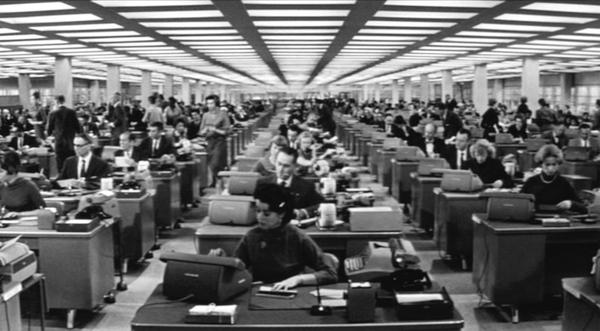
Technology analyst Benedict Evans shared an interesting image from a classic 1960 film “The Apartment.” The scene is set in the office of a large insurance company in New York – drones laid out at desks almost as far at the eye can see. Each desk has a telephone, rolodex, typewriter and a large electro-mechanical calculating machine.

Excel

As Ben points out – “In effect, every person on that floor is a cell in a spreadsheet. The floor is a worksheet and the building is an Excel file, with thousands of cells each containing a single person. The links between cells are made up of a typewriter, carbon copies (‘CC’) and an internal mail system, and it takes days to refresh whenever someone on the top floor presses ‘F9’.”

(Incidentally, as the protagonists are a desk worker and an elevator attendant, this is actually a romance between a button and a spreadsheet cell.)

It is clear that the capabilities of analysis tools in 1960 was far below our ability to analyze them. So, Microsoft Excel and other spreadsheet programs offered huge benefit simply because they helped bridge the gap between the average manager’s ability to analyze data and the tools available to do so. This, in turn, spurred businesses to collect more data in the hope of extracting insights. So, over the late 90s and the 2000s, every junior consultant and investment banker became an Excel ninja. Being able to use the tool to the best extent possible added real value.

All was well. Until “big data” entered the picture.

Excel spreadsheets had a major capacity upgrade recently that finally allowed a million rows. However, that makes it massively inadequate for a real world “big data” dataset. So, what is “big data?”

The consensus is that big data refers to data sets that have 3 V’s – volume (i.e. size), velocity (speed of data in and out) and variety (range of data types and sources). These data sets are in the size of hundreds of millions of rows with inputs coming in every second. To imagine a big data set, imagine a massive spreadsheet that receives point-of-sale data for McDonalds or Wal-Mart in real-time.

The next question, then, is – how do we make sense of all of this? It is hard to have a simple answer to this “big” question. So, I’ll share a couple of observations from my big data and analytics classes –

  • As any person who has analyzed data in Excel will tell you, you can make your data tell any number of stories. The presence of large amounts of data doesn’t change that fact. If anything, it becomes easier to manipulate the data to tell the story you want.
  • Additionally, the biggest problem plaguing poor analysis – mixing correlation and causality – definitely doesn’t go away. While correlation can be instructive in itself (sophisticated retailers have used correlated buys successfully to push the right coupons), it is dangerous to imply causal relationships because of a number of reasons – e.g. there could be a third effect that causes both.
  • Big data has increased our ability to experiment with different campaigns and messages. However, unless the experiments are well designed and executed with groups that are perfectly random (or close), these results can be erroneous.
  • In some ways, this gets to the root of the fundamental issue with analysis – analysis, by itself, is generally useless. Analysis, supported by business judgment, can be incredibly powerful.
  • The effect of this issue gets magnified when we have huge amounts of data. There are often more variables than we know what to do with. And, while machine learning tools like neural networks can help us find relationships between them, they won’t mean much if they aren’t combined with good business judgment.

All this leads me to conclude that we’re now in a situation that is very different from the 1960s picture we started with. At that time, an average manager’s analysis capabilities were far ahead of the tools and data available. Now, it is safe to say that the tools and data available far outstrip the average manager’s analysis capabilities. Forget the average manager, it is safe to say that even the most sophisticated managers will struggle with driving the right analysis and then interpreting the results right. While we can expect the tools to become easier in 5-10 years, the for analysis and insights are not going to go away any time soon. If, by chance, you are wondering as to why I am not referencing sophisticated data science teams that exist to solve this problem in leading companies, I’d like to go back to the key driver of great analysis –  “good business judgment.” The ideal analyst is someone who combines amazing tool capability with business judgment. Very few of these people exist. Great analysis is driven by managers AND data scientists. And, for managers to work well with data scientists, they need to become good consumers of analysis.

So, if there’s one thing I’ve taken away from these classes, it is the importance of doing whatever it takes to get on board the big data train.

For those who don’t plan to attend graduate school, consider online courses in statistics that cover basic statistics tools. Open source tools like R make it easy for anyone to be analytically savvy.

And, if you are fortunate enough to attend a graduate school that is emphasizing big data and analytics, take full advantage of the opportunity.

I am certainly trying to do so.

A learning from Chocolat

My wife and I watched a nice Anglo-French movie called “Chocolat” this weekend. The setting was a conservative village in France ruled by a Mayor who used religion to maintain strict norms and alienate outsiders. The village community are forced to question their beliefs when an outsider who doesn’t adhere to their strict norms opens up a Chocolate shop near the square. Over time, the village, and, in particular, the Mayor, learn to appreciate and, eventually, accept her.

There was a lovely line in the movie that summed up the challenge the villagers faced. The village priest summed it up thus –

I think that we can’t go around measuring our goodness by what we don’t do – by what we deny ourselves, what we resist, and who we exclude. I think we’ve got to measure goodness by what we embrace, what we create, and who we include.

The village, to me, was a nice analogy of the human condition. Every time we find a system that works, we are tempted to hold on to it by resisting any new force that threatens it. It is tempting, as a result, to exclude anyone who thinks differently. But, a life lived well embraces what’s new, strives to create and be inclusive.

This isn’t a “good-to-have.” It is a necessity.

After all, what got us here won’t get us there.

Downtime focus

I asked myself a question – what do I focus on when there’s downtime these days, i.e., what sort of problems does my mind wander to?

The list was fascinating as it consisted of a list of problems that weren’t really problems in the big scheme of things.

One of the biggest benefits of being human is this ability to see ourselves and our thoughts from a different perspective. The reason this is hard to do is because we don’t often like what we see.

I certainly didn’t.

But, a problem we’re aware of is a problem that stands the chance to be solved. So, here’s to awareness… and an eventual solution.

Meaningful anxiety – The 200 words project

Last week, we found that stress was found to be a predictor of a meaningful life – contrary to our generally negative perception. Researchers at Yale found that this negative perception greatly decreased the quality of our lives.

So, how do we go about switching our perception of stress?
In a study, researchers had people come into a lab about to go into a job interview for the job of their dreams. In the stressful waiting area, researchers told some participants to focus how they were going to impress the interviewers. Another group was asked to think about how the job was connected to their values and to counter anxiety by thinking about why they cared about the job so much.

The “meaning” group were rated higher and were found to be more inspiring and uplifting.

Similar studies have found that the way to switch our perception of stress is to embrace it by digging deep to understand why we care and, then, to recognize that a meaningful life is also a stressful life.

Stress, like adversity, is an opportunity to learn, grow and express our values. And, most importantly, to trust that we can handle the challenge.

When you’re feeling stressed out, just make contact with the paradox of stress. Recognize that stress is not a signal that there’s something wrong with you but a sign that something you care about is at stake, an opportunity to think about what you care about. – Kelly McGonigal (paraphrased)


Source and thanks to: Kelly McGonigal @ 99U