
Why your garage matters

A garage has had a symbolic role in innovation. We think of startups founded in garages – even if they hardly ever are.

As Steve Johnson writes in “How We Got To Now,” most innovations occur in the “adjacent possible.” And, a few make seemingly impossible leaps.

While the popular theory for innovation is that it is the work of a genius, there are plenty of high IQ individuals at any given time. If there is a common thread, it is that inventors worked at the intersection of multiple fields. Ada Lovelace could see the future of computers as she lived at the edge of science and art. Steve Jobs and Elon Musk are modern day examples of cross disciplinary mastery.

Staying within the boundaries of a discipline can enable incremental improvements – which are critical to progress. But, to make leaps, we have to travel across borders – sometimes geographical. These time travelers often have hobbies and interests in varied fields. And, this is one of the reason garages have such a symbolic role in innovation. After all, garages are peripheral spaces where hobbies are worked on.

So, what does this mean for you and me?

Pick a side project. Any side project will do. Work on something you care about and get better at it. It may seem like it has nothing to do with what you do to earn your paycheck. But, it’ll surprise you. When this one runs its due course, it’ll lead you to the next one. And, so on. Very soon, you’ll have a body of work that speaks volumes about who you are and what you care about.

These side projects serve as differentiation in our career – in ways we’d never have imagined. They also give us energy and cross-disciplinary ideas that we would never have dreamed of.

And, most importantly, our side projects are how we walk toward our future selves.

We build ourselves into who we want to be, in time.

And, all that tinkering in our garage plays a big role in that process.
Ikea Retail Therapy

Swedish agency Åkestam Holst spent 2016 using Ikea ads to explore family dynamics in all shades. Then, they came up with an ad that was a masterclass in how to rethink advertising.

With “Retail Therapy,” Ikea’s website renamed products to match common Google searches in Sweden. Here are a couple of examples –
“My daughter is out all night” – a disco ball
“My partner annoys me” – a double-desk separated by a cubby wall
“He can’t say he loves me” – A magnetic writing board :)

Additionally, this campaign was also smart because high volume searches for terms like “He can’t say he loves me” lifted Ikea’s product ads to the top of the Google Adwords pile. AdWeek accurately called it “a visibility coup so maniacally clever that it’s hard to hold a grudge.”

We don’t sell products. Instead, we sell solutions to problems. Ikea’s ad campaign was a wonderful illustration of that idea. Well played, Ikea.

“Whether it’s a snoring husband, a never-ending gaming son or any other relationship problem you have, Ikea can come to the rescue … or at least put a smile on your face while you keep Googling for an answer.” – Ikea Retail therapy


Source and thanks to: Adweek, The Retail Theory ad spot (1 min, 36 seconds)

We are lent into each other’s keeping

Tom Tunguz had a beautiful post on his excellent blog – “We are lent into each other’s keeping.”


(Cal Fussman, Esquire author and interviewer, and Muhammad Ali must catch a plane, but they are running late.)

Later in his life, Ali suffered from Parkinson’s disease, which slowed him significantly. Fussman is worried about missing the plane, and is trying to hurry them through security.

Just then, a woman pulls a camera from her purse to take a photo with Ali. Ali stops, walks towards her and takes several photographs with her, before continuing on.

When Fussman asks Ali why he did it, Ali replies, “That was likely the only opportunity she would have to take a photograph with me. I wanted to make sure she had the one she wanted.”

Certainly, the experience gave Ali some satisfaction, but as Fussman relates in the interview, the empathy Ali showed impressed him the most.

Fussman confesses in the podcast that he respected and admired Ali more after having met him – something that doesn’t happen with many heroes.

The entire story reminded me of an old friend who often tells me, “We are lent into each other’s keeping.” Our time with each other is borrowed, it’s duration is unknown, and that uncertainty make it precious.

Ali recognizes this uncertainty, and finds a moment to show empathy, understanding and be kind.

Fussman ends the interview with Ali asking him for words of wisdom. When Fussman asks, “How you define evil?”, Ali replies, “Unfriendliness.”

As I’m rushing through my days, trying to make a plane or get to the next meeting, I think about Ali, hobbled by Parkinson’s, the best known celebrity of his generation, dancing through the airport, still taking the time to be kind to a stranger.

We are lent into each other’s keeping.


Something about this story made me choke up for a few seconds. I guess it just resonates beautifully with my experiences and my why.

There is always the opportunity to get caught up in the latest human foible of the day – someone was rude and maybe someone was playing unnecessary politics and work. Life can pass us by if we pay too much attention this stuff.

I am frequently reminded of a line I read from someone on his advice to his 20 year old self. He said – “Be kind, life will roll on with you.”

True. We are indeed lent into each other’s keeping. Thank you, Tom, for a beautiful story.

Learn as we go

Of course we’ll learn as we go. We don’t really have a choice if we want to live our lives with a semblance of consciousness.

But, foregoing an opportunity to prepare when we have the chance is irresponsible and, generally, foolish. In nearly every kind of work, a little bit of extra thought and preparation go a long way. We’ve all been there – that supplier who came well prepared, the interview candidate who demonstrated her thoughtfulness and the spouse who showed she cared.

There are more humans on the planet than we’d like who don’t have the luxury to take the time to prepare. So, preparation is both an opportunity and a great privilege.

And, with great privilege comes great responsibility.

Preparation is how we do small things with extraordinary love. And, that extraordinary love and care is what makes the world a better place for all of us.

3 scheduling tips for meetings with people you don’t know

Many of us reach out to people we don’t know every once a while. It could be for advice, for potential opportunities or for help of some sort. Here are 3 tips I’ve learnt from scheduling meetings on both sides of that table.

1. Be open to an email exchange. There are folks who prefer email if it is a simple ask. The best way to solve for this is to outline your ask clearly in the email. That way, if it just means investing 5 minutes into typing a detailed email, it is almost always preferred to the overhead of scheduling a call.

Related, the clarity of the ask matters a lot as it clearly illustrates the difference between those who are prepared and not.

2. Asker’s responsibility. If you ask for time, it is your responsibility to find times that work. My sense is that there is a three strikes rule of sorts here. I would try to avoid more than three emails going back-and-forth to find a time. And, as an asker, you can do that by being flexible.

3. Make it easy for them to say yes/no or propose a new time. When you have permission to find time on their schedule, draft a detailed email that outlines all the times you might be available in the next week. Assuming you are located in different time zones, a simple way to show thoughtfulness is to send times in their timezone instead of yours.

There’s a new trend of sending people links to online calendars. I think online calendars are great. However, I don’t think sending these is the best idea if you are asking someone else for help. There’s too much friction – clicking a link, finding a time that suits you, etc. That doesn’t mean they don’t or can’t work. I just think adding friction is not the best idea if you have no relationship.

A bonus tip – the best calls are those where you’ve made a good enough impression that the person on the other side is happy to take another call. Your preparation for the call will always come through. And, your follow up will go a long way as well. Always send a thank you note – ideally with what you learnt and what you plan to do next. And, if possible, stay in touch by giving them updates on your progress.

Cold calls are a wonderful way to build connections that might lead to relationships. Very few of them go great – that’s subject to chemistry. But, preparation can ensure none of them go badly. And, that’s a worthy outcome to work toward.

Lessons from queue optimization

I play the queue optimization game every time I go to a supermarket or gas station. The goal is to find a queue that’s moving really quickly and get out as fast as possible. So, I generally look around carefully before getting into a queue and then measure my progress. As with many games, I “win” on some days and I “lose” on others.

The other day, however, I was too tired to look around and calculate how well I did. So, I still enjoyed the same rush from attempting to find the perfect queue and disengaged after that. I learnt a couple of things about the feeling of happiness in the process.

First, happiness lies in the process. That became evident to me because I enjoyed the process of thinking about which queue would be best. And, based on what I saw – number of people, how many items those people were carrying, I made a decision that I was happy about.

Second, we lose any feelings of happiness when we spend our endlessly comparing our outcome. Not attempting to compare how I did turned out to be a big win.

Third, outcome data is necessary to get better. That doesn’t mean outcomes don’t matter. They do. But, the best way to think about them is to use the data to improve our models. For example, if I’d been held up in my perfect queue, could I have learnt something about what to avoid the next time? It is this data that has led to current models in the first place. But, it is important to look at it from the eye of data collection instead of judgment. By definition, we made the best decision we could based on the information. And, when our models get better with the data from this round, our decisions will get better too.

It is always interesting when you re-learn something that you know to be true. In this case, none of this was new to me. But, to learn and not to do is not to learn. So, I’m clearly still learning.

PS: 2 pro tips while we’re having fun –
1. Queues in the far corner are regularly neglected because nobody makes the effort to move beyond the middle.
2. The most important variable isn’t the length of the queue but the number of goods that a person has. Following similar logic, avoid refilling in a queue with large cars ahead of you.

PPS: This also illustrates why being an optimizer is tiring work. If possible, choose to optimize in very few things and switch to being a satisficer instead.

Wrong stakes

One of the marks of an unconscious approach to life or business is to get the stakes all wrong. This approach has two modes – a mission critical mode and an unconscious mode.

The mission critical mode involves words like “crisis” and, well, “mission critical” and could last long periods of time. The unconscious mode serves simply as a lull between two crises. The stakes seem non existent and the activity is uninspired.

In reality, however, both these modes rarely exist.

Most of us are never really in “crisis” mode. That’s just a result of the proliferation of battle terminology in business (which spills over to life). As long as we aren’t shipping life saving drugs, things are generally going to be fine. There’s really no need for the drama. Creating conditions of unnatural pressure for long periods of time isn’t a recipe for long term well being or success. Give people a chance to work toward a true calling or mission (e.g. I want to build an electric car that will actually make it mainstream and reduce our world’s reliance on oil) and they’ll do the work with limited push.

Second, even if the stakes aren’t as high as we sometimes make it sound, there isn’t such a thing as a low stakes life either. The stakes always exist  in the “no drama” zone and the things we do always matter. We touch many people every single day and affect their happiness. The work we do, the art we create likely does the same as well. Sure, we might pine for bigger impact but, if we look carefully, the number of people we get to impact impact in meaningful ways over the course of a normal lifetime adds up to large numbers. Pretending that it doesn’t matter is an abuse of privilege.

It is a privilege to be alive. And, now that we’re here and functioning, what we do and say matters.

We can choose to do it well, to make it meaningful and count. We can choose to commit to doing the small things with extraordinary love.

Needless to say, the unconscious approach is easier and lets us off the hook. The tough part about these choices is that we must find strong intrinsic reasons to do it – regardless of the stakes. It isn’t easy to pay attention in our lives. And, it is very hard to keep applying consistent effort because, for the longest time, it feels like all the effort counts for very little.

Until it does.

Stuff that matters

Sometime during the week, we’ll be pulled into thinking about stuff that doesn’t matter. It may start with that crappy meeting or unhelpful conversation. But, it could lead us to think about the many things that we don’t really care about – status, the thing after the next thing, riches or earning plaudits from someone who is deliberately hard to please.

It is hard to avoid that. But, life is so much better without that noise and pointless rumination.

So, one way around it is to start the week by thinking about all the stuff that actually matters to us: good health, nourishing food for the stomach, mind and soul, the feeling of our heart beating rapidly after a sprint, the touch of a loved one, our love for the team we work with, and progress toward change we believe in.

Today is an opportunity to focus on the stuff that actually matters. And, maybe, just maybe, we’ll remember to start more days this week with the same focus.

But, we’ve got to begin somewhere. And, that’s today. That’s why we call today a gift – the present.

It is an opportunity like no other.

Let’s make it count.

Not selling Basecamp by the seat

Basecamp co-founder, David Heinemeir Hansson, had a thoughtful post about why they chose not to sell Basecamp by the seat.

The problem with per-seat pricing is that it makes your biggest customers your best customers. With money comes influence, power and pressure. By maintaining a per-company pricing (regardless of size), no one customer’s demands would automatically rise to the top. So, they didn’t have to displease many to please a couple of large customers.

Second, they didn’t want to deal with the mechanics of chasing big contracts. They wanted to keep their company small and nimble. And, finally, this enabled them to build Basecamp for businesses like themselves – the “Fortune 5,000,000.”

John Shattock, the CEO of Beam, once said – “Values aren’t values until the cost you money.” Wikipedia is a classic example of this idea. They could easily become one of the biggest ad businesses on the planet. But, they choose not to.

Similarly, by clearly trading off large amounts of money for freedom, the Basecamp co-founders continue to demonstrate the simple, counter intuitive, and provocative approach to running a tech company that they’re famous for.

The problem with per-seat pricing is that it by definition makes your biggest customers your best customers. With money comes influence, if not outright power. And from that flows decisions about what and who to spend time on. There’s no way to be immune from such pressure once the money is flowing. The only fix is to cap the spigot. – DHH


Source and thanks to: Basecamp blog

(This story and quote is part of “The 200 words project.” I aim to synthesize a story from a book (and, occasionally a blog or article) I’ve read within 200 words consecutive Sundays for around 45 weeks of the year.)

Lessons from buying jeans

A decade or so ago, I bought two pairs of jeans and loved them. I wore those pairs until a year ago when they couldn’t handle my bulging abs (okay, okay, I just put on some weight).

Over the past couple of years, I’ve been wearing jeans more frequently thanks to graduate school and a workplace where wearing jeans is the norm. So, I reflected on my jeans purchase record recently. Since my 100% hit rate a decade ago, I’ve purchased 6 pairs of jeans in the last 3 years and my hit rate is around 50%. I gave away 2 pairs and still use 4 pairs but, really, use only 3.

So, why the low hit rate? Each time I went to buy jeans, I went in attempting to solve a particular frustration. It was either trying to get a more comfortable pair or trying to find a certain color or, more recently, trying to find a more comfortable waist size. So, I always over indexed on that and ended up forgetting other my key priorities.

I abhor waste. My wife and I moved continents two years ago with just 6 suitcases that contained all of our belongings. And, we try hard to keep things simple and make the most of what we buy. So, thinking about this jeans hit rate does annoy me.

However, as writing here as taught me, mis-steps are simply learning opportunities. And, in that spirit, here are 3 simple steps to better buying decisions. One note before we get to the list – this is from a satisficer’s point of view. So, I view over-analyzing small decisions as waste as well. :-)

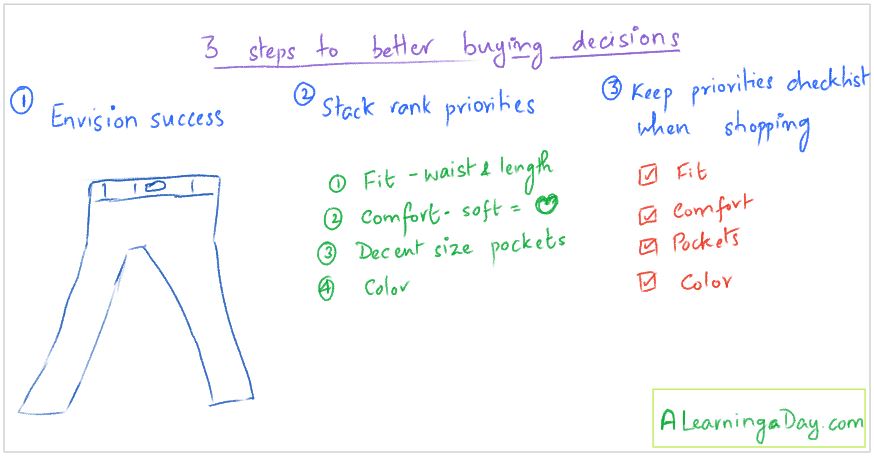
3 steps to better buying decisions –

  1. Envision success. What does success look like?
  2. Stack rank priorities. Make sure you have a list of 3-4 things that really matter to you.
  3. Keep this list of priorities with you when shopping.

The best part about this process is that it takes all of five minutes. However, the five minutes are well spent as they’ll save money and eliminate any unhappiness from unnecessary or uncomfortable purchases. And, given we spend a significant portion of what we earn buying things, it is worth the investment to do this right.

It is likely you do some version of this for your “big” purchases. However, I think it is worth doing for the small things as well – they add up.

Minimalism and efficiency are a beautiful thing. And, besides, excellence is not an act, but a habit.