Would it help?

“Would it help?” – 3 powerful words that cut through the noise.

The next time you find yourself:

  • feeling a surge of anger
  • getting irritated
  • reacting to something that isn’t going as per plan
  • thinking up a sarcastic response to get back at someone
  • harboring envy or jealousy
  • feeling worried

Ask yourself – would it help?

A calm and measured response aside, nothing really does help. Any other reaction is a waste of time, energy and emotion.

You know this. I know this. We also know it is hard to remember this in the heat of the moment.

So, instead of expecting us to respond better, let’s just make it a point to ask – “Would it help?”

Over time, we will respond better.

(I thought of this wonderful line recently as I thought of a post from December 2015 after watching “The Bridge of Spies.” If you’ve seen the movie, you’ve likely seen these words in action. And, if you haven’t, maybe it’s time to see the movie. :))

Smart or thoughtful

Smart: Having or showing a quick-witted intelligence. (adjective)

Thoughtful: Showing careful consideration or attention. (adjective)

Somebody I once knew and was influenced by used to rank and judge everyone they met by IQ – or intelligence quotient. As a consequence, I did too. The way I saw it, there was nothing more important than being smart. As long as that criteria was met, the rest would be figured out.

As I reflect on this phase, I realize how much this way of thought screams of a fixed mindset. When you focus on smarts, you assume intelligence is fixed. It is a world view that encourages judgment and opposes learning and growth.

The funny thing about world views is that it takes a really long time to completely get rid of them. I caught the remnants of this world view a few weeks ago when I reflected on something I did. I inadvertently asked myself – “Was that the smart thing to do?”

“No, but it was the thoughtful thing.”

And, it was. The outcome hadn’t worked out as I’d hoped. But, I’d given the process every bit of attention, consideration and engagement. When I attempted to think of myself as smart, I spent way too much time analyzing and fretting about outcomes.

I don’t now. Being smart matters little to me.

I’d pick thoughtful over smart any day of the week.

Horses, cars, and the disruptive decade

There’s an interesting, oft-repeated, story among technology geeks about the difficulty of getting forecasts about disruption right. In the mid 1980s, AT&T hired McKinsey & Co. to forecast cell phone adoption in the US by the year 2020. After racking up what must have been a multi million dollar bill, McKinsey said the answer would be 900,000 subscribers.

They were off by a factor of 120x.

Currently, the forecasts from leading energy analysts and think tanks on Electric vehicle adoption shows ~30% adoption in 2040. Clean energy guru Tony Seba believes things will work out different. He predicts that all new cars will be electric by 2030. In addition, all new cars will be, at minimum, semi autonomous by 2030. And, finally, all new energy will be solar by 2030.

It is very hard for us to predict the future because we are wired to think about improvements linearly.

But, technology growth is never linear and generally occurs due to a combination of technological innovations that combine to make new things possible. The current artificial intelligence wave was not made possible by deep learning algorithms alone. Instead, it took parallel computing (GPUs) and the ability to process big data that made deep learning algorithms effective.

Energy guru Tony Seba calls this “technology convergence.” Convergence happens when a group of technologies come together to make new things possible.This is why technology adoption follows “S curves” — they don’t occur linearly.

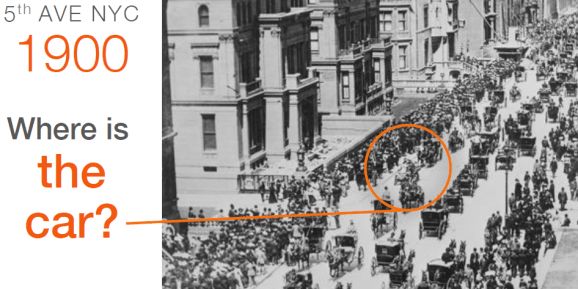
To illustrate this, this was 5th Avenue in New York City in 1900. There is one car in the photo.

In 1913, it was hard to spot the horse.

My belief is that we will see the adoption of electric vehicles and solar accelerate in the next decade. Autonomous vehicles will follow closely. It is an exciting time as it will actually enable us to make significant progress to our climate change goals as a global community.

It is a decade that will be similar to prior periods of technology upheaval. For the longest time, the big oil cartel and coal powers will all seem to dominate.

Until they won’t.

Longer version of this note on Medium or LinkedIn.

Comparing processes and comparing results

There’s a lot to be gained by comparing our processes versus those of others.

For instance, how does someone you consider successful approach their life? What do they do well? What could you learn from how they approach life?

The main danger here is that we might only be viewing some processes in isolation. Someone’s approach to work, for example, may not translate to healthy personal relationships. But, still, if we keep an open mind, there’s plenty we can learn from folks who’re different from us. Some of these lessons will translate to us living our lives better. Many, on the other hand, will just involve us getting to know ourselves much better. For example, once you realize the process behind how someone built their wealth, you may decide that it’s not for you.

Comparing results without understanding processes, as a result, is a guaranteed source of unhappiness. It is akin to surfing your Facebook feed and finding yourself envious of the exotic vacations your friends are enjoying. Results never tell us the full story. They don’t tell us what went in what worked. And, they almost always leave out vital strokes of luck that accompany every accomplishment.

A large proportion of human unhappiness comes from people comparing their kitchens with everyone else’s Instagrammed meals. It is an unfair and useless comparison.

And, most importantly, at least from the point of view of this blog, we learn nothing from it.

Strong opinions and no curiosity

I met someone recently who had strong opinions on a few topics. We were part of a group where two folks worked on digital ads and where the other was a start-up founder who had just received some seed funding. It turns out he (and it generally is a he) hated ads and believed there should be no advertising on the planet. He also believed that getting funding early was the wrong thing to do. So, he launched into multiple tirades during the conversation. This also happened to be the first time we were all meeting each other – so, let’s just say it was an interesting conversation.

I have a simple principle when it comes to the strength of opinions – the stronger your opinions, the more it is your responsibility to be curious.

People who combine strong opinions with high levels of curiosity lead with questions and take the time to understand the other person’s point of view. They, then, debate and discuss with the objective of learning something. People who have strong opinions and no curiosity just launch into their point of view. There’s no listening or learning – it is only about “teaching” and moralizing.

It isn’t just that curiosity is the difference between being interesting or annoying when you have strong opinions. It is that, without curiosity, you lose all the learning in the conversation. So, all the attempts to teach and moralize are a waste of energy. Learning only happens everyone around the table are willing to be vulnerable, listen and learn themselves.

And, that can only happen if you lead with curiosity.

Doing the work and presenting the work

Would the iPhone have been as successful if Apple shipped it without that presentation from Steve Jobs?

Given how exceptional the device turned out to be, it just might have. But, that presentation sure helped.  A lot. In fact, years of doing those phenomenal presentations meant the iPhone was already set up for success.

There are many of us who separate doing the work and presenting the work. And, I’ve heard many talk about how they feel they’re good at doing the work but not as good as presenting it. I’m definitely one of them. I’ve moaned about it in the past. And, even if I moan about it less, I often slip on giving enough thought to the presentation and narrative.

But, as in the case of the iPhone, presenting that piece of genius in a way that befit it was an important part of doing the work. It is hard to separate the effect of the making and the sharing. Sure, it would be impossible to present something that isn’t built. But, once it is built, the presentation is a key part.

The presentation isn’t always a presentation of course. It is about building and sharing a story that resonates with the folks who’d like to buy it. We also call this marketing.

Companies that succeed do a phenomenal job marrying great R&D (research and development) and marketing. We need to do so in our work as well.

Do the work first. But, don’t forget to take a step back afterward and share a story that resonates. Give your work the story it deserves.

Which lever are you going to pull today?

In every part of your life, you get to pull two levers today.

  • In your business, you can choose to juice up revenue or take a hit to improve customer value.
  • At work, you can choose to put in extra effort that’ll help your next promotion or raise or invest time into learning a skill that matters.
  • At home, you can choose to spend more time answering email to fight the fire of the day or engage with your family.
  • On the dinner table, you’ll can choose to eat that pastry or get an extra serving of broccoli.
  • On the exercise mat… well, you’ll first need to choose to go to the gym or to open the exercise mat over everything that’ll help in the short term.

The answer is not to ignore the short term. We need all that stuff – revenues, promotions, raises, fire fighting, etc. But, to what end?

Nearly every indicator and incentive we see is short term focused because the short term is easy to measure. Those levers are the brightly colored ones in front of us.

The best way to fight this is to unabashedly optimize for the long term. When in doubt, pick customer value, long term learning, engagement with the people that matter and more time on the exercise mat. And, oh, you won’t go wrong with picking the broccoli more often than not.

Err on optimizing for the long run. The short run becomes the long run before you know it.

Street sweepers and lives that matter

“If a man is called to be a street sweeper, he should sweep streets even as a Michaelangelo painted, or Beethoven composed music or Shakespeare wrote poetry. He should sweep streets so well that all the hosts of heaven and earth will pause to say, ‘Here lived a great street sweeper who did his job well.”

This quote from Martin Luther King Jr., makes a profound point – we get to decide how much our work and life matters. We know this deep in our hearts but, often, choose to bury it amidst the busy-ness of day-to-day living.

But, whenever we stop and decide to do a small thing with extraordinary care, it matters.

And, when we decide to demonstrate extraordinary care in what we say and do consistently, we make a difference.

Work you love vs. Love your work

There are plenty of great critiques to the idea that we must follow our passion and do work we love. All these critiques point to people who became passionate about what they did after they got good at it. Besides, few know what they’re passionate about, anyway. 
 
On the flip side, there’s good evidence to show that interests matter. We all gravitate toward certain kinds of work. And, it is better for us to find careers in those kinds of work. I have experienced that myself – there are certain jobs that I intuitively feel more excited about over others. 
 
My sense is that, over time, we’ll come to accept that this debate has no right answer. Instead, like all great opposing questions, the answer lies somewhere in the middle. Interests matter, but don’t let yourself get fixated on which one is the right one. Instead, once you are in the proverbial ball park, cultivate that interest, get good and create options to find exactly what you’d like to do. So, if you know you gravitate toward research, go get a Masters in something that sounds interesting to you. Over time, you’ll move toward the right subject in time for your P.hD.
 
My thesis in this debate, aside from the strong belief that the answer lies somewhere in the middle, is that our dominant strategy is to enjoy the process of doing good work. This is irrespective of what we choose to do. You don’t have to love that boring excel spreadsheet task to put in your best effort. Neither do you have to love to march to do it well. The rush from doing good work is addictive. In time, we tend to recognize and love the process of intense preparation, sustained effort and thoughtful follow up. The results of the work matter – but, far less than we imagine. Besides, good processes ensure good outcomes in the long run anyway. 
 
The process of doing good work is our dominant strategy because good work opens up opportunities. And, these opportunities help us get closer and closer to what we gravitate toward.
 
As kids, we are told that what matters is that we gave it our best shot. That advice turns out to be incredibly wise.

Building reputation and incentives into marketplace products | Thinking Product

This is a “Thinking Product” post where I have more outstanding notes questions than concrete thoughts or a framework. I haven’t given the subject of reputation in marketplaces much thought. But, I thought about reputation this week as I took four Uber rides during a day of travel.

The driver side of the marketplace. I read an interesting post today titled “Give me my reputation back” in which Gavin Kelly lays out a case for portability of reputations. He writes –

The popular image of this segment of our economy is of free-wheeling, hyper-flexible freelancers who come and go as they please. Gig-workers can, after all, work through whichever platform they wish, for as long as they wish. The free-market distilled. 

Yet this is a partial account. It overlooks a barrier to mobility: the non-portability of their customer ratings and reviews. This is no side-show. You can’t, as Henry Ford said, “build a reputation on what you are going to do.” Ratings crystallise hard-won reputations; they are the passport to future earning power. Lose them and, regardless of experience or prior standing, you are pretty much starting from scratch.

This state of affairs is all the more odd given that, to avoid being treated as legal employers, platform-companies like Uber present themselves as mere online notice boards used by independent businesses to pick up trade. Strange, then, that these businesses can’t move these reviews with them.

I think this is a valid thought and one that is similar to the argument that we ought to be able to take our data on centralized platforms and move it. I don’t expect the gig economy companies to take action. But, our regulators need to pay more attention.

The rider side of the marketplace. Uber has been more upfront about the rider rating (i.e. the average rating you receive from drivers) and you now see it the moment you touch the options menu. I had a few thoughts here and questions here –

  • Rating manipulation: Uber says it doesn’t reflect individual changes to ratings, for example. But, it is pretty easy to tell. For example, I received three 5 star ratings and one 1 star rating on Wednesday. It was easy to tell because I saw an immediate change in my rating and the last change involved a large fall from 4.74 to 4.64. So, is it possible to manipulate your own rider rating? Here’s an example – what if I gave a 5 star rating and a generous tip to the driver right after I finish the ride? Wouldn’t the driver know immediately and reciprocate? Similarly, what if I “got back” at the driver who rated me one star by giving him a one star rating? Could Uber update ratings after a 24 hour period instead? (I did neither – but am curious)
  • Feedback for a one star rating: I was really curious about the reason for my one star ride. I was waiting for the driver, greeted him, stayed quiet until he needed directions within our apartment boundaries and got off. I wondered if the rating was a mistake and asked Uber support if there was a reason for this. But, Uber support just gave me a list of generic tips. What if the rating system persuaded both riders and drivers to give at least a line of feedback if they gave an extreme rating – e.g. one or two stars?
  • Introvert bias?: I would be really curious for studies on the correlation between introversion and Uber rider ratings. If I’m taking an Uber after a work event or a social occasion, the last thing I want to do is have a conversation with my Uber driver. But, an extrovert would be have differently and my hypothesis would be that extroverts have higher Uber ratings, on average.
  • Kids bias?: Another bias I’m more certain of is that against parents traveling with young kids – especially if the driver isn’t a parent himself/herself. How do you correct for such biases in these rating systems? Do you bother?

As we move toward a world with more marketplaces enabled by mobile phones, I wonder what the consequences of such rating and reputation systems will be. I’ve heard great things about an episode of Black Mirror where everyone is obsessed with their overall rating. What happens in a world where we feel constantly watched and judged?

While I was curious about ratings and reputations in marketplaces during my Uber day, I definitely felt judged when I got my one star rating. For some reason, I’ve had issues with the Lyft app on my phone over the past few months. But, the one star rating with no explanation pushed me to uninstall and reinstall the app so I could use Lyft next time.

I’ll be back with more notes and questions after using Lyft on my next travel day in the coming months. :-)