Counter productive behavior and perspective

Most infants hate changing clothes. So, they generally cry, kick, and scream when it happens. That is, of course, completely counter productive. It only lengthens the process and makes it worse.

I found myself amused when I observed this counter productive behavior the other day until I realized that we aren’t all that different as adults. We often do our equivalent of crying, kicking, and screaming when we deal with inevitable change, have an unexpected difficult conversation, or worry about something we don’t control.

That’s why taking the time to develop the sort of perspective that leads to equanimity can be very powerful. The sooner we can eliminate the counter productive behavior, the more productive we can be.

And, a great way to develop that sort of perspective is to spend more time with folks who have that perspective.

Unlimited vacation perks and game theory

There have been a few news articles going after perks like “unlimited vacation.” The trouble with these articles is that they typically go after these perks quoting folks who run workplaces without these policies and thus tell you that these perks are dangerous. There’s an inherent skin-in-the-game problem there.

A better approach might be to examine such perks from the lens of game theory. The challenge with unlimited vacations is that one’s natural behavior is to want to take a little less vacation than their neighbor – i.e., not enough to be the slacker on the team. This means the natural equilibrium point is to reduce the number of vacation days to zero.

This problem can be easily solved by shifting the equilibrium. For example, companies like Hubspot and LinkedIn (where I work) either mandate 2 weeks of vacation or shut down entirely for 2 weeks in the year. Another way to do this would be to have negative incentives below a certain threshold – e.g. maybe you get some benefit deducted if you don’t take 3 weeks off.

Company culture goes a long way in creating equilibrium points as well. Smart employers understand that breaks result in more productivity. And, cultures can create norms that make it unacceptable to not take these breaks.

Perks aren’t culture – their use is dictated by culture. They are rarely good or bad by themselves. Ping Pong tables, for example, can actually be pretty great if you use them every once in a while to blow off some steam with a teammate.

So, if perks aren’t being used as intended, it is better to evaluate the equilibrium created by the culture and incentives in place. And, game theory is our friend.

(Inspired by the game theory chapter on “Algorithms to Live By” – a very good book :-))

Productive communication

We often think of productivity in terms of work we get done. But, our ability to communicate has a big impact on our own productivity as well as that of others around us.

And, as a friend pointed out the other day, we can get a lot more done if we can manage to communicate consistently in a way that manages to challenge people’s thinking without making them feel defensive.

PS: I’m not sure yet as to what the key to challenging without creating defensiveness is – since I’m not good at it myself. Would love your ideas. I’ll aim to share a synthesis after giving this more thought.

Two question career advice

Someone I know shared the following two questions when I asked her about her favorite pieces of career advice – “First, are you going after hard problems? And, second, would most of the folks who work closely with you now want to have you on their team when they go on to their next gig?”

I love the two question format of career advice. I’ve found myself mulling both questions and frequently asking myself if I am going after hard problems since that conversation.

Questions are powerful. Good questions can be game changing.

The World Cup, Google, And The Omnipresent Sorting Theory

France were crowned the new world football champions in the summer. Croatia were the runners up.

The interesting question, then – can we confidently say Croatia was the second best team in the tournament? Would they have beaten Belgium or Brazil if either team had been in their half of the bracket?

While it is likely to be just a battle of your opinion versus mine, I’d hazard a guess that Belgium and Brazil were probably better teams. The challenge is that elimination via brackets does a good job identifying the winner. But, it does a poor job of finding second place. The best approach to finding the stack rank of the teams would be to do a comprehensive round robin where everyone plays each other – equivalent to the English Premier League for example. But, we don’t have time for that in the world cup. So, brackets are the way to go.

Sorting theory
In Computer Science, a sorting algorithm puts the elements of a list in a certain order. Computers, in many ways, are just sorting machines. They take vasts amounts of data and find ways to sort them intelligently and make them available when we need them.

Sorting theory is a key part of introductory computer science and it tends to be a popular interview question topic. Barack Obama was famously asked a question about the most efficient sorting algorithms in an interview at Google. That’s how mainstream sorting questions are. :-)

The efficacy of sorting algorithms is judged by the big O notation. It is the worst case scenario of time taken to sort “n” items. The first sorting aglorithms had a worst case performance of N^2 square. This means the performance gets really bad as the number of items increases. As a result, sorting and, by extension, computation was very expensive.

This was until the Merge sort came along.

Merge sort and life applications of sorting theory
The merge sort has legendary status among sorting algorithms because it made “linearithmic” sorting possible. The worst case is NlogN – effectively MUCH faster than previous sorting algorithms. (Wikipedia has a simple illustration of how merge sort works – if you are interested)

Merge sort is what you do when you split a large pile of laundry, split it into little piles, sort those piles, and then merge them together. The process of elimination in competitions via brackets is, thus, a variant of merge sort.

As Brian Christian and Tom Griffiths share in their book “Algorithms to Live By,” there are plenty of other such life applications of sorting. For example, sorting theory teaches us to never sort email into folders if searching is easy. Sorting is expensive (read: giant waste of time).

Sorting theory also teaches us to use “bucket sort” when possible. Bucket sort or bin sort is what you do when you just separate your laundry into various “bins.” Assuming a small number of bins, it gets sorting done in linear time.

We also see sorting theory play out in every organization via the pecking order. Pecking order was first observed in a brood of chickens who figure out their leadership order by pecking away at each other. The most powerful peckers are higher up in the order. Humans do it too – it is called politics and usually just requires two humans, a room, and some incentives.

Okay, so what does all this have to do with technology and the future?
Brian Christian and Tom Griffiths have a couple of intriguing questions for us here – What is Google? The default answer would be “search engine.”  But, is it really a search engine? Or, should it be called a “sort engine?”

The power of Google is not just in the searching but in its ability to do the sorting. In fact, we could make the argument that it is the efficacy of their sorting algorithm that makes Google the massive money making machine that it is. Google rose to power sorting results into pages with 10 relevant results. Over time, they added ads to the side and then on top and became one of the most valuable companies on the planet.

Let’s take a look at what Google’s sorting looks like right now. These are screenshots as I scroll down for a search for “mattress” – I’ve captured 8 screenshots from beginning to end and I’ve encircled the ads in red.


3 observations –

1. It took me 2 entire screen scrolls before I saw the first completely organic result.

2. I counted roughly 16 organic results/groups and 7 ads.

3. I don’t think I ever scroll past screen 2 – my guess is that I’m not the exception here.

Google, then, is still a sort engine. For most retail searches, however, it just sorts more ads these days than organic results.

Who gets to do the sorting for you?
There are two lucrative marketplaces on the internet – attention marketplaces and retail marketplaces. The biggest leading indicator for the success of a marketplace is whether or not they do the sorting for you.

If Facebook gets to sort the information you see through the course of a day (and, for a majority of the world’s adults, they do), the attention marketplace is theirs. And, if Google gets to sort the results of your retail searches, then they win big as well.

Understanding this truth about sorting explains a lot about the state of the big technology players today. Facebook – including Instagram, Whatsapp, et al – sorts the information the world sees every day. But, they’re working hard to invest in video because they don’t want Netflix and YouTube to sort what you watch.

The New York Times homepage used to be the most prestigious display of sorting two decades ago. It isn’t anymore. Old world publishers are, thus, falling by the wayside. The smarter ones are realizing that the only place they can do the sorting of information for their users is email. So, they’re doubling down on email and building subscription businesses on that (quaint?) piece of technology.

Disney, 21st Century Fox, and the like don’t want Netflix to sort the shows you want to watch. They’re scrambling. So are large telcos who’re finding ways to get in on this action.

Google, on the other hand, is targeting a different kind of foe. Google makes a lot of money off retail searches. But, increasingly, people are starting their retail searches on Amazon. Worse still, they’re able to do so by just talking to Alexa. From a monetization standpoint, that is an existential threat for Google. Google’s $550M in Chinese retailer JD.com is just the tip of the iceberg for Google’s marketplace ambitions. Expect plenty more to follow.

One thing is for certain – In all these moves and the many more to come in the future, sorting will be omnipresent.

(Also posted elsewhere as part of the “Notes by Ada” Project)

Avoiding the inconvenient no

I find myself reflecting frequently about the number of times I say no to our ~2 year old. It is the easy default response to the things she wants to do – explore away by turning everything upside down without any regard for her own safety.

After months of attempting to strike the balance, I’ve recently found a better approach that’s helped me make peace with this process. Now, I ask myself – Am I saying no because it is dangerous for her (e.g. playing with something very heavy or hot) or because it is inconvenient for me (e.g. something that will result in a mess that I need to clean up)?

And, when the answer is the latter, I do my best to stay silent.

Reflections from the billionaire war of words

There’s been a massive war of words between a few current and former Facebook billionaires that’s commanded a ton of media attention in the last few days.

I get that they’re attempting to prove their ideologies and actions right. As Yuval Harari might say, we have a strong need to believe in our own myths. But, it just comes across as childish and petty while also proving that having plenty of wealth does not guarantee happiness. Far from it.

As they continue to snipe and call each other names, I find myself wishing they’d switch the focus of their fight to an arbitrary topic (any topic, really!) that actually matters – how to better use their billions to help people whose lives are impacted by the very technologies that made them rich or how we can do better to tackle climate change.

We need more attention on that stuff.

The blessing and curse of packet switching

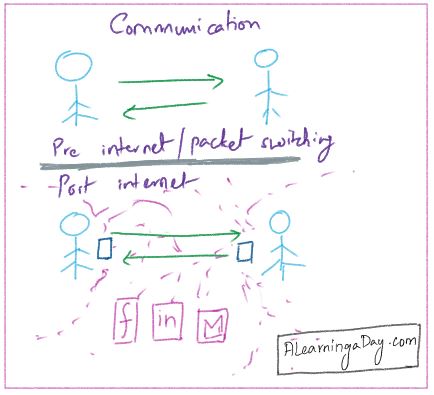
One of the core innovations behind the internet was the switch from circuit switching to packet switching. Pre-internet, if someone wanted to communicate with you, they either found time with you in person or called you on a phone/”landline.” And, when they called you on the phone, no one else could interrupt as the “line was busy.”

Packet switching, on the other hand, breaks communication into packets that reach a destination without worrying about busy lines. While phone lines used to be either free or busy, our destinations today (email accounts, social media accounts, phone inbox) deal with packets all day along. There is no concept of idle time since people and services send us packets through the day and wait for us to acknowledge them.

Consequently, idle time has disappeared in our lives too. The constant presence of packets means we check our phones in the bathroom or when others are trying to communicate with us (the irony) in a generally futile attempt to be packet-zero. While packet switching has its many benefits, its curse is that it is built to serve the communication system and not us.

There’s a Tahitian saying that tourists have watches but Tahitians have time. While we can definitely look at packet switching as a cause for that, there’s also a deeper implication. If we don’t take control of how we consume and respond to these packets, we’ll be surrounded by communication – but will have forgotten how to communicate.

(H/T Algorithms to Live By by Brian Christian and Tom Griffiths – for the inspiration)

Our work won’t speak for itself.

Our work won’t speak for itself. On a good day, it may just do 70% of the talking required. But, it still needs us to make the effort to package it and make the case for it.

But, it bears repeating – it won’t speak for itself. And, even if we build it well, they may not come. In fact, unless we put in the effort to sell it, they most likely won’t.

A useful assumption, then, is that quality work will do half the talking. The rest is up to us.

The world and the places we work seem fairer places once we internalize that and do the work to make sure our efforts count – after we do the work.

PS: The note to self version of this started with – “To my intense disappointment, I’ve come to realize that our work alone won’t speak for itself.” :-)