Averages and statistics

A friend who is in the market for a home recently shared how averages and statistics have little predictive value. While they might give you a sense of the likely range of outcomes, your unique preferences may land you well above or below these numbers. You are, after all, a data point.

I’ve observed that the same is true for the other challenging activity that many of us go through – job searching. When we’re out there looking for the next gig, it is tempting to get caught in the “average and statistics” zone by asking “do I stand a chance based on people like me who’ve been through the process before?” 

While it is important to know these numbers and use them to not spend all our time on unlikely events, the flip side holds as well. We are just one data point. If we’re focused and thoughtful about how we approach our search, averages and statistics can matter lesser than we think.

Understand them, then learn to ignore them.

Product sense = The ability to build for value

A note for new subscribers: This post is part of a bi-weekly Sunday series on my notes on technology product management (this is what I do for a living). You might notice that these posts often link to older posts in the series on LinkedIn even though they are all available on this blog. That is intended for folks who only want to follow future product management related posts. Finally, for all those of you who don’t build tech products for a living, I believe many of these notes have broader applicability. And, I hope you find that to be the case as well…

Product managers who consistently build good products over time are said to have good “product sense.” It is one of those sounds-insightful-but-it-really-is-vague terms that is thrown around a lot when product managers are assessed and evaluated. I think the use of the word “sense” makes it natural to equate product sense to “spidey sense” – something a tad more extraordinary. :-)

Product sense is simply the ability to consistently build for value. This note is going to be about why it matters so much and how it manifests itself in the process of building products.

For starters, let’s go back to what an IC (individual contributor) product manager doesa product manager brings a team of cross functional stakeholders together to build a product that is valuable, usable, feasible.

Of the three outcomes a PM is responsible for, the most important is value. Building a useless product that is beautifully designed and well engineered is a waste of everyone’s time. On the flip side, if you get to build a product that is incredibly valuable, you can survive many iterations of poor design and/or technical architecture. And, if you need any convincing, look at the launch version of products you now love – they most likely started out looking ugly or suffered from “this site is down” errors far too often.

So, let’s begin to explore the notion of value.

Value = benefit to others. The value of anything we do is measured by the benefit others get from it.

How, then, do we “add value” in our jobs? There is only end recipient of value in our jobs – the customer (used interchangeably with “user” for consumer product companies). But, when we build or work on products, there are 3 broad ways we create value –

1. We build for basic user needs/what is considered “table stakes”: This constitutes everything a company does to serve its customers’ basic needs and match competitor offerings. While “table stakes” sounds simple, this is often really hard to get right and tends be the foundation on which companies build their differentiation. One example for internet products would be SEO or search engine optimization. While it is definitely table stakes as customers expect to find you easily when they search for you, it is still hard to get right.

2. We are enablers for our co-workers/partners: This includes all products targeted at improving the productivity of our co-workers as well as all the tools we build to enable partners to sell our products to customers.

3. We work on stuff that differentiates our company from the competition: Every successful company succeeds on the basis of some differentiation. While working on the “moat” sounds all hip and snazzy, this is often a result of a relentless focus on the customer’s problem or “job-to-be-done.” This is also rarely one thing – instead, it tends to be a combination of things a company does to elevate its status from what is considered “table stakes.” Think: all the small things that Ikea does to successfully serve anyone who wants to quickly furnish a home.

This all sounds pretty basic – why is it so hard to do when we are building products? Building for value is hard to do in the same way exercising, reading good books, and eating healthy are hard to do. This should be how everyone builds products. But, other stuff – typically corporate politics, bad organizational or product culture, and organizational inertia – gets in the way. This “other stuff” results in bad product management.

Bad product management involves product teams building products that put the needs of the company or executive team ahead of the needs of the customer.

All this brings us back to the 4 core skills of an IC Product Manager – problem finding, problem solving, building effective teams, and selling. 

Since product sense is about building for value, I believe that “problem finding” or the ability to define customer/user problems well is the skill that differentiates good product managers from great product managers. As my hope with this series is to drive clarity, I’ve intentionally stayed away from using “product sense” instead of problem finding or problem definition – even if product sense is common usage. And, in our next post, we’ll dig into developing our problem finding muscle – via problem statements, hypotheses, and riskiest assumption tests.

A career and life sidebar. For the life learning/career learning geeks out there, the notion of “value” goes well beyond building products. It has profound implications to success in our careers and our lives. Take the idea “success” as an example – we succeed (externally) when we create or offer something that the world wants or values. It is this value that generally translates into wealth.

For example, we communicate well when the others in the room understand what we say. Our clients and managers don’t appreciate us for the work we do. Instead, they appreciate us for the problems we solve for them. Like him or hate him, this was the magic behind Steve Jobs’ work. He had a deep understanding for the problems we wanted solved and for the stories we wanted to hear. He remains a great example of someone with great “product sense.”

The implication for us – we often orient our narratives around what we did – “I worked so hard” or “I did so much” or “I said so many times.” Unfortunately, such effort counts for little. Outcomes >>> Outputs. Our external success, instead, is a function of how well we understand the exact nature of the problem others around us would like solved. As we get better at solving these problems for our world, we earn the right to do the same for “the world.”

As we’ll explore over the course of future posts, most of the principles that enable us to build products (or build anything for that matter) are just as applicable to our lives. Thanks, as always, for your attention – I look forward to your notes and feedback.

Take rest before you are forced to

A simple technique to prevent illness – take rest before you are forced to.

Of course, this isn’t limited to rest. We can also hydrate before we need to, eat healthy before it becomes mandatory, and stay active while it is still optional.

Our bodies have phenomenal early warning systems built in. And, weekends are the perfect time to turn down all the noise and listen for signs.

Happy listening.

Focusing on trends in feedback

If you are like most people in most places, useful feedback is rarely given and generally shows up only when you ask for it. And, asking for it can be a deeply uncomfortable experience.

Getting started on the journey requires us to embrace the obvious – there is always going to be room for improvement and we might as well know what it is. But, “exercise well” and “eat healthy” are obvious too. And, yet, it takes time and effort to embrace them. The obvious things are often very hard to do and recognizing that helps make the process easier.

But, what do we do when we are actually in a room with folks sharing things they wish we’d done better? Consider ignoring individual pieces of feedback and focus on trends. There are two reasons to do so.

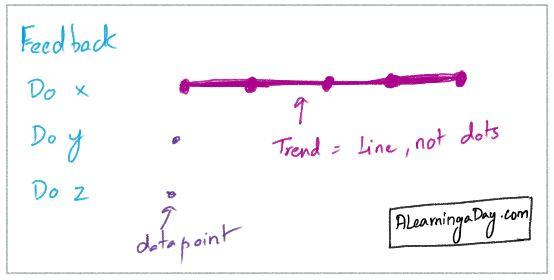
First, while individual pieces of feedback may be useful from time to time, they are generally noisy in isolation. Aggregating feedback into trends instead enables us to focus on lines, not dots. When we see the same idea show up from multiple folks, we can be sure that working on it will be valuable.

Second, focusing on trends takes away the personal aspect of feedback. When we look for trends, we elevate our focus from individuals to our audience. And, if most of our audience believes we need to speak faster, then speak faster we must.

A focus on trends has made it easier for me to get comfortable asking for feedback. The side benefit of this comfort is that asking for and receiving feedback becomes less of an event the more you do it.

A fail safe method to guarantee misery today

There’s a fail safe method to guarantee misery today – compare yourself to others.

If all we do is stop ourselves every time we are tempted to compare ourselves to others and redirect that energy to getting better, we’ll make a measurable long term difference to our productivity and happiness.

It isn’t a race. It is a journey. The only thing that matters is the progress we’ve made today relative to where we were at yesterday. The key, then, is to find ways to remind ourselves of this truth as often as we need to.

Maasai warriors and culture

The Maasai tribe have roamed Tanzania for centuries. And, given the challenges of living amidst the world’s largest lion population, the rite of passage for Maasai boys to become “warriors” was to kill a lion.

Over time, this decimated the lion population in Tanzania. The Tanzanian government responded by banned this practice – to no avail.

Conservationists, on the other hand, tried a different approach. They enlisted help from the Maasai warriors to protect lions. The new symbol of courage for the warriors is saving lions while safeguarding their communities instead of killing them. And, this program has made more progress over the past years than other attempts over the past decades.

This anecdote speaks to the power of culture to drive meaningful change – in ourselves and others. When we transform the “this” in “people like us do things like this,” we transform ourselves, our worlds, and, in time, the world.

(H/T: This is Marketing by Seth Godin)

Breaking up with the first draft

I spent some time over the summer re-learning how to write better documents at work. As I look back at the lessons I learnt by observing what I actually changed in how I approached writing, the biggest one was willingly breaking up with the first draft.

Barbara Minto in “The Pyramid Principle” made a strong impression when she said the biggest writing problem most people have is learning to separate the thinking from the writing. She poked fun at how the first draft takes on an “incredible beauty” in the author’s eyes that we don’t like to disturb.

I found her observation to be spot on. We write the first draft for ourselves – to clarify our own thinking. And, if we embrace the process of rewriting, we write subsequent drafts for our intended audience.

There’s a meta learning in this too – we have a tendency to get comfortable after an initial learning period in any new skill. It takes a lot of effort to fight inertia and break out of version 1.0 into the next. And, then again to the next. To get better, we need to embrace “what got you here won’t get you there,” push for feedback and learning, and embrace reinvention.

It is how getting better works – in life as in writing.

A principle for deciding on social engagements

The single most useful principle I’ve found for deciding on social engagements is the Derek Sivers decision making principle of “If it isn’t a HELL YEAH, it is a no.”

The principle isn’t universal as there are many decisions that need to be made with less than 100% certainty. But, I’ve found it to be spot on with social engagements – especially if you are introverted.

As introverts, we face a lot more downside from a crappy social engagement. So, it pays to be selective. :-) This principle helps us do just that.

But, perhaps the meta principle here is to find and use a principle that works for you to make decisions in areas like social engagements. Decision making is work. And, principles help make the process much easier while delivering consistently better outcomes.

Opening windows

I spent three months on a project in Shanghai in 2013. The Air Quality Index in Shanghai during that period was always “hazardous.” So, we spent a lot of time indoors and never opened the windows.

In hindsight, that time was a gift as it helped me appreciate fresh air in a way I hadn’t till then. Ever since, I’ve always been a proponent of keeping windows open wherever I am and generally choose fresh air over air conditioning when I get a chance.

For a few days last week, I was reminded of those months as we experienced poor air quality due to a bad forest fire near where we are. The air cleared up on Wednesday just as we headed into thanksgiving weekend and, in doing so, gave us another thing to be thankful for.

While the fire gave us plenty to think about from the standpoint of climate change, I’m going to leave that discussion for another day. For now, I’m going to give thanks for the ability to open windows and take in fresh air.

It is one of the many gifts we have that we tend to appreciate most when it is absent.