Ozark and slippery slopes

We recently watched the Ozark series on Netflix. It is the story of a financial planner who relocates his family to the Lake of the Ozarks in Missouri after a money laundering scheme goes very wrong. It is a good show with strong and well developed characters.

The one idea that the show hammered home for me was the idea of the slippery slope. It shows the downstream impact of one decision that compromises our ethics. That decision leads to the next bad one and the one after that. Covering the tracks of each of these decisions lead to many more decisions that further compromise our ethics.

Before we know it, we find ourselves in a place that is unrecognizable from where we started.

It reminded me of the Clay Christensen anecdote about a cyclist who made the decision to dope “just this once.” No cyclist starts cycling with dreams of becoming a doping addict. But, he might make an exception “just this once” for an extenuating circumstance. And, before he realizes it, doping becomes the new norm. A slippery slope.

Clay’s advice is two-fold. First, make sure you have ethics and principles that you care about. And, second, stick to those ethics and principles 100% of the time. Never make allowances for extenuating circumstances because life is a never ending series of extenuating circumstances.

We know this to be true. The Ozark story arc brings it to life on the screen nicely.

The Morgan Housel compilation

I had 3 notes to share as part of this year end “Morgan Housel” goodness compilation –

(1) The first is a post titled “We have no idea what happens next.” As is his wont, Morgan Housel shares a fascinating story about the aftermath of a volcanic eruption in Indonesia in 1815 that disrupted the world for more than a year.

After it resulted in a famine in Germany, it inspired Justus von Liebig to devote his career to improving agriculture. That, in turn, led to Ammonia based fertilizers that changed the course of large scale agriculture. A great example of innovation that was likely inspired by a global catastrophe that was also simultaneously impossible to predict. Morgan then concludes with –

Then there’s the big unknown: the crazy, disconnected, counterintuitive change set in motion this year that we’ll only be able to piece together in hindsight. The kinds of things that only happen when seven billion people have their lives thrown upside down, experience a bunch of stuff they’d never imagined, and are either motivated or forced to do something completely different than they had considered in January.

No one should even guess what that might be. The unpredictability is the point.

But when good vaccine news came out this week, several people said, “there’s light at the end of the tunnel.” Maybe. But I suspect we have no idea what happens next.

Indeed.

(2) Next, he made an insightful observation in another post about low interest rates.

When interest rates are zero, stories about what the future could be are more important than what the present actually is. Interest rates tempt investors away from stories about future potential with promises of returns right now, this year.

Once those returns fall to zero, stories about what could potentially happen years from now – even if it’s low probability – gain most of the market’s attention. And people are good at coming up with awesome stories. That’s part of why Tesla is worth two-thirds of a trillion dollars, and the market is at an all-time high with 10 million people unemployed.

(3) Finally, after reading his book – The Psychology of Money – I shared a few copies with friends. It is an interesting book because it isn’t about how to invest or how to think about money. Instead, I describe it as a book that is about how to think about thinking about money.

The book is a collection of stories and anecdotes that provide food for thought. And, it can either be a light heavy read depending on how you’re feeling.

I walked away with a list of questions that I intend to work through in the coming days. It made me think. And, for that I’m grateful.

Thank you, Morgan, for your excellent work.

A hierarchy of feelings we need/crave

A theory I’ve been mulling of late is a hierarchy of feelings that we need/crave.

I think said hierarchy is safety -> love -> belonging -> respect -> admiration.

It starts with physical safety. That means a certain amount of money combined with good health. That money buys us space and essentials. In its absence, we are at our worst, are overwhelmed, and function well below our normal intelligence levels.

Once we have that, we crave mental safety. This means being surrounded by people who we trust. Staying clear of bullies and/or mental or emotional abuse moves us past this.

Next, we yearn for love. Living with someone we love and who loves us is a very special gift.

After love, we seek belonging within a group. We typically find it in our work, with our friends, as part of our faith, and/or some other social group.

Most humans spend their time seeking one of safety, love, and belonging. The absence of these at critical points in our life spawns insecurities that stay with us for the rest of our lives.

For those fortunate enough to move past these, the next needs are respect and admiration. These move us from the realms of insecurity to confidence.

But, both of these are tricky needs to navigate. That’s because they often have us fooled into believing we need widespread respect and admiration.

In reality, respect and admiration from ourselves and a few others we care about is all we need. But, that is tricky in its own way because the one person whose respect we crave the most – the person we look at in the mirror – is the hardest to win over.

A tree that grows quickly

“In undisturbed ancient forests, youngsters have to spend their first two hundred years waiting patiently in their mothers’ shade. As they struggle to put on a few feet, they develop wood that is incredibly dense.

In modern managed forests today, seedlings grow without any parental shade to slow them down. They shoot up and form large growth rings even without a nutrient boost from added nitrogen. Consequently, their woody cells are much larger than normal and contain much more air, which makes them susceptible to fungi—after all, fungi like to breathe, too. 

A tree that grows quickly rots quickly and therefore never has a chance to grow old.”

| from a summary of “The Secret Wisdom of Nature”


There’s a lesson in there somewhere for all of us.

Getting distance

Every year over the past eight years, I’ve made it a point to take time off after the 10th of December (give or take a couple of days) through to the new year. I do this with one goal – to get some distance from the rest of the year.

The first eleven months are dedicated to the pain and joy of day-to-day living. In these months, I attempt to live my life in a way that is consistent with values and principles I hold dear.

December, on the other hand, is focused on figuring out what these values and principles should be. Of late, that has meant figuring out how they should evolve for the next year based on everything I’ve learnt this year.

That comes with distance, reflection, and an accompanying dose of perspective.

As I start on that journey this year, I feel very aware of the many amazing things I take for granted during huge parts of the year. Articulated in the language of the things that matter to me – I like what I do, I think it matters, and I do it with people I care about and learn from. These are massive blessings. Especially so in a year that has revealed the enormous privilege that comes from having a steady income from a job that can be done remotely.

And, perhaps, most of all, I have the luxury to take most of the last month of the year off for said reflection and distance. In nearly every other year, this has coincided with either visiting our parents or having our parents visit us. However, given the circumstances, that isn’t possible this year.

But, the extended time off tradition remains more important than ever. That’s because I’ve also come to believe/realize that taking extended time off at some point of the year is critical for anyone who is paid for their judgment and creativity.

Why? Aside from all the good that breaks do for us, I keep going back to that word – “distance.” A long break helps us get that space to think, to take stock, and to get some perspective. Given that time and space and an insightful book, we realize the futility of some of the battles we fight and the importance of the many little things and wonderful people in our life that we take for granted.

That in turn helps us zoom out of the minutiae and refocus on what matters. We do this by reflecting on what we’ve experience and synthesizing the essence. That essence may just be one or two insights that change how we operate – i.e., those one of two insights form the most important lessons we’ve learnt this year. And, those lessons compound over time and step change our productivity.

For many of us, they also do more than just that. They remind us just how much we have to be grateful for. And, that gratitude inspires happiness. The kind that sticks around.

If you haven’t managed much distance this year, here’s hoping you get some ahead of 2021.

Flow is something the reader experiences

“Your job as a writer is making sentences.
Your other jobs include fixing sentences, killing sentences, and arranging sentences.
If this is the case – making, fixing, killing, arranging – how can your writing possible flow?
It can’t.

Flow is something the reader experiences, not the writer.

A writer may write painstakingly,
Assembling the work slowly, like a mosaic,
Fitting and refitting sentences and paragraphs over the years.
And yet to the reader the writing may seem to flow.”

| Several short sentences about writing by Verlyn Klinkenborg


Verlyn Klinkenborg’s warnings about flow are as articulate as they are important. This passage reminded me of a quote from five time NBA All Star Damian Lillard – “If you want to look good in front of thousands, you have to outwork thousands in front of nobody.”

You can bet that the process of outworking thousands in front of nobody was fraught with pain and struggle. Few would describe that process as “natural” or filled with “flow.”

But, given time, energy, and patience, that process will create performances filled with flow. Or as Verlyn Klinkenborg notes in the context of writing – “Flow doesn’t describe the act of writing. It describes the effect of writing.”

Powerful.

PS: In case you are intrigued by all these notes on sentences, Anna has a fun blog where she deconstructs the first sentences of books.

Who we spend time with, by age

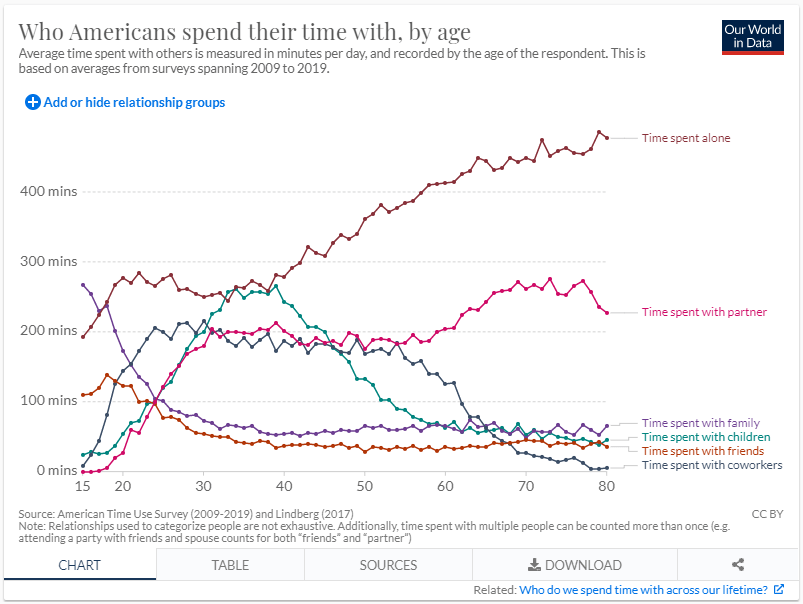
The Our World in Data team had a fascinating chart visualizing who we spend time with, by age. While the data is from Americans, I suspect some of these patterns hold in various places around the world.

This chart struck me as the single best argument made for the importance of self-compassion.

Be kind to yourself or the many hours you’re going to spend with yourself as you grow older are going to be * awkward *. :-)

Good? Bad? Who knows?

One of my favorite stories is about a farmer in ancient China who used an old horse in his fields. One day, the horse escaped into the hills and when the farmer’s neighbors sympathized with the old man over his bad luck, the farmer replied, “Bad luck? Good luck? Who knows?”

A week later, the horse returned with a herd of wild horses from the hills, and the neighbors congratulated the farmer on his good luck. He replied, “Good luck? Bad luck? Who knows?”

Then, when the farmer’s son was attempting to tame one of the wild horses he fell off its back and broke his leg. Everyone again sympathized with the farmer over his bad luck. But the farmer’s reaction was, “Bad luck? Good luck? Who knows?”

Some weeks later, the army marched into the village and drafted every able-bodied youth they found. When they saw the farmer’s son with his broken leg, they let him stay.

Good luck? Bad luck? Who knows?


I love this story because it reminds me of a lesson I think and write about from time to time – you never know if a good day is a good day.

In that spirit, I wanted to share an update on our immigration foibles. After my wife lost her job, I asked for help here and via a LinkedIn post. We got a lot of tips and ideas, a couple of wonderful connections, and lots of support (thank you!). We decided that the best path forward was to pursue litigation and engaged an attorney.

One day after doing that and four days after her job loss, the extension came through day before yesterday.

What followed was an overwhelming sense of relief and amusement at the sequence of events.

Bad luck? Good luck? Who knows?

The person making the pass

Some soccer and basketball coaches operate with a rule of thumb – the person making the pass is responsible for the outcome.

It is a helpful rule of thumb to avoid blame and create a culture of accountability.

It also turns out to be a helpful rule of thumb for us as communicators or product managers. The responsibility of understanding our audience and landing the message or product falls squarely on us.

No points for complaints or blame.

Tony Hsieh and notes on happiness

Tony Hsieh, the co-founder of Zappos.com, passed away a few days ago.

Fittingly, there was a lot of appreciation for all he brought to the world. Hsieh built a very unique customer and people centric culture at Zappos before it was sold to Amazon. He shared his approach in his lovely book – “Delivering Happiness.” And, after the Zappos sale, he also spent a lot of his time and energy attempting to revitalize the Las Vegas downtown.

A few days later, it emerged that he had been on a self destructive loop in the past months with far too much alcohol and drugs. The Forbes article detailing this is a sobering read.

I was reminded of three things at once.

First, COVID-19 has made 2020 a particularly difficult year for our collective mental and emotional wellbeing. In Tony Hsieh’s case, these challenges severely exacerbated existing problems and ultimately proved fatal. But, for those of us who know of friends and family who’re having mental health issues, let’s encourage them to get help and be as supportive as possible.

Second, Tony Hsieh became a hero for many after he wrote “Delivering Happiness.” I loved that book and thought of him as an enlightened leader after reading that book. But, as he wisely noted in the book – “Things are neither as good or as bad as they seem.” So true.

Finally, I was reminded of Dave Winer’s excellent blog post – “Your human-size life.” Below is the post in full – it is one I think about from time to time. And, it is where my mind went after I read this final chapter of Tony Hsieh’s story.


In the early years of this blog I wrote a lot about the personal struggles of people who had attained financial independence only to find out that it revealed that money was not what was standing in the way of happiness. That’s contrary to the message of our society, which is this:

– Until you’re rich, you’re miserable.
– Once you’re rich, it’s all great!

I was fascinated with this topic, because a few years earlier, when the company I founded went public, I had achieved this independence, and found that I wasn’t happy. I felt like I had done all that had been asked of me, and I was promised happiness, and I had been cheated, and wanted to understand why.

Before I hit the mother lode, I was just another gold digger, struggling to make payroll, even though my company had offices on Easy Street (not a joke) in Mountain View. I was actually having as much fun as you could have, but didn’t know it at the time.

One evening, I was walking around the neighborhood of the office when I met a friend of a friend, let’s call him Joe (not his real name) and stopped to chat. I had heard that he was very rich, and asked why he lived in such a modest middle-class neighborhood when he could afford an estate in Los Altos Hills or Portola Valley. He said he preferred to live a modest life, to live within his ability to use his wealth, and just kept the money as a cushion in case something went bad, someone in his family got sick, or some other emergency. 

I thought then this was puzzling, I didn’t get it, but now, with the benefit of almost 30 years of hindsight, I realize he was totally right. One of the biggest mistakes rich people make is to try to live larger than a single human being can. A mathematical impossibility. You can buy a big house, but you can only sleep in one bedroom at a time. You can own twenty fantastic cars, airplanes and yachts, but you can only be in one at a time. You can own an NBA team and a MLB team, and you get to sit in the nicest seat in the house at games, but you still can only sit in one seat. In other words, your humanity doesn’t increase just because your wealth did. You don’t get bigger. 

And it’s even worse than it appears — the struggle to live more than one life will fail, and it will make you feel like a failure, just as you felt before you made the money! So being rich does not mean success if your goal is to achieve immortal super-human-ness.

You can see that horrific struggle in Peter Thiel’s actions and statements. He says he’s going to live forever, and so will today’s college grads. And I assume in the back of his mind he’s also going to solve the problem of just getting one body to use. He will persevere and find a way to sleep in his San Francisco mansion and his New York penthouse at the same time. But here’s the problem — even if he achieves these goals, and of course he won’t — he still won’t be happy. 

I can say this with some certainty because I’ve been down the road he’s on, and I got off. And I just watched. Watched as the super-rich of my generation got old and their arteries hardened. They got used to talking to servants, and having their asses kissed at all times, and never having to listen to anyone tell them they’re full of shit. I’m a few years older than Thiel, and if he had seen what I have seen, he wouldn’t be so happy about living forever. 

I think we all need a struggle, I think that’s where our creativity comes from. We need something that feels unattainable, but actually is not. But the struggle to rise above our humanity, that’s not going to happen for any of us. And the desire to have it robs your very human life of any value. 

Joe had it right. Live a gentle human-size life. Go for a walk in your middle-class neighborhood and run into a friend of a friend and share what you see, and influence their life for the better. That’s the kind of thing a human can do. And it is, imho, where happiness comes from.