When something we say or do causes a misunderstanding or a breakdown in communication on our team, there are typically two kinds of lessons for us.
(1) The obvious kind: We could have communicated better. Words – both spoken and written – matter. With thought and practice, we learn to use them better.
(2) The second kind: The underlying system could be improved.
Here’s an example – we forgot to update an old “welcome” slide at a broader team meeting the other day and it missed folks on the team. The obvious lesson here is – proof read slides! It’s a good lesson, an important one even.
But, the system lesson was around our prep process. If we had, for example, sent a draft of the slides to our team leads, somebody would have caught it before the meeting.
When things go wrong because of a communication mishap, it is tempting to spend all our time cleaning up the mess and kicking ourselves over the obvious communication lesson.
But, it is far more useful to examine the system instead. System-level fixes are higher leverage (they help others too) and are thus more powerful in the long run.
I’ve shared Noah Smith’s articles from time to time. I thought his post yesterday was fantastic. I’m copying it in full as it helped me get smarter on multiple topics I’m curious about all at once – economic growth, technology, “the metaverse,” and the limits of obtaining resources from our planet.
Thank you, Noah, for the thought provoking post.
Also, if you’re curious about other notes on the metaverse, Ben Thompson’s post today predicting that the first applications of the Metaverse are likely going to be in the world of work also resonated.
People have been pestering me to write a blog post about how infinite growth is possible on a planet with finite resources. Now Facebook has changed its name to Meta, and has announced that it’s spending $10 billion this year on augmented reality and virtual reality, which it calls the “Metaverse”. So that gives me a good opportunity to write that post about infinite growth.
The term “Metaverse” actually comes from the 1992 Neal Stephenson novel Snow Crash, widely considered one of the core works of cyberpunk sci-fi. It’s remarkable the degree to which cyberpunk authors managed to anticipate the decades that followed — the internet, the inequality, the fragmentation of society, the weirdness of A.I. But of course one reason sci-fi anticipates the future is that it inspires the futures that people try to create, and so people in the tech industry are now working on filling in the remaining gaps in the cyberpunk dreams of their youth. And one of the biggest remaining gaps is AR/VR. In plenty of sci-fi novels, people spend their time in virtual environments. In real life they do too, but in a different way — people still mostly interface with the internet via 2-dimensional text, pictures, and videos on screens. Cyberspace is still a qualitatively different realm than meatspace. The Metaverse is an attempt to make the two spaces more similar. I don’t know if Facebook — er, Meta — can pull it off, but I’m excited to see what they come up with.
So how does this have anything to do with economic growth and resources use? First, let’s remember why that’s an interesting topic in the first place. There’s an idea going around called “degrowth”, which says that economic growth is unsustainable because it leads to the exhaustion of the Earth’s resources. The degrowthers want governments to curb their plans to improve living standards, or even reduce living standards outright, in order to preserve the planet. This is extraordinarily bad politics, but it’s also bad economics. And the idea of the Metaverse can help explain why.
First, let’s talk what economic growth does and doesn’t mean. It doesn’t mean “growth in resource use”. What it means is growth in the market value of the things an economy produces — in other words, growth in GDP.
GDP isn’t a perfect measure of human well-being. It leaves out everything that doesn’t get bought and sold in a market — leisure time, sunshine, low crime, or the value you create when you clean your own house. It’s certainly not a measure of human happiness. It’s not even a measure of utility, in fact — if people get valuable stuff for free (like Facebook), that doesn’t get counted in GDP either.
But as long as people keep creating more stuff that people want, and finding ways to make people pay for that stuff, GDP keeps growing. The question is whether that requires increasing use of natural resources. Degrowthers say yes; the assertion that “a finite planet cannot sustain infinite growth” has become something that people intone online as if it’s self-evident. But is there any truth to the catechism?
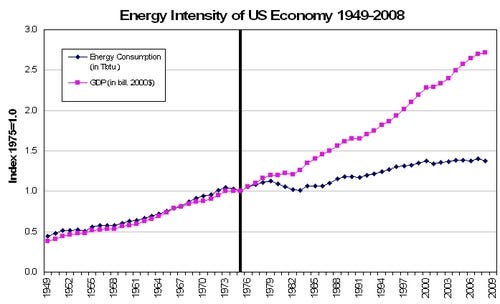
The typical degrowther argument is that in the past, GDP and resources use have always been tightly correlated. But this is just drawing a line through some data — it’s not based on any deep theory. And in fact, these correlations can change very quickly. Just as one example, here’s energy use versus GDP since 1949:
If you were sitting in 1970, you could look at this curve and claim, very confidently, that economic growth requires concomitant increases in energy use. And you’d be wrong. Because the trend is your friend til the bend at the end.
There’s simply no deep reason that economic growth requires increasing use of any physical resource. Economic value is all about the configuration of stuff, not the amount of stuff. If you took a hammer and smashed your phone to pieces, the resulting pile of trash would still contain the same amount of silicon and cobalt and gallium arsenide and so on. But now those resources would not be a valuable thing. Rearranging resources from a less useful configuration into a more useful configuration is what creates value!
Nowhere is this more clearly evident than software. Software is pure information — just 1s and 0s — but creating that information creates huge amounts of value. Software products alone are about 1.3% of world GDP, and the digital economy overall is over 15% of GDP.
Now, the digital economy doesn’t use 0 resources; you have to build the cables, launch the satellites, fabricate the chips, run the servers, and so on. But if the digital economy allows people to derive value from information in cyberspace rather than from physical stuff in the real world, it can increase GDP while cutting resource use.
Think of the classic movie American Graffiti. George Lucas depicts his memories of a 1950s world where young people have fun, hook up, and get social status by driving around in cars all day and all night. This is hugely resource intensive. Nowadays, kids can have fun with their friends by chatting, sharing stories, and playing video games online. They can use Tinder to hook up instead of cruising around. And they can get social status by accumulating Facebook likes, TikTok views, and Twitter follows. Thus, young people have been ditching cars for smartphones. That means less gasoline burned, less steel and aluminum used, and so on. But more fun ultimately to be had.
And, as long as capitalists find ways to make people pay for that fun, it means more GDP too. Dematerialization, not offshoring, is what has allowed U.S. GDP to continue to increase at a more-or-less steady clip even as we’ve reduced our usage of energy, fresh water, copper, aluminum, and other metals, as well as our carbon emissions.
The Metaverse is just that process taken one step further. The more fun or useful stuff you can do in VR — games, business meetings, vacations, hangouts — the less you’ll have to suck up physical resources to do it in meatspace. The more you can transform your subjective world by overlaying it with AR, the less you’ll have to suck up resources transforming your physical environment to suit your tastes. Thus, the Metaverse can help continue the decoupling of physical resource use from economic growth. The logical endpoint of all this, of course, is personality upload — completely digital environments with no need for any physical resource use except what’s needed to sustain the simulation.
But of course there’s a limit to dematerialization. Eventually you move everything online. At that point, does economic growth start requiring increased resource use once again — to run more server farms to create more virtual environments for more uploaded people, etc.?
Well, maybe. But maybe not. We just don’t know. It’s certainly possible for economic growth to happen in a virtual environment with no increase in real resource use. To see this, just do a little thought experiment: Imagine simply simulating the economic growth that has already happened on Earth.
Imagine that sometime far in the future, with highly advanced technology, we create a complete, physically exact simulation of the planet Earth in 1600 A.D., complete with the minds of 554 million digitized human beings. And then suppose we simply run that simulation forward, as the digital people develop steam engines, railroads, tractors, cars, airplanes, and so on.
This is a very real increase in GDP! The digital people are seeing their lives improve, and they’re paying for the improvement in digital marketplaces. There’s absolutely nothing fake about that GDP; a digital car that a digital person pays for in a digital marketplace represents every bit as much economic value as the real-world equivalent.
But note that although the use of virtual resources in the digital, simulated world is increasing in this scenario, the use of real-world, physical resources probably isn’t increasing. It probably does not take any more energy, or silicon, or gallium arsenide to faithfully simulate the world of 1900 than the world of 1600 (as long as you’re making sure to simulate the entire planet, particle for particle).
Of course, this example is impossible; we’ll never be able to make a simulation anywhere close to that big. But the thought experiment illustrates the key principle here: People in virtual environments can create economic value without putting any strain on the real resources of planet Earth. You can think up lots of more realistic examples of growth in virtual environments if you like.
Something like the Metaverse is key to that process, because actual production and sales of goods and services in virtual space will probably require a more immersive digital environment than we’ve yet created. As things stand, people may spend their time hanging out on Twitter and Facebook, but with a few exceptions, they still produce and sell stuff in the real world. The more complex and flexible of a virtual reality the Metaverse creates, the more humans will actually be able to innovate new goods and services within that reality. All of which will presumably require fewer physical resources than taking the train to your brick-and-mortar office and banging out code on a physical keyboard.
Now, can virtual worlds allow growth and innovation to continue forever — literally infinitely — on a finite planet? Well, the boring, stupid, angels-on-the-head-of-a-pin answer to that question is “No, because eventually the Universe will decay into heat death”. Another similarly boring useless answer is “No, because eventually the sun will explode and melt all the server farms.” And a third boring useless answer is “No, because the set of possible quantum states of a planet with finite resources represents a compact set, and thus any continuous function defined on that set must attain a global maximum”.
But if you think any of these cutesy answers has any relevance for real-world policymaking, you are a silly person, and your views should not carry weight in policy discussions. The actually important policy question is not “Can growth go on literally infinitely?”, but “Can growth go on for a very very very very very very very long time?”.
And the answer to that question is “Who knows?”. That depends on human desire, human ingenuity, and the set of possible technologies that it’s possible to create. Those aren’t things that can be predicted in advance. And if you think they can, consider whether even the most visionary cyberpunk author writing in 1992 could have predicted that people would be paying millions of dollars for tokens that say they confer ownership to digital art that other people just right-click and save? (Well, OK Rudy Rucker probably could have predicted it.) Currently, rich countries are increasing their GDP while decreasing their resource consumption; that’s an encouraging sign. Hopefully developing countries can go down that path much more quickly than today’s rich countries did, since they’ll have the internet much earlier in their development.
To sum up, we don’t actually know how much growth is possible for a given amount of resources. We need to limit resource extraction for environmental reasons, but we shouldn’t assume that this will cause a halt to growth. Instead, we should expect it to shift our production from bent pieces of metal to subtler means of enjoyment. The more we immerse ourselves in virtual environments, the less of a need we’ll feel to destroy the real environment. That’s why we should cheer the effort to create the Metaverse, whether it ultimately succeeds or not.
There’s a fascinating anecdote from when the British occupied India.
As the city of Delhi was infested with cobras, the officials offered a bounty on cobra skins. Soon, however, a cottage industry of cobra farming sprang up. People were breeding them for their skins.
So, while the British paid out more and more money, but the cobra infestation did not abate. Instead, the cobra farming only added to the problem.
When authorities finally got wise to the scam and withdrew the bounty, the farmers set their now-worthless cobras free. In this case, truly the road to hell was paved with good intentions – and cobra skins.
It is unclear if this is a true story. But, it makes for a great reminder of the power of perverse incentives.
One for us to keep in mind as we design incentives ourselves.
As we talk to others about our decisions, it is easy to buy into the narrative that we make “the best” decisions. Our way worked fabulously for us after all. Maybe you should do as we did?
Of course, that isn’t true.
Just because it worked for us doesn’t mean it’ll work for someone else.
In such conversations, it helps to replace talking about the outcome (i.e. the decision) with an explanation of the process of how we got there. Once we share what we were optimizing for and how we ended up where we ended up, it becomes much easier for those listening to figure out what would apply to their situation.
Understanding ourselves and making decisions that work for us is a good thing. If we’re going to talk about it, let’s focus on how we might be able to help someone else.
For years, every effort at generating energy from nuclear fusion generated no more than 3% of “ignition.” That means, for every 100 units of energy used to generate the reaction, the attempt produced no more than 3. We need at least a 101 for the effort to be net positive.
Then, a few weeks back, the National Institute of Ignition at the Lawrence Livermore Laboratory, did something unprecedented. A single laser shot shattered the record for the amount of energy product. Most importantly, energy produced was a whopping 70% of ignition.
As we figure out how to navigate the climate crisis with expected amounts of dysfunction (try getting large groups of humans to do anything together), playing offense with innovate technology is going to be just as important as playing defense by reducing emissions.
I hope this near-breakthrough accelerates funding for nuclear fusion. Cracking this would make for a giant leap in our efforts to create limitless clean energy.
There’s a lesson you learn when you assemble furniture – brute force is rarely the answer to your problem.
When it goes well, things seamlessly slot into the right place. If you’re finding yourself using brute force, there’s likely something you did wrong. So, more often than not, we’re better off retracing our steps and avoiding unintentional damage.
It is a learning that is applicable well beyond furniture assembly.
Periodic reminder to self – the goal isn’t to avoid mistakes. It is to avoid repeating the same mistakes.
If we’re trying different things and stretching ourselves, new mistakes and those embarrassing falls/stumbles are inevitable.
So, instead of spending time reviewing that dreaded highlight reel of all of our mistakes as we wrap up the week, here’s to celebrating the new mistakes (and the accompanying learning). :-)
Failure, after all, isn’t in the falling down. It is in the staying down.
The Atlantic featured an interesting article from Paul Bloom recently about what having kids does to a parent’s happiness. Here’s the TLDR:
(1) On average across multiple studies, parents reported a decrease in happiness and marital satisfaction.
(2) This happiness decrease is uneven however. It depends on how old you are, whether you are a mother or father, and where you live. Countries with good child-care policies have significantly higher scores relative to countries that don’t (the US reports the largest drops). Mothers report a steeper drop than young fathers.
(3) But, despite all this, parents still describe parenthood as “the best thing they’ve ever done.” There are two explanations. The first is memory distortion – we forget the pain and remember the peaks and ends. Another is attachment.
(4) “This relates to a second point, which is that there’s more to life than happiness. When I say that raising my sons is the best thing I’ve ever done, I’m not saying that they gave me pleasure in any simple day-to-day sense, and I’m not saying that they were good for my marriage. I’m talking about something deeper, having to do with satisfaction, purpose, and meaning.”
(5) “The writer Zadie Smith puts it better than I ever could, describing having a child as a “strange admixture of terror, pain, and delight.” Smith, echoing the thoughts of everyone else who has seriously considered these issues, points out the risk of close attachments: “Isn’t it bad enough that the beloved, with whom you have experienced genuine joy, will eventually be lost to you? Why add to this nightmare the child, whose loss, if it ever happened, would mean nothing less than your total annihilation?” But this annihilation reflects the extraordinary value of such attachments; as the author Julian Barnes writes of grief, quoting a friend, “It hurts just as much as it is worth.””
The sub title of the piece did a great job laying the stage for these takeaways – “Research has found that having children is terrible for quality of life—but the truth about what parenthood means for happiness is a lot more complicated.”
I was at a celebrated winery recently where they explained their approach to making wine. I knew little about making wine. So, it was all new.
One idea that I found fascinating was that they refused to irrigate their plants. The grapes are planted on a hill with limestone 10-15 feet below the ground. Limestone is known for holding moisture. So, the roots need to make it to the limestone and get the moisture directly from the limestone.
Our guide explained that this lack of irrigation defines their wine’s taste and character. The harder the plants have to work, the more resilient they become. And the more resilient they become, the more likely they create strong wine.