Our appreciation for life is proportional to the extent to which we’ve internalized both that it will end and that we have no idea when that might be.
Aspens and Pando
Aspen trees have got a fascinating “under-story.”

One aspen tree is a small part of a larger organism. A “stand” or group or “clone” of aspen trees is considered a singular organism with the main life force underground in the extensive root system. So, before a single aspen trunk appears above the surface, the root system may lie dormant for many years until the conditions are just right, including sufficient sunlight.
And, “Pando” – a clone of Aspen trees in Utah, is the single largest living system on the planet. This collection or clone of Aspens is spread across 108 acres and is one of the world’s oldest living organisms.
Mindblowing.
Air conditioning and Ronald Reagan
Author Steven Johnson tells a fascinating story about Willis Carrier. Working in a humid Brooklyn printing shop, Carrier needed to find a way to reduce the humidity so the ink didn’t run on the page. So he created a dehumidifier which seemed to also make the air cooler.
Before long, others in the shop wanted to spend time in the printing room because of how cool it was. That then led to the modern airconditioner.
A fascinating side effect of this is how it changed the population spread in the US. Suddenly, people could live in hotter places without worrying about dying of heat. Tucson, Arizona, grew 400 percent in 10 years, Phoenix 300 percent, Tampa, Dallas, Houston, Atlanta, population double, triple. Carrier’s invention was circulating people, as well as air, changing lives, changing America.
But then something even more interesting happened. People moving to the hot states were older and tended to vote Republican. And the growing population in the conservative South meant more Electoral College votes there. Between 1940 and 1980, Northern states lose an incredible 31 Electoral College votes, while Southern states gain 29.
Enter Ronald Reagan. As Steven Johnson says – “A very important component of Ronald Reagan’s election in 1980 is kind of the Sun Belt bloc of conservative voters that just would not have existed. It sounds crazy to be like, a guy in Brooklyn is trying to stop the ink from smearing on the page and it ends up helping to elect Ronald Reagan. But it’s actually just a couple of steps between those two things.“
Just a couple of steps indeed. A wonderful reminder of the power of unintended second and third order effects of past events that shape the forces that we see in play today.
Better feedback questions
“What feedback do you have for me?” is a commonly used feedback question that doesn’t perform well because of how open ended it is.
Two kinds of constraints help.
(1) “Do you have any feedback for me on the structure of my presentation?”
(2) “If you had to pick one thing that went well in that meeting and one thing that you’d suggest I do differently, what would you pick?”
Variant (1) puts a clear constraint on scope. Variant (2) puts a constraint on the amount of feedback you’re seeking – in effect helping the giver prioritize.
If you’re not getting high quality feedback, it might just be time to revisit the questions being asked.
Constraints and focus in our questions are leading indicators of clarity.
James Webb and the pale blue dot
NASA has shared the first images from the James Webb telescope.
This first image shows some of the most distant galaxies we’ve ever seen or studied (overview of the images are here).

“Carina’s Nebula” shows the process of the formation of a star.

“Southern Ring Nebula” shows the gas around a dying star.

“Stephan’s Quintet” shows a compact group of galaxies.

Seeing these images inspired awe and reminded me of Carl Sagan’s note on a view of the Earth in the Milky Way galaxy as a pale blue dot.
“It has been said that astronomy is a humbling and character-building experience. There is perhaps no better demonstration of the folly of human conceits than this distant image of our tiny world. To me, it underscores our responsibility to deal more kindly with one another, and to preserve and cherish the pale blue dot, the only home we’ve ever known.” | Carl Sagan
Peace with the undone
Peace arrives when we realize we’ll never get everything on our list done.
The only way forward is to prioritize.
The hallucinated model world
“We organize much of our lives around reassuring ourselves about the accuracy of the hallucinated model world inside our skulls.” | Will Storr, The Science of Storytelling
The Science of Storytelling has done a great job reminding me just how much of our lives are shaped by stories. The section that featured this quote, however, took it another level deeper as it pointed out just how central stories are to our identity and how we fight to reassure ourselves about them.
Mentality
Juan shared a deck by an anonymous artist with a few slides about mentality. Here are the 5 that resonated the most.
(1) “Keep at it.”

(2) “Just get started already.” I thought this was fantastic – so very true.

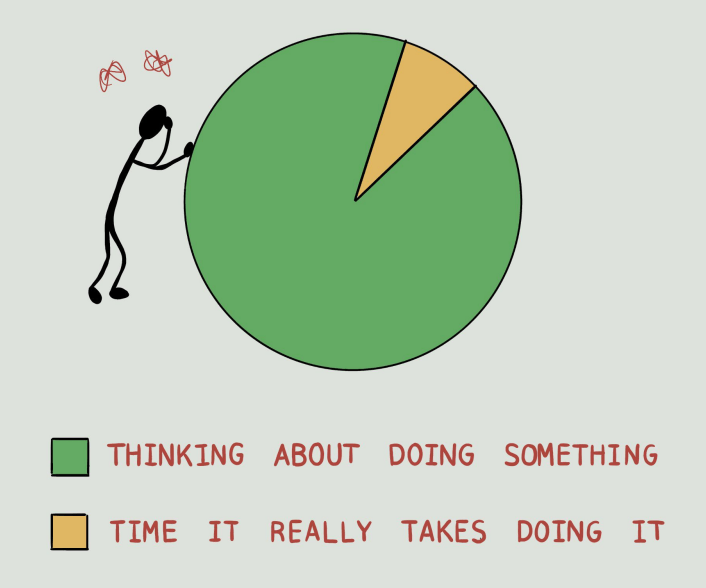
This illustration is a variation of the same idea.
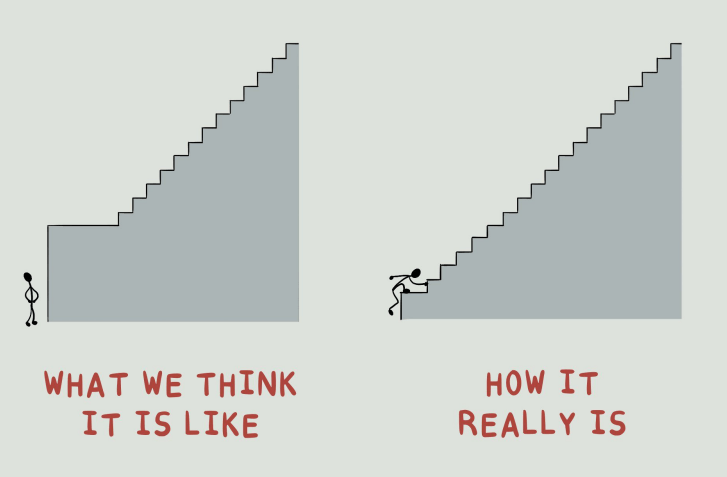
(3) “Don’t over-think it, just get started.”
(4) “Failing is not the falling down, it is the staying down.”

(5) “Make sure to look back and celebrate your journey so far from time to time.”

Kudos to the anonymous artist on this. And thanks, Juan, for sharing.
Parking in perpendicular spots
Angled parking spots are great. They make it easy for us to drive straight in.
Perpendicular spots – especially those that don’t have much room between rows of cars – require a different approach. Attempting to drive straight in and adjust is an exercise in pain.
Instead, we’re better off –
(a) turning into the next parking spot – stopping behind the parked car
(b) backing up and straightening
(c) and driving into ours

Perpendicular parking spots are a great metaphor for things we want on a day-to-day basis.
We can’t just walk in and get what we want. Instead, we need to take others into consideration, do some amount of zigging and zagging and even take a step or two backward to eventually get it.
No drama. Just part of the process.
Are we aligned on the problem?
The simplest way to understand if a team is aligned on the problem they’re solving is to ask every member to write out the problem statement and then share it with the group.
It is amazing how much downstream angst this simple exercise saves.
When in doubt, it is worth a try.

