I’m making my way through Walter Isaacson’s “The Code Breaker.” It is the story of Nobel Prize winning scientist Jennifer Doudna and her pioneering work in CRISPR gene editing.
I don’t yet have much in the way of lessons learnt from the book as much as gratitude for such an in-depth take into the research process of one of the greatest breakthroughs of all time. The iterative process of discovery, the collaboration between Doudna and Emmanuelle Charpentier and their respective research teams is a nice combination of fascinating, inspiring, and riveting.
The story illustrates the power of bringing together people with curiosity, single-minded determination, resilience, and a willingness to collaborate on thoughtful hypothesis driven experimentation.
It is a great reminder of an enduring idea – high quality teams, led by strong and capable leaders, can accomplish amazing things.
When asked about government subsidies, billionaire Elon Musk said“Delete them all.”
Marc Andreessen made waves when he funded Adam Neumann – who previously magically converted over $20 Billion in investments to a company worth $4 Billion – $350M pre-product to fix the housing crisis.
For years, Dan Price – the CEO of Gravity payments – built a massive social media following around leaders doing the right thing.
That’s all on one hand.
On the other…
… Tesla and SpaceX would not exist today if it weren’t for government subsidies. Tesla alone is estimated to have received over 2 billion dollars in government support.
…the same Marc Andreessen said he’s “IMMENSELY AGAINST” the development of ~130 apartment units in his elite town because they’d “MASSIVELY decrease” home values.
…Dan Price is being investigated for rape and multiple counts of sexual assault.
While such inconsistencies are especially commonplace amongst those with extreme fame, wealth, and power, they are on display all around us.
Two implications for us:
(1) Remember that things aren’t what they seem.
(2) Don’t listen to what people say. Watch what they do.
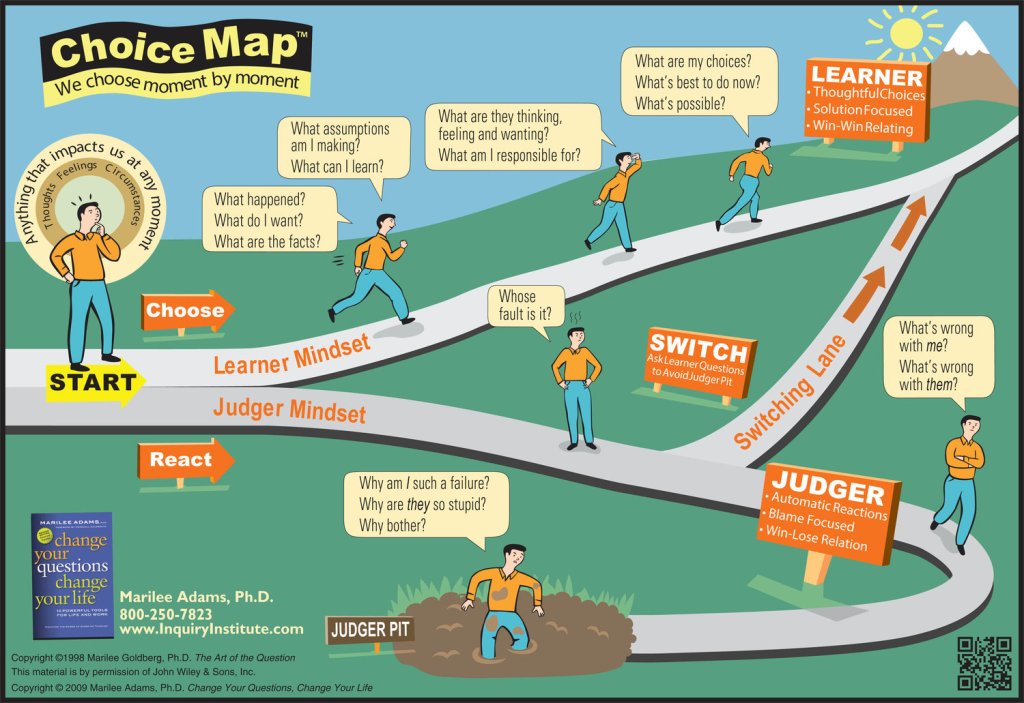
Years after first reading about it, I keep coming back to the Marilee Adams’ Choice Map from time to time. It is the single best illustration of Carol Dweck’s “growth mindset” in action. Dr. Adams’ map shows the difference between asking “learner” questions and “judger” questions.
I was recently thinking about this map and realized that the difference between the two can be boiled down into one word – constructive.
The learner path is constructive because it creates forward momentum and energy. The judger path, on the other hand, has the exact opposite energy. It sucks all energy and takes us straight to that judger pit.
The judger path is all about the reaction. The learner path is all about the response.
A note for new subscribers: This post is part of a series on my notes on technology product management (this is what I do for a living). You might notice that these posts often link to older posts in the series on LinkedIn even though they are all available on this blog. That is intended for folks who only want to follow future product management related posts. Finally, for all those of you who don’t build tech products for a living, I believe many of these notes have broader applicability. And I hope you find that to be the case as well…
——————————————————————————————————-
A quick overview of what we’ve covered on “Notes on Product Management” so far –
We’ve talked about 4 skills as critical to the life of an IC/individual contributor Product Management – problem finding, problem solving, selling, and building effective teams. Over the past 36 editions, we’ve teased out how each of these skills break down into a series of sub-skills (e.g., problem finding requires empathy along with the ability to build strategy which breaks down further into a few sub-skills). At some point in this journey, I intend to lay out the entire map of sub-skills. But, in the meanwhile, it is time to spend time on a sub-skill that – along with empathy for the people who use our products as well as those on the team – is wins the prize for the most critical sub-skill -> Writing.
There are 3 reasons writing is critical to a Product Manager’s job:
(1) It improves our thinking: Writing is both reflective of and improves the quality of your thinking. The word essay comes from the French word essayer which means to try. When we write long form, we effectively try to figure something out. It is why most good documents take many iterations to get right. It takes time and effort to improve the quality of our thinking. That quality of our thinking improves the quality of our work and the products we end up building.
(2) It is how we build leverage: A well-written document or weekly update scales and is the simplest and most effective form of driving leverage in any given week. We’ve talked about leverage being the most important goal for a product manager as we aim to bring cross-functional teams together to solve valuable problems in ways that are usable and feasible – given our unique constraints (there always are many!).
Writing helps us share our point of view, bring people along, and replace ambiguity with clarity. This is especially important considering most of us spend some proportion of our time working remote. The more the physical distance between teams, the more important our ability to write.
(3) It helps us write better copy. Learning to write better impacts our products too. The more we develop a spidey sense for what is good copy vs. what isn’t, the clearer and more effective our products become.
Okay, you’re convinced – now what?
There’s a unifying principle that brings together the steps we’re about to discuss. “Each person should write 5x more but write 5x less.” (H/T: Mike)
This means we all would benefit from writing a lot more than we do right now. But when we write, we also need to convey what we’re going to say in significantly fewer words. This dual push to both writing more while writing concisely is at the heart of honing our craft.
Luckily, there are also 5 concrete steps we can take to become better writers.
(1) Start early and leverage subconscious processing/the Zeigarnik effect.
The Zeigarnik effect – named after Dr Bluma Zeigarnik – identified our mind’s propensity to subconsciously work on completing tasks we started. This is why stopping a song half-way can get it stuck in our heads for the rest of the day.
The Zeigarnik effect is incredibly useful in our attempts to write better. Every time we realize we need to write a document or an update, open up a blank sheet and type in a few sentences. That act alone ensures we’ve started on the task. Whether we continue it the next day or the next week, our minds would have already progress thanks to subconscious processing.
(2) Choose to develop a reputation for concise documents by adopting artificial constraints
A great document does not have to end in 1 or 2 pages. Nobody will sweat an extra half page. But adopting these artificial constraints go a long way in our ability to write concise documents. They force us to think creatively about communicating ideas and inspire clarity through brevity. They’ll also drive home a simple lesson – if we can’t make our point in 1-2 pages, what are the odds we’ll do it in 10?
As time passes, we’ll also get better at differentiating between content in the main 1-2 pages and supplemental content that goes into the appendix. For example, the appendix is a great place to document “FAQs” or frequently asked questions. As you share a doc and get a raft of comments in, it is easy to fill up this FAQ section with questions from commenters.
Adopting artificial constraints enforces a certain rigor and discipline in our writing process. I think that rigor/discipline creates consistently higher quality work.
A note on formatting: I think of this discipline in formatting too. For example, every one of my documents has 0.5″ margins and uses Source Sans Pro x 10 point font x 1.15 line spacing. I use one of Google docs’ default blues for section headers and use italics and underlining sparingly to make points. That push for visual simplicity helps remind me to choose simpler language and shorter sentences.
Also, this approach to constraints means “pageless” formatting is a deal breaker in my book. :-)
(3) Use simple and repeatable narrative structures
Most documents I write have one of 2 narrative structures:
(1) The strategy narrative: The flow is -0
Problem and opportunity statement: Details the problem (user and need/job to be done) and the opportunity to solve the problem. The only key here is to have clear user data/insight that makes it unambiguously clear that it is a real need.
Lessons learnt/Key insights: I look to share 2-3 lessons learnt or key insights – could be driven from the market or more commonly from internal data or research. Each lesson translates to a hypothesis that becomes a strategy pillar.
Success metrics: Outline true north, signpost (i.e., metrics we expect to move that we think will move the true north metrics), and guardrail metrics
Product principles: Key implications from organization-wide and project specific product principles.
Strategy and roadmap: Detail key initiatives with projected impact in a simple table that share how they fit into the strategy. A key part of this table is detailing what we will NOT do. This is also where we link to the design vision/narrative.
Risks: Because there always are some.
There’s more to talk about on the subject of strategy docs and the challenges with getting some of these sections right. We’ll aim to cover that in a future post. For now, though, the important part is having a simple and repeatable structure that enables us to focus on the content and articulation.
Note on formatting: Every once a while, the nature of the text in the doc or the presence of images that describe certain sections will make it easier for the doc to be in “landscape” vs. “portrait” mode.
(2) Situation – complication – action (includes escalations): The other common narrative structure involves describing a specific problem and our plan to fix it. This follows a 3 part structure:
Situation: Share the context/background – e.g., we need a particular API to deliver reporting to our customers.
Complication: This gets to the exact problem we’re facing – e.g., the API has been unstable and is causing workflow breakdowns.
Action: Here’s what we’re going to do to solve this problem – e.g., we’ll do x in the short term and y and z to solve this for good.
As you can see in the template, these can also be used to write out escalation documents with minor changes to the narrative structure.
(4) Develop a sense of pride in your ability to rewrite docs. Stephen King had a great quote to describe the writing process – “Write with the door closed, rewrite with the door open.”
Your documents start out with just you and your story or argument. But, once you get the essence of the argument out of you, it then belongs to everyone who you intend to read it and anyone who wants to read it and be influenced by it. Or criticize it. If you do your job right, more people will want to do the former instead of the latter.
I believe that happens when we develop a sense of pride in our ability to rewrite documents when we realize our intended message isn’t flowing through. Some documents can take 10 to 15 rewrites before we get it right.
That sense of pride replaces groans when we get feedback (the default state) with curiosity and enthusiasm about the prospect of landing our message better.
(5) Write like you talk. Often.
Seth Godin shared an incredible post a decade ago called “Talker’s Block.” In it, he observes that nobody gets talker’s block. Why, then, is writer’s block so endemic?
As he shared in another insightful post, this word didn’t exist till 1940. Writing was a hobby for most people – so there wasn’t fear associated with it. Now, however, we all write. As a result, the fear has grown proportionally.
In Seth’s words – “We talk poorly and then, eventually (or sometimes), we talk smart. We get better at talking precisely because we talk. We see what works and what doesn’t, and if we’re insightful, do more of what works. How can one get talker’s block after all this practice?”
So, if we want to avoid writer’s block and get better at this craft, we just need to sign up to write like we talk. Often.
For Product managers, this means –
Send weekly updates. Share something interesting about your product area, your target user, or even the market. Tell us what we should know about your work and why it matters. Get creative with the format to make it interesting if needed or mix it up. But send it consistently.
Always work on that strategy doc. Strategy docs aren’t written on stone tablets. They need to be constantly iterated on. You might make major changes on a 12-18 month timeline. But you’ll want to keep clarifying those docs and iterating regularly.
Ship 1 new doc every two weeks by writing every time you sense disagreement on confusion. If you take every opportunity to write, you’ll likely write one new document every two weeks. Some of these will just be for you. Others will make it to your team. Take every opportunity to write.
Write about your side projects outside work. If writing documents at work is too much pressure, work on this skill outside work.
If there’s a theme in all of this, it is aiming for quantity. That quantity will help us develop our own style and inspire the quality we seek. It also will help us get to that quality much faster over time.
Write 5x more. We’ll then learn how to write 5x less. With high velocity.
——————————————————————————————————-
As with any craft, there are experts who’ve taken the time to share their advice. Here are a few books that have resonated with me:
(1) The Pyramid Principle by Barbara Minto: Barbara Minto’s book was a game changer. The two biggest takeaways from this book for me were – (1) Start with the executive summary/headline and (2) Expect high quality writing to show up after you rewrite that first draft that you created for yourself.
(2) The Elements of Style by Strunk and White: My grasp for grammar isn’t particularly strong. This helped.
(3) Several short sentences about writing by Verilyn Klinkenborg: This book was a beautiful reminder of the importance of starting with a focus on getting the atomic unit of writing – the sentence – right. It is also a critique of the heavy-handed Strunk & White school of teaching as it pushes us to identify and embrace our own way. It is nice to read it after “The Elements of Style.”
In addition, I’ve been halfway through Stephen King’s “On Writing” for a long time. I do intend to finish it. And I’ve heard great things about “Draft No. 4” by John McPhee.
Perhaps, most of all, I’ve learnt from attempting to write myself. I’ve been writing every day on this blog since May 2008. This practice has been life changing.
We’re all walking every day on this journey we call life.
Some days, the terrain is uphill.
On others, the terrain is downhill.
Both present different kinds of challenges. Going downhill, for example, feels great. But it also strains our ankles.
On some days, the terrain feels uphill. And on others, it feels downhill.
So much of our ability to make progress in this life lies in our willingness to just show up and keep walking – regardless of the nature of the terrain and how we feel on any given day.
Our discipline, mental fortitude, and ability to keep perspective help us transcend these variables and extenuating circumstances – both of which are ever present.
They help us find the strength we need to pick our direction and keep walking.
And then show up again tomorrow regardless of how good or bad today was or felt.
It is harder than it sounds.
But then again, life is difficult.
It is only when we accept this truth do we learn to transcend it.