
Specialist styles and strengths

“At the highest levels of any kind of competitive discipline, everyone is great. At this point the decisive factor is rarely who knows more, but who dictates the tone of the battle. For this reason, almost without exception, champions are specialists whose styles emerge from profound awareness of their unique strengths, and who are exceedingly skilled at guiding the battle in that direction.” | Josh Waitzkin, The Art of Learning.

I love this note.

Josh, a child chess prodigy, describes the process of his falling out of love with chess beautifully in this part of the book. A big part of that was being coached to play in a style that didn’t suit his strengths or natural approach.

But, to his point, it is an idea – like all great ideas – that has widespread applicability. Leading teams, for example, works just the same way. The best leaders lead in a way that suits their style in contexts and organizations that suit their strengths.

Understanding ourselves and placing ourselves in teams and contexts that suit our unique strengths may be among the most important things we do.
Small goal posts and simple shots

I joined a couple of folks who were kicking around a football/soccer ball in a park with a couple of small sized goal posts. There was a spunky young kid playing in goal with 3 of us taking shots.

When the ball was passed to me, I curled a couple of beautiful goals in. Top corner, hard to stop.

A few minutes later, a bigger adult swapped as the goalkeeper. My remaining 3 shots were all over the place – nowhere near the goal.

Somehow, the sight of the bigger goalkeeper got me shooting everywhere but the goal. In my attempts to outdo this keeper, I couldn’t get the basics right. In that process, my odds of beating this keeper went straight to zero.

It got me thinking about how we can often lose battles completely in our heads. More often than not, simple is best.

But simple is hard.

Lemonade enthusiasm

Of all the skills that are most useful to live a good life, I think the ability to consistently take the many lemons life throws at us, figure out how we can make and sell the lemonade with what we have available around us, and do so with unending enthusiasm is the most useful skill of them all.

You don’t always get good lemons and you definitely don’t have all the tools you need. But that’s also when we realize that being constructive and enthusiastic are worth at least 25 IQ points.

Choice and perspective

Happiness is a choice.

Joy is a choice.

Optimism is a choice.

Yes, some are biologically more likely to skew toward these. And yes, some have the circumstances (where they were born, who they were born to) that make it more conducive more these choices. Privilege helps.

But, and here’s that but, choosing these requires perspective.

And perspective cannot be handed from one person to the other, it is earned. It is the gift at the end of adversity and reflection.

There’s always a reason to be glum. There’s always a reason to complain. Things are never perfect. We’re constantly dancing with the suboptimal – balancing risk and uncertainty.

That is when that earned perspective that helps us take stock and consistently find reasons to be optimistic and grateful… and find the joy, peace, and equanimity that we seek.

Simple and opinionated

I often think about choices we make as product designers as a series of trade-offs. One code trade-off is around how much we want to design for the power user.

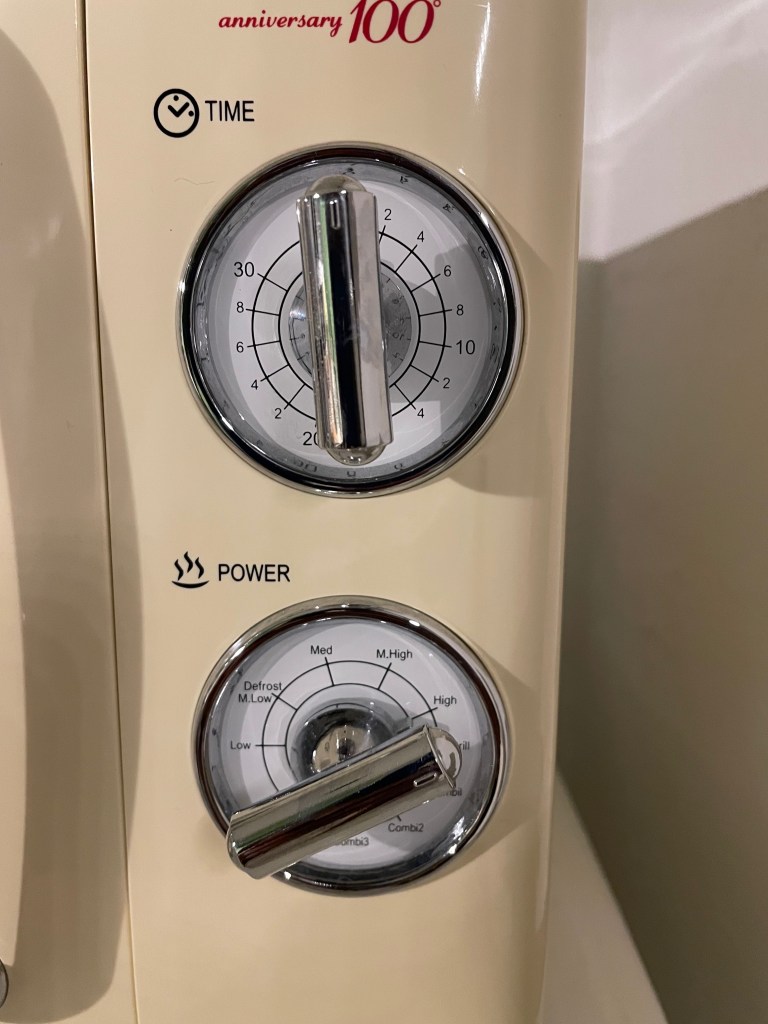
I’ve often thought about that trade-off when I’ve operated microwaves. Microwaves have gotten so complicated with an ever expanding set of options. However, if I had to guess, over 90% of the usage is some version of the “add 30 seconds” or 1 minute button.

This microwave’s design brought that trade-off to light. All this microwave does is allow users to change power level and time with a simple dial. No learning curve required. It just works.

It won’t work for the person who wants to use the microwave to defrost something. But for most folks, it’ll probably do the job.

I loved this design because it beautifully illustrates the trade-offs we need to make when we make our products simpler. We’ll effectively be telling some group of people “this is not for you.”

And that’s both okay and why building simple product is hard.

Simple product is opinionated product.

To carry or not to carry

Sometimes, we find ourselves in situations where we’re debating whether or not to carry something with us. Should we take a cap or that extra bottle of water when it doesn’t feel like it’ll be needed?

If you’re debating whether to take something with you and the cost of carrying it is low, the optimal decision is to simply take it with you.

If you don’t end up needing it, the cost was low anyway.

And if you do, you can now feel great about your decision making and skip cursing yourself for not acting on an impulse.

Share wifi password

One of my favorite delight features on the iPhone is the ability to easily share wifi passwords. This could happen when a guest asks for your wifi at home or when you’re traveling to a new place. Trying to relay an alphanumeric password is a high friction experience.

But not anymore.

Once you have the wifi working on your device, all the other person has to do is to go to settings and click the network. You’re immediately asked if you want to share the password. And then you’re presented with this lovely confirmation.

Repeat as many times as needed.

I’m sure this little feature competed with many other small nits/requests on the product team’s backlog. I’m so glad they prioritized and shipped it.

The simplest way to delight a user is to reduce friction.