1 line checkouts are much better than multiple line checkouts – MBA Learnings

A few weeks ago, I wrote about why queues form. The one line answer is that they form because of statistical fluctuations and dependent events. The concept is simple – if your presence at a meeting is dependent on the previous meeting and the average time in the meeting is variable, it is likely that you’ll have people waiting for you, on average.

There’s a really cool application of this principle when it comes to checkout lines in stores and supermarkets. Multiple line checkouts are woefully inefficient.

So, if the supermarket next door replaced multiple checkout lines and replaced it with 1 line, it could reduce your waiting time to approximately 1/3rd your normal waiting time. Why? Because longer lines minimize variability. If you are stuck in a short queue with 2 coupon sharks who take forever to pay, your average waiting time becomes very long. Such variability is minimized in a single queue as it is unlikely you have a coupon shark at every checkout counter.

The beauty about 1 line queue systems is that it also feels fair. We all hate it when we see that other queue go much faster. The downside, however, is that single queues can look and “feel” really long. So, the conventional wisdom is to have multiple queues because long lines can turn off customers.

Whole Foods in Manhattan, however, decided to just ignore the conventional wisdom ten years ago and implement the more efficient single queue checkout. It has worked fantastically well for them. And, now you know why.

Whole Foods Manhattan(a line manager at Whole Foods Manhattan who makes sure people move quickly to the nearest open register)


Conflicting incentives – MBA Learnings

In my last post about the tension between debt, shareholders, management and taxes, I ended with a line that leads straight into today’s post – “But, if there’s one thing I’ve learnt about markets, they’re rife with conflicts of interest.”

Let’s now take a look at the life of John Doe. John is an executive at a leading Fortune 500 company headquartered in the US. He gets paid $1 million in cash, 4 million in stock, and 20 million in various incentive related bonuses that are tied to “EPS” or earnings per share.

Now, let’s think about the many decisions he needs to make as a CEO that impact other constituents –
– How much debt should the company take on?
– How much tax will the company pay? (vs. how much of income will it recognize in low tax jurisdictions?)
– Should we pay dividends or repurchase shares?
– Should I take riskier investment bets or less risky bets?

Every one of these has an implication on the company’s profitability. And, a company’s profitability directly affects it share price. However, they do so in different place.

Let’s take dividends vs. share repurchases. When John’s company has a $100 in extra cash, they can either choose to pay the money in dividends to shareholders or choose to buy back their own shares from shareholders. Technically, they are both ways of returning money to shareholders. However, dividends inevitably reduce the share price (a company’s share price reflects the value of future cash flows – less cash available = less share price) while share repurchases generally have a positive effect on EPS.

While there are other impacts of making a dividends vs. repurchase decision, this difference alone highlights a conflict of incentives. John Doe and his executive team are often compensated on EPS. And, the markets often price stocks as a multiple of EPS. So, when the firm increases of EPS, it inevitable leads to an increase in share price. Now, it is great when that happens because of excellent management and/or smart investment bets. But, financial re-engineering, e.g. taking on excess debt, avoiding taxes, and/or repurchasing shares vs. paying dividends can also increase executive compensation significantly. John knows that he’s, at best, got a few good years as the CEO of this firm before he inevitably gets fired. So, why not make the most of it and swing these decisions in his favor?

There’s been a lot of discussion in the news about executive compensation as such decisions frequently come under scrutiny. In some ways, these conflicts make the markets fascinating. In other ways, they can make us cynical about decisions made by companies. My take has been to examine decisions more carefully to really understand what is going on and to understand the incentives in place. More often than not, the behavior we reward is the behavior we get.

One final plug on executive compensation – there are huge implications on the importance of ethics in these conversations. There has probably been an uptick in these conversations post the Enron debacle. I don’t think these conversations happen nearly as often as they should.

The tension between a debt tax shield and costs of financial distress – MBA Learnings

There’s been a lot of news over the years around companies who book their revenues in foreign entities and avoid taxes. Amazon, Starbucks, Google and a few others have been tried in courts because of an inordinate amount of revenue booked in Luxembourg. Let’s take a few moments to deconstruct this –

Let’s imagine a company earns $200 in revenue. Let’s also assume costs are $100 => Profits are $100 as well.

Now, the $100 is subject to tax. So, $30 goes to the government (assuming a 30% tax rate) and $70 goes back to the company as after-tax profits. If the company is a fast growing company like Amazon or Facebook, it’ll generally choose to re-invest the amount in growth. And, if it is a slower growth company, a large portion of this amount generally finds its way back to shareholders.

Given the incentives in place for the shareholders to maximize their wealth, the 30% tax is an “unnecessary burden” (if you take the point of view that taxes are nothing but a waste of cash forgetting that it is taxes that provide the infrastructure for businesses to thrive). As a result, companies typically adopt 2 common strategies –

1. Take on debt. Even if our imaginary company doesn’t really need debt, it takes on $1000 of debt. Assuming a 5% interest rate, it now has to pay out $50 this year. As a result, its profits are now $50 => the amount paid in taxes is halved to $15. Shareholders are happier.

However, debt comes at a cost. Let’s imagine this company invests the $1000 in a risky venture that doesn’t work. Now, it has to pay interests out of its core business profits. The good news is that it has a strong core business and the interest amount doesn’t dwarf the profits of the core business. So, in this case, we’re safe. However, when companies take on huge amounts of debt to fund large investments, they can often end up paying a lot more than interest in the form of “Costs of Financial Distress” or “Bankruptcy costs.” This happens when the market believes its debt burden is too high and the stock begins losing value.

The takeaway here is that there is an optimal amount of debt for every company where the benefits gained by paying lesser taxes are lesser than the costs of financial distress. That’s why capital structure (the ratio of debt to the overall value of the firm) matters.

2. Create foreign subsidiaries. If Luxembourg offers a 0% tax rate, it pulls companies toward investing in a foreign subsidiary based out of Luxembourg. This way, our imaginary company’s tax payers don’t lose any value to taxes. The only condition here is that the money earned in Luxembourg has to stay in Luxembourg. If the company tries to bring it to the US, it’ll have to pay the 30% in taxes. Large multinationals don’t have problems doing this, of course. There are plenty of local investment opportunities.

So, as companies become increasingly global, we’re going to see more of the foreign subsidiary strategy brought in to play. Given a company’s incentives, it is common sense to optimize its tax payments because its value in the market is driven by the value it returns to its shareholders. This conflicts with the interests of the regulators, of course.

But, if there’s one thing I’ve learnt about markets, they’re rife with conflicts of interest.

Statistical fluctuations and dependent events – MBA Learnings

In last week’s MBA learning, we dove into the idea of managing queues by managing our utilization. In that post, we briefly discussed why queues form. Today, I’d like to dig deeper into that question.

So, why do queues / delays occur? They occur due to a combination of statistical fluctuations and dependent events. In simpler terms, statistical fluctuations can be described as variability. If we go back to the analogy of the ice cream stall, it is unlikely that the queue is exactly 5 people through the day. There will be times when the queue will be long and then times when it will be short. These differences are statistical fluctuations.

Life in the world of managing queues becomes harder when you combine statistical fluctuations with dependent events. A beautiful example of this combination at play is demonstrated in this 1 min 46 sec video called “The Subway Delay Story” by the MTA, New York’s subway operator.

In this video, the sick passenger requiring assistance and an emergency stop is an example of variability. And, every train behind the held train is a dependent event.

Another simple example of statistical fluctuations and dependent events at play is in connecting flights. We all have probably experienced delays in one flight that results in a chain reaction of delays in other flights. As a result, most airlines experience a deteriorating performance in their arrival times as the day progresses.

So, what can we do about statistical fluctuations and dependent events? Well, books have been written on the subject, So, instead of attempting a comprehensive answer, I’m going to share my simplified set of 3 ideas you can apply immediately in your life –

1. Be sensitive to the combination of statistical fluctuations and dependent events in your own life. One simple application would be to avoid scheduling back-to-back meetings through the day. It is inevitable that one of them will spill. And, this, in turn, will result in a chain reaction through your day.

2. Control for statistical fluctuations / variability by building in safety capacity. This is a continuation of the idea of reducing your “utilization” and building in safety capacity. So, if you are scheduling many meetings during the day, leave little gaps in between so you can catch up on delays caused by fluctuations.

3. Look for creative ways to reduce variability. Disney offers “fastpass” tickets to various rides that allow customers to skip the queue at these rides at certain times. These times are designed such that groups of customers are incentivized to go to these rides at different periods during the day – thus, reducing the likelihood that everyone shows up at the same peak time. The equivalent in our personal life would be to plan ahead and avoid deliverable “peaks.” If you foresee two projects coming due in the same week, finish one up a week earlier and treat yourself (equivalent to the fastpass) so you avoid the peak rush.

And, finally, look out for statistical fluctuations and dependent events in the coming week. It changes the way you think about queues. And, if that isn’t magical, what is?

Managing queues – MBA Learnings

I’ve been sharing a run of Operations learnings of late as a part of this series. This has been surprising as I never considered myself a fan of the subject. However, thanks to a combination of a Professor who’s more than managed to pique my interest and a realization that learning to manage business operations isn’t very different from managing life operations, I’ve enjoyed my time studying Operations. And, today’s topic is managing queues.

Managing queues is particularly interesting as we all experience, and generally dislike, queues. The average wait time in a queue is given by the following formula –

Queue formulaTo break down each of the parts of this formula in simple terms (with an analogy of a queue at an ice cream stand)-
– Mean service time is the amount of time taken by the person serving the queue
– Utilization is the amount of time he/she spends serving out of his/her total time on the job
– Variability (more on this later) is a measure of how steady the demand is. If people enter the queue steadily through the day, it is much easier to deal with demand versus random fluctuations

Things get interesting when we study the effect of utilization on increasing waiting time. This graph, from HBR, illustrates it beautifully –

What this graph is saying is that waiting times more than double when your solitary ice cream server is working 80% of the time. It doubles again when he finds himself working 90% of the time. Why? Because delays are caused by sudden fluctuations in the queue, e.g.,  a mass of tourists that come in to buy ice cream in the midst of their city tour. And, since our solitary server has no spare capacity, it is inevitable that waiting times go up.

So, if you are staffing your restaurant, for example, and if you find yourself running at 100% capacity all the time, that may not be the best thing for your customers since it is inevitable that waiting time goes up. (If you are an exclusive restaurant, it may not be a bad thing – that’s a different matter.)

The insight in managing our personal lives is pretty profound – if we organize ourselves such that we always find ourselves running at 100% capacity, it is inevitable that queues will build up on our plate. That’s because work doesn’t arrive at a constant rate. An emergency project is bound to show up and, if we’re running with no safety capacity, that could be a problem. Additionally, we’ll never have the bandwidth to deal with other sorts of fluctuations that may occur outside work – a family member that gets sick, a friend that needs help, etc. So, it is a good idea to maintain safety capacity.

And, how do you do that? Learn how to scope projects well. I had a manager who was a master at making sure we needed no late nights to get to the finish line on our projects. He believed our best work was done when we were relaxed. He reiterated that he’d rather we build models slowly, but accurately, rather than fast and requiring multiple revisions. He also believed we should always be able to deal with issues that come up with minimal stress. And, of course, he consciously developed this single skill that, in my opinion, distinguishes great managers from bad ones.

In short, he understood the importance of safety capacity. We should, too.


Optimizing proxy measurements – MBA Learnings

In our Operations Management class, we discussed how Wilson tests the durability of its tennis balls. It does so subjecting them to pressure and checking for signs of contortion in the shape of the ball. It isn’t possible for Wilson to put each ball through hours of tennis hitting and then confirm it is ready for sale. So, it works with a proxy measurement. It is unclear if customers can tell the difference between a tournament standard ball and a non-tournament standard ball. Perhaps professional tennis players can.

There isn’t necessarily an issue with this proxy. It seems to have largely worked out okay for them. But, it is a proxy measurement nevertheless. And, it is foreseeable that there might come a day (if it isn’t already here) when the distance between the proxy and the needs of the customer grows and Wilson fails to adapt simply because it is optimizing for the wrong thing.

Proxy measurements such as the Wilson durability test are critical in Operations. Proxy measures are critical in our life’s operations, too. They’re our attempt at simplifying a complex world and making our lives easy to navigate. As I was thinking about proxy measurements, venture capitalist Fred Wilson had an incredibly insightful (and timely_ post today around using entrepreneurs using valuations as a scorecard on his excellent blog. In Fred’s words –“When you set out to build a great company, it’s hard to know how you are doing along the way. There does come a time when you know you’ve done it. Apple, Google, Facebook, Amazon, Salesforce, Tesla, etc got there. We know that. And the founders of those companies know that too. But two years in, three years in, four years in, it’s hard to know how you are doing. The market moves quickly. Customers are fickle. Competition emerges. Trusted team members leave. Your investors flake out on you. And so on and so forth. So entrepreneurs want something they can hang on to. They want a scorecard. A number. Validation that they are getting there.”

He notes that valuation is that scorecard. This idea is perpetuated even more so these days when financing and the valuations are reported every day as the most important news items in the tech blogs. And, then, he describes the dark side from decades of experience as a leading venture capitalist –

“This obsession with valuation as the thing that tells you and the world how you are doing has a dark side. And that is because valuation is just a number. Unless you sell your business for cash at that price, valuation is just a theoretical value on your company. And it can change. Or you can get stuck there trying to justify it year after year all the while doing massive surgery to your cap table to sustain it. 

And the markets can move on you and one day you are worth $2bn and the next day your are worth $500mm. Did you just mess up by 75%? No. The market moved on you.

The message of this post is don’t let yourself get sucked into a world where a number is your measure of self worth. Because you don’t control that number. The market does. And some days the market is your friend and other days it is most decidedly not your friend.

Measure yourself on whether your employees are happy. Measure yourself on whether your customers are happy. Measure yourself on how much free cash flow your business is generating. Measure yourself on how your brand is known and appreciated around the world. Measure yourself on how your spouse and children feel about you when you come home from work each day. You control all of those things, at least to some degree.

But please don’t measure yourself on valuation. It might make you feel good today. But it won’t make you feel good every day.”

Fred’s post beautifully illustrates the issues with proxy measurements. It is easier to treat income and a job title as a measure of success or a valuation as a measure of our self worth. It is much harder to identify and measure the things that actually matter – happiness, love, and so on.

But, beware what you measure. Because, what you measure will be what you optimize for.. and the worst outcome is a life spent optimizing all the wrong things.


Lean operations in real life – MBA Learnings

In the past week, we’ve been deconstructing the idea of “Lean operations” in our Operations Management classes. Lean, for the uninitiated, is a way of operations pioneered by Toyota’s legendary founder Taiichi Ono. It was simply called the “Toyota Production System” till academics from the west re-branded it as “lean.”

Lean embraces the idea of “kaizen” or continuous improvement. The process behind Lean improvement is illustrated by the image below –

Photo credit – Handsongroup.com

The concept illustrated here is that having large amounts of inventory can hide the issues in the system. The best way to understand and fix problems is to gradually lower the inventory level. As soon as we do that, we start bringing problems to light and can begin the process of continuous improvement. It is critical that we don’t bring the water down all at once as it is impossible to fix everything together. In fact, yesterday’s solution is, very often, today’s problem. So, it has to be one at a time and it has to be continuous.

The beauty about learning Operations Management is that every learning has a direct application in our daily lives. There was an interesting article on 99U.com titled “Don’t work harder, work faster” – inspired by social media consultant, author, investor and speaker Gary Vaynerchuk. This is Gary talking about the idea of working faster –

“I always tell people to start working harder, to hustle. I truly believe that people could watch an hour less of Scandal and instead do some f****** work. But there’s another variable that I don’t talk about enough: be much faster in the hours you’re already in. Train yourself to do a little bit more in each hour than you normally would. Every day add something, and get it all done. The first few days you may not get it all done, but keep adding on, and you’ll get there. It’s training for a marathon. It takes time, but once you’re done, you’ll see that you’re doing much more in a day because you’re moving faster.”

That’s lean operations in action. Even though I am nowhere close to as prolific as Gary, that’s been my experience with thinking about a learning every day too. Over these years, it’s been a gradual process of thinking about ideas like productivity and making small tweaks that have all added up over time. I feel myself getting through larger volumes of work than I ever thought possible a few years back and, yet, seem to be able to make time for sleep, food, exercise, read and even meditate for 15 minutes. This was in complete contrast to my life just three years ago – I’d barely manage 7 hours of rest, exercise half the amount I do now and never find time/space to meditate.

Small improvements over a long period of time add up. That’s what makes Lean and the idea of “kaizen” really powerful. It isn’t a one shot “to do” list item though. It is like taking a bath – you need to take one every day.

Lean is a way of life.

The Good Life Sessions – MBA Learnings

I wrote about the idea of searching for the good life 3 weeks ago. That was the day we conducted the first of three “Good Life Sessions” in school. It was a fascinating process and experience for a few reasons.

First, I have never seen this topic tackled. Books have come at it from various angles but there was no ready made content or structure we could use. So, both the roots as well as the structure came from personal experiences. That always makes it interesting because personal journeys are rarely similar. That said, there are underlying principles that we can extract.

So, in some ways, we never set out for this to be perfect solution to anyone seeking the good life (that would either be a result of extreme vanity or foolishness – depending on your point of view). Instead, we framed this as a way to get exposed to tools and frameworks that would hopefully get our attendees thinking about these things and help them on their journeys. At the end of the day, designing a life you consider “good” is a personal endeavor. There’s no tool or template that will solve it for you. However, there are principles that you can apply. And, we tried aggregating these principles in these sessions.

We broke the idea of “the good life” down by asking 3 questions. As a special gift to you, we’d like to share the worksheets we worked through during the sessions. Each of the links lead to the worksheets –
1. What do I value?
2. How do I find my personal mission? (Mission statements examples sheet)
3. How do I create an action plan to live a life consistent with this mission?

We worked hard to keep it simple. Hopefully you’ll find it easy to understand and follow as well. If you have any trouble, please just leave a comment or email me on the email address in worksheet III.

As I wrote in that original post, there are many false assumptions around ideas of happiness and purpose. Many assume that you only pursue these once you become wildly successful. That’s missing the point. It is only when we live a life we consider “good” do we feel successful in the first place. This isn’t about getting things “right” or being “balanced.” I keep going back to the ‘life as an ECG’ analogy – good lives work like good ECG readings. There’s a lot of fluctuation around the line. Too much fluctuation is a problem. A flat line is a massive problem.

It works the same way with attempting to lead a good life. First, you define what is good and, in that process, create that anchor line. And, then, you spend every day balancing around that line.It’ll never be perfect. But, it’ll be good. And, most importantly, it’ll be good as you define it. And, I’d argue that there are few things that matter more..

(Hat tip to the Good Life Team for making this happen. And, to the one and only Clayton Christensen, whose fantastic book “How will you measure your life?” has inspired me more than any other)

Find your show dog – The 200 words project

I hope you’re having a nice weekend. Here’s this week’s 200 word idea thanks to Prof Cerf at Kellogg with a bit of the backstory from Fundingverse.

When Paul Iams visited a mink ranch in 1946, he noticed the dogs at the ranch, who also ate food made for minks, seemed exceptionally healthy and beautiful. So, he developed Iams 999, a superior quality high-protein variety of dog food. However, sales stagnated at 100,000 dollars and Iams looked in trouble.

The vision of Clay Mathile, a new manager, however, changed everything. Mathile asked the question – what is a segment that would love what is great about Iams (superior quality => shiny coats, healthy dogs) and not mind what isn’t great about Iams (high cost, limited distribution)? Show dogs! So, he went on to focus all advertising on show dog owners who were more than happy to buy premium dog food and go through the difficult sourcing process so they had a competitive advantage.

Soon, Iams was ready to expand again. Next, they focused on breeders who cared about healthy, shiny dogs and didn’t mind the extra expense. Breeders naturally recommended the new owners continue Iams.

By 1999, Iams had 900 million dollars in sales and was acquired by P&G – a classic case study in the power of segmentation.

IAMSSource and thanks to: www.EBSketchin.com

“In finding the ideal market for your product as well as for yourself (e.g. your spouse and employer), your ideal segment is one that loves what’s good about you and doesn’t mind what’s bad about you.” | Moran Cerf, Kellogg School of Management

The paradox of revenge – MBA Learnings

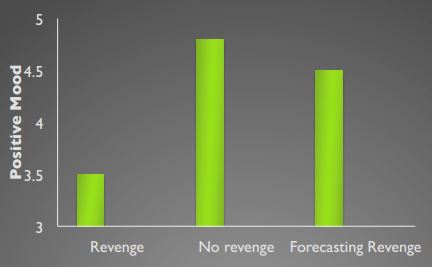
Carlsmith, Wilson and Gilbert of Harvard University published a study about the effects of revenge.

Individuals encountered a free-rider and were given the option to punish, not punish or forecast feelings about punishing the free-rider. Their positive mood was then monitored and measured. The results of the study are nicely summed up in 1 image.

The Paradox of Revenge
People who punished others felt significantly less positive because they continued to ruminate about their offenders while those who forgave moved on.

I think this idea applies beyond revenge. The more we give space to negative feelings like anger, ego and revenge, the more they take over our lives. As The Buddha summed up beautifully in a quote on anger – “Holding on to anger is like grasping a hot coal with the intent of throwing it at someone else; you are the one who gets burned.”

There’s a lot that can go wrong. Forgive. Move on. And, when communicating with yourself, remember “Jennifer, relax!