Every once in a while, we come across folks who choose to live their life as an inspiration. Now, inspiration is relative. What inspires you may not necessarily inspire me. If you are an artist, Da Vinci might be inspiring while, if you are a footballer, Lionel Messi may be the one for you.
Da Vinci and Messi, though, are stars. They are great examples, but it stops there. In real life though, you are likely to be inspired by people circumstance brings you together with. Life has a funny way of connecting people. You tend to attract, by means of what you do, the kind of people you like to your life.
What we tend to find is that we are likely to find many friends amongst these folks life brings us in contact with. Many good friends. We are likely to find that the more we open our heart to such friends, the more space we have for more.
Amongst these friends, however, we will most probably find a choice few that inspire us. It’s funny I use the word choice because these few choose to live life as inspiration.
Find them. Stick with them. Shower them with gifts, love and affection. Seek their counsel when you are in need of help. Whatever you do, don’t let them go. They’re precious. Every moment you spend with them will likely be a learning experience. The learning may come in very different forms thanks to their inherent uniqueness but there is no doubt that you will learn more than you can even digest.
And, once you’ve completed your Jedi training, pass on what you’ve learnt from them.
i.e. Find and get inspired by people around us and learn from them. Be inspirational ourselves and pass it on to others.
i.e. Find Heroes. Be a Hero.
Because we all are the Hero’s of our own life. We just need to begin acting the part.
Let’s imagine you decide to leave the door to your house open for a day with a sign saying ‘Free Chocolate – Only one per person please”.
Most likely, you will have a sizeable proportion passing by who will ignore you. Another bunch will likely come in and do exactly like you intended. One of those might even leave you a thank you note. Then, there will be that small group that will make you pay for it – literally. Some might take the whole bunch of chocolates ignoring your instruction and yet some others may walk away with something else in the room.
Let’s imagine you knew nothing about human nature when you did this. What would your reaction be?
‘I’ll never leave the door open again.’ is the most natural response.
Derek Sivers has a brilliant video on this and he makes some very valid points on the importance of taking stock and reflecting before responding.
I, however, would like to use this analogy to highlight a slightly different idea.
Staying positive is similar to walking about leaving your doors open. Every once in a while, there WILL be an idiot who will mess things up either by saying something mean or just behaving like an idiot. And you’ll likely remember that idiot because all the others who benefited from your positive presence will likely never tell you they did. And even if they did, you would think about and remember the badmuch longer than you’d remember the good.
When that happens, it’s far far easier to sulk, complain, say something mean and even burn a bridge than it is to swallow it and stay positive. It is tempting to just succumb to the imp within and respond with something cutting that makes the other person feel small.
Just like it’s way too easy to just show up with no energy, enthusiasm or commitment. (Why else do meetings have a bad reputation?)
Easier. Not better. Or happier.
If you are still unconvinced, try spending an entire day smiling, staying positive and ‘giving energy’ to those you interact with, and you’ll see what I mean.
I am tempted to think we spend way too much time these days with machines, like computers, mobile phones and cars who are indifferent to our moods, to realize that humans don’t work like that. Our moods matter. Our energy matters. These things make a massive difference. Just because we don’t see it doesn’t mean it doesn’t happen.
Staying positive does not mean all is sunny and well in your life.
Just like happiness does not indicate the absence of sorrow. It just shows the courage to smile despite the sorrows.
Essentially, every day and every moment, we are showing the world the kind of stuff we are made of.
Positivity, bloody hell.
(For the non Football (read: Soccer) folks, “Football..Bloody Hell” is a famous Sir Alex Ferguson quote following Manchester United winning the European cup with two goals in the last 3 minutes of the game after trailing the opposition for 80 minutes.)
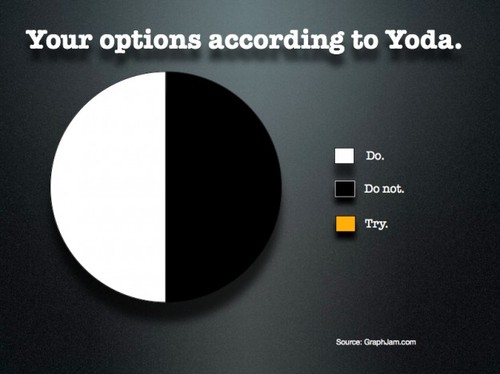
I mentioned the other day that most things in life these days seem best explained by Yoda quotes. Of late, I’ve begun on a new experiment thanks to Yoda. And that’s removing try from my language.
Like many things he nailed, I find Yoda nailed the use of try too. When I tested myself on the use of try, I realized I used try primarily when I wanted to say No. And, in a few instances, I used try because I didn’t fully believe I could do, and hence, was creating an excuse. And sometimes, even setting myself up for failure.
The past month has been a journey in removing try from my language. I caught myself doing that on email twice yesterday and decided to either decide to do, or not.
I do not underestimate the difficulty of a task like this anymore though. I realize that I’m working against years of mental conditioning. And I also appreciate (now more than ever) that the basics are the hardest to get right. Besides, I also realize that this is directly related to our Integrity.
Integrity is one of those commonly used value words which is hardly ever understood. I don’t claim to fully understand it myself. The best definition I’ve found on integrity is one that Covey uses – ‘The ability to make and keep commitments.’ And that, as we all know, is extremely difficult.
There is a post somewhere in this discussion on ‘Developing Integrity’ – Yes, I do not believe integrity is intrinsic, I fully believe it is a habit.
That said, I do believe that removing try is a great first step to higher integrity. When you can’t or don’t want to do something, take the difficult step and just say No. And when you can, you simply have to believe, and then get it done.
‘Live so that when your children think of fairness, caring and integrity, they think of you’
I’m working on it. Hopefully I’ll be ready in time.
This week, on RealAcad Mondays, we have an interview with Taco Roest, thanks to RealAcader Vincent Jong, a very inspiring young man who is on his way to starting up a venture incubator in Germany. I have had the opportunity to work with Vincent over the past couple of months and I’ve met few people who ‘get things done’ the way Vincent does.
Vincent got to know Taco during his work at Deloitte in the Netherlands in 2005. The service organization in which Vincent was working had to be reorganized due to structural underperformance on the Service Level Agreements (SLA’s). Taco became the Senior Manager in charge and started a major transformation project which eventually took more than 2 years to implement. When Vincent approached Taco to find a role in this project, they quickly discovered a shared strong result-orientation and a passion for getting things done.
For the next 2+ years, Vincent worked directly under Taco and was given the responsibility to design parts of the reorganization, calibrate this with senior management, and implement the changes. Taco would provide regular coaching and step in when his seniority was required.
Their efforts resulted in a successful transformation of the organization and strong performance on the SLA’s. At the end of the project Vincent moved to Austria for his Masters, but they stayed in regular contact. In 2010 they even jointly created a talent development concept called Early Bird to offer the same experiences Vincent had to other students.
About Taco
Taco grew up in the Amsterdam region in the Netherlands. In 1998 after finishing his study, he started to work as a Consultant at Arthur Andersen where he became global project manager within a few years. After the Enron case, Andersen in the Netherlands was taken over by Deloitte in 2002.
In the new organization, Taco became line-manager and worked his way up to a senior manager position in 2006, responsible for Portfolio & Project Management within Deloitte in the Netherlands. Apart from managing a broad team of project managers, he has been personally involved in a restructuring of the Deloitte organization and successfully led a transformation within the service area. Recently he left Deloitte to setup portfolio management at a pension fund in the Netherlands. He still lives in the Amsterdam region, is happily married and a proud father of two sons.
— 1. What inspires/drives you?
I’m driven by work in a changing environment with a good mix of operational and strategic tasks, getting the mandate to start new initiatives and building and developing an organization using people, process, and technology. The trust and freedom provided by an executive plays an important role in this.
Furthermore, I am inspired by developing people, especially young people that are starting their careers. What I’ve noticed is that the challenges and choices that are presented to young professionals are often not provided with the right form of guidance to help them arrive at the best decisions. I enjoy interacting with these young professionals helping them develop themselves and finding out what is best for them.
But of course, work is not everything. I get a lot from my work, however, you have to also find a balance between your private life and your career. It is important to have a healthy private life, therefore I always ask myself why I’m doing things and what I get out of it. There will be moments in your career when things don’t go well and when you are not able to influence it in any way. Therefore, it’s important to make sure that work is not the only thing in your life.
2. What has/have been the most defining moment(s) of your life so far?
After my study, I joined Arthur Andersen, which has had an important influence on my development with regards to knowledge, attitude, and my ambition level. I was allowed to travel a lot and it was the first time that I was introduced to corporate work methods, the internal rat-race e.g. up-or-out performance appraisals. Many of the things I learned there made me who I am today.
Then, getting the first opportunity to do line-management in 2002 was also an important moment which finally allowed me transfer my knowledge and experience to other people and help develop them. I would recommend everybody that gets offered the opportunity to manage or lead to take that opportunity. If you haven’t done that before you are 35, you might never be asked again.
A final defining moment I experienced was in 2006 when I realized that. if you really want to get somewhere in life, delivering good results is not enough. I attended a training on “Understanding and Influencing”, which taught me many new things on how people think and different ways you can interact with them. It also taught me to switch between process and content in interactions, which can have an immense influence on the emotional impact of discussions or confrontations.
3. What advice would you have for future leaders?
Learn how to motivate yourself and be proud of your achievements. To be a strong leader, you should not be dependent on the motivation of others to get you going. Then, start with selecting the right people and motivate them, and help them motivate themselves.
Be aware of the balance between IQ, EQ, and PQ, being respectively the intelligence, emotional, and physical quotient. The emotional and physical aspects are often overlooked. Usually people who don’t perform well at work also have something going wrong at the emotional and physical levels. Be aware of this for yourself as well as for the people you are leading.
Finally, make sure you find out what you like to do. Develop yourself independently but find time to look at yourself critically. Develop a feeling for momentum and have an eye for opportunities. Manage the expectations of your subordinates, bosses, clients, etc. and success will come over time.
— I think there’s a very deep point there about the emotional and physical aspects getting overlooked. A stable and happy personal life generally has a massive impact on our work life and being physically fit goes a long way in keeping us energized during the day.
Thank you Vincent and Taco. Have a nice start to the week, folks.
This week’s book learning is part of the ongoing series of inspiring learnings from ‘Switch’ by Dan and Chip Heath.
David Allen, the GTD guru has a great story on actionable todo lists from one of his workshop. This is a conversation with Jim, who was stuck on a task.
“Get a tune up for the car. Is this the next action? Not unless you walk around with wrench in hand, dressed for grease.” Jim chuckled. “Whats the next action?” “I need to take the car to the garage. Hmm. That means I need to call the garage.” “Do you have the number?” “Damn it! I don’t. My friend Fred has it. I knew something was missing!”
Isn’t that often what happens to us? We know something is missing but we don’t know what it is. Creating todo lists is murky business. We need to be able to keep asking ourselves what the next action is and simplifying it.
No wonder Alcoholic anonymous insists that the first step is just to go 24 hours without alcohol. Don’t worry about the rest. We take it action by action, step by step..
We have gradually been building up to this over the past few weeks of book learnings. The key concept is, of course, setting ourselves up for success by keeping our proposed actions simple and actionable. This story is another great example.
A close member of framily has suffered a repeat injury and will probably be off contact sports for the rest of his life. There’s a bit of history behind this that I don’t want to delve into. When things go wrong, it’s never because of one thing. Like Gladwell explains in Outliers, a plane only crashes when a combination of 10 odd things go wrong. In this case, it was similar. It was a case of wrong place, wrong time and bad luck. But I’m still sad.
I’ve had a similar experience with another member of framily over the past few years. I wrote to him the moment I heard this.
I’ve learnt over time, especially thanks to these two close friends, that messing with our body or health is typically a slippery slope. The stuff that’s forbidden always feels and looks good. How else can we explain the amounts of alcohols and tobacco consumed every single day?
Some of this stuff may be okay in the short term but they end up being cause for an incredible amount of agony in the long run. Among the famous quotes on the matter is the one by iconic footballer George Best –
‘In 1969 I gave up women and alcohol and it was the worst 20 minutes of my life.’
Very good for humor but if you’ve ever read about Best’s life, then you’ll likely be filled with sadness. Reading about Best was probably my biggest influence to not touch alcohol and tobacco. I clearly remember digging deep into the story of this United and footballing legend four years ago. Dubbed as ‘a fifth beatle’, World player of the year and European winner at 22, he was the kind of player you expected to eclipse Pele. But then, events took a tragic turn. His career and life gradually fell apart and he died a few years ago with multiple liver and kidney problems.
I clearly remember the horror I felt when I read his story. And I remember telling myself ‘If a man of his genius was ruined by it, what about someone like you?’
And I remember deciding that it wasn’t worth the risk. I don’t think I’ve missed much. And I doubt I will ever make a better decision.
I remember this being reinforced by Richard Feynman’s note on alcohol. On a trip to Brazil, he realized he suddenly felt a craving for it. And he decided to quit right then. ‘My brain is too precious.’ I’d echo what he said and say it referring to my body. It’s way too precious to mess around with.
Life would be boring without these excesses is what I’m told from time to time. Well, sure.
I’m happy with boring. I’d much rather not be lying in a hospital bed twenty years, regretting the damage I could have prevented. I don’t think a few seconds of happiness is worth the long term agony. I’d much rather spend that time building something meaningful.
This post has been coming for a while now as this is a subject I’ve been thinking about over the past few months. This is thanks to a collection of incidents – incessant Visa issues when traveling for work, becoming a Permanent Resident in Singapore, reading M K Gandhi’s autobiography, many many debates and email exchanges with friends and acquaintances.
I’ve wrestled with the question of identity a fair bit. What is identity? Why does it matter? What does being ‘Indian’ mean? Am I patriotic? What is patriotism?
It’s been more than 5 years since I have left home now and factoring in graduate school, it will probably be atleast 5 more before I give myself the option of going back. Will I give myself that option though? I can’t tell yet.
I have many thoughts on this issue. And I’m going to dive in with no structure or research backing whatsoever. This is going to be a rant in it’s purest sense – a collection of thoughts and ideas I am wrestling with based on my own experiences and thinking. It is likely to be very long. And it is likely to be similar to The Pursuit of Happyness rant and yet, likely to be very different thanks to the simple fact that I have many more questions here than answers. So, here goes..
The first bunch of questions I asked myself were – Does citizenship matter? Am I even a citizen of a single country? The world feels like a global village. Am I not just a denizen of this global village? The next bunch wave of questions were around – Does a ‘piece of paper’ (i.e. my passport) mean anything? If I were to switch citizenship, would it mean I’m any less Indian? Is it wrong to seek another piece of paper to make travel and life easier? And finally – What does ‘being Indian‘ mean to me? Am I proud being so? Does this mean anything beyond some emotion I may be clutching? Is this part of my identity? What is my identity? Do I ever plan to give back? Will it ever work out for me in India?
These questions have popped up from time to time over the past year. And I’ve given each of them considerable thought.
One of the things I encourage every young Indian to do is to spend atleast a year abroad. Ideally, in places more developed. As a child growing up in India in the boom periods of the 1990s and early 2000s, I frequently recollect hearing India Shining and India 2020. Being an avid debater and public speaker, I can recall many competitions, republic and independence day celebrations where I gave my views on the topic. (Well, more like my mom’s views on the topic). I can’t say I was ever convinced though. Luckily, I was constantly reminded to question what I was being fed. And here, I must thank my Mom.
My mom is the quintessential traveler. She is one of those people who is at home in a foreign land. I’ve probably traveled more and lived abroad longer but my mom, in many ways, embodies the spirit of traveling. Thanks to her open mind and spirit, she truly takes a deep dive into a new culture and society and enjoys traveling like few others I know do. Having been exposed, she always insisted that we were fooling ourselves. And she wanted me to go out and experience the world. I happily agreed. So, thanks to her, I opened my mind to studying and living abroad. And very soon, these dreams became reality. I had 4 years of life experience under the excuse of studying engineering in Singapore.
Understanding Singapore was truly eye opening. Life in Singapore was in many ways an exact opposite to life in India. Massive vs small, old vs new, unclean vs clean, corrupt vs un-corrupt, chaotic vs orderly – it really was a contrast. Singapore, in many ways, is as close as you can get to perfection in this world. I still wasn’t satisfied though. I wanted to experience the west. After a short stint in the middle east, it’s becoming close to a year being based in London. London, funnily enough, is a lot like home. Most of the adjectives I’d associate with home would fit right in. Thanks to Mom and Grandparents, then RealAcad and work, I’ve also had the good fortune of traveling around Europe for a short while and spending a few weeks in total in the US. Other continents are sure to follow as well.
All these experiences have given me an incredible amount of perspective. I look at India from a very different lens now – from the outside. And I see a very different picture. While I do hear of the enormous economic boom and increased focus on India thanks to the failings of the leaders of the West, I find myself still unconvinced. And here’s why. India is essentially still tribal. We are still run by families. The two essential aspects of modern civilation – wealth and political power are concentrated in the hands of, literally, a few families. Most of our political history has been controlled largely by one family and most of the wealth today is in the hands of massive family owned conglomerates. There’s very little reason to change – that’s a comfortable position to be in. And a lot of the political effort thus far has gone into just that – keeping the status quo.
These reasons make it significantly harder for young upstarts to make it. Doing business is not easy, education is managed murkily, infrastructure is pretty bad and corruption is rampant. Aside from this, there is an incredible diversity that we have to deal with. People of all colors and types from 28(or more) very different states. That said, when compared to Europe’s warring states, I find India’s unity-in-diversity pretty incredible.
Over these years, I’ve had coffee table discussions and debates from time to time on this topic, especially back home. I’ve spoken with folks who are convinced that the west has gotten it all wrong and that India is the true great country. And, on the other hand, I have spoken with many who have just become cynicial about the country and talks of growth and prosperity. Then again, for the large part, most others don’t really care. I’ve had a few discussions about this with Indians on the outside as well. Again, we have a mix. Few of these want to go back and stay close to family, most others can’t see themselves going back for the next couple of decades and then, of course, there are few others who would go wherever life takes them.
I’ve also had chats with Indians who have given up their citizenship. Here, some of their reactions have amused me as many want nothing to do with India. I sense shame when they speak of India. They like to associate themselves with their new motherland. And yet some others switched passports for professional reasons – ease of travel and the like.
One of the better discussions I had, though, was with a Chinese friend who spoke of business and life in China 20 years ago and how things had gradually been changing. I found the discussion very insightful as I could relate completely to the China of 20 years ago. Being a few years ahead of us on the S curve (albeit with a very different approach), our discussion on China’s progress gave me a lot of optimism. She spoke of the emerging middle class which forced the rigid system to change gradually and gradually become more open to the middle class changing things. She spoke of how an increasing number of Chinese are making their way back home thanks to a better business environment and increased entrepreneurship. And, of course, China’s growth and general progress has reflected this shift.
The other big influence in my thinking has been thanks to the US. I am a huge fan of the United States. I truly believe in the US being a land of opportunity and I have loved every moment I have spent in the United States. I share the general optimism of the American people, their belief in entrepreneurship and the power of technology and of course, their insistence on democracy and freedom. I love their work ethic and I am in awe of their advancement in research and technology. I am one of those who would like to see the US remain the leading super power and I’m hopeful they will find their way back.
My blog roll reflects this admiration. All my role model bloggers and many of my blogging influences are Americans. And herein lies the biggest reason this post has been coming. Over the past few months, I have watched and participated in (particularly at AVC) many many intense debates amongst the Americans on Obama, healthcare, entrepreneurship, tech and the economy. And I have been amazed at the common thread of patriotism that runs deep within them. Deep. Real deep. And, as a result, I’ve found myself wondering (much more!) about my own roots and beliefs.
The other big influence, as mentioned earlier, was the autobiography of M K Gandhi. A truly fascinating book. That book reminded me, once again, of the freedom struggle. I had lost touch with all of this. More questions and observations popped up. In many ways, I actually found myself feeling that Gandhi was one of the few who truly got the Indian psyche. He had the kind of ideas that worked in India. He preferred hunger strikes to violence, for example. His career also made for an interesting study. Grew up in India, studied in England, worked in South Africa and only returned home in the latter part of his career. But, by the time, he was back, he was ready to have the kind of impact he did.
Decades following Gandhi, I find his overall process still works. Hunger strikes have still proved themselves most effective in rallying India’s population. And I have already mentioned my bias towards going abroad and getting exposed. It makes sense.
The biggest realizations over the past few months, however, came when talking to a wiser Indian friend. We were discussing identity and the concept of building. We were discussing how, at the end of the day, we were essentially Indian. Changing our passport wouldn’t change that fact because that’s how the world identified us. And, at the end of the day, in our heart of hearts, that’s how we identified ourselves. We then also spoke about the concept of building. And, one of the things we agreed on was the importance of building at home. If we didn’t, who would?
Did that mean we would take the next flight home and set up shop? Not really. It did mean that it was part of the big picture. It meant we saw this period of learning and growth as a phase. But, at the end of the day, we did see ourselves going back and giving back.
In many ways, this is the biggest indicator of where I am in my thinking about India. Despite all those things that seem terribly wrong with the country, I am optimistic of how things look for a number of reasons. The biggest reason is the change that I believe economic prosperity will foster. The richer the common man becomes, the more push there will be for change. And I’m optimistic this will happen. The degree of entrepreneurship is generally a great way of measuring progress. And that’s been on the up. There is progress, even if it is painfully slow.
The other big factor that makes me positive is that India seems to have many of the ingredients that the US has/had in it’s glory years – democracy, chaos, hardworking people, a young population, struggles with discrimination (black-white in the case of the US and caste system in India’s case) and a thread of unlikely unity amidst the diversity.
I’m not one to be carried away by talk of projection of boom and neither am I one to be depressed at the thought of the massive challenge that lies ahead. Where one may see trouble, I generally like to see opportunity. And hence, there is no lack of opportunities and building to be done. Like in the China situation, it is my belief that it’s only a matter of time before the environment becomes easier for the middle class to asset influence. The big question, of course, is whether this will happen soon enough. That said, I also know there will never be a perfect time. I’ll be the first to admit that I’m not expecting ‘ideal’. All I’m hoping for is good enough.
My mother often asks this very deep question every time we speak – ‘Will India ever be first class? Will it ever be a truly great place to be?’
I don’t know. I have reasons to be optimistic. Change is the way of things. And change in India is long overdue. But, then again, the more I think about it, I realize that I don’t really care. I will go back anyway. I’m just not ready yet and neither do I believe that the time is right. But I’m convinced the time will come.
And then, when I ask myself – Why don’t I care?. I realize the answer here is threefold. Firstly, it’s because I’m eager to build. And I’m confident that there are many more who have the same eagerness and desire to build. We can change things. That’s a given.
The second is best explained by one of my all time favorite Elliot quotes, one that I recently mentioned in a recent post.
We shall not cease from exploration, and the end of all our exploring will be to arrive where we started and know the place for the first time. | T.S.Elliot
I find this incredibly true. I’m still exploring. But, the end will arrive. The end may be a few decades away but it will come. It is, I understand, the way of things.
The most important part of the answer is that, at the end of the day, India is home… and home is where the heart is.
That said, there’s a high probability I’m looking at all of this the wrong way. I’m looking forward to the discussion! :)
A close younger friend was on her way to writing her first job application and needed her resume done. 10 days and 12 drafts later, I expressed full satisfaction at the end product. This included a couple of iterations with 2 other friends.
It turns out that she did not expect such a trying process. I don’t blame her. But, the beauty of hard work and a touch of pain is that learnings from such experiences are always incredibly deep. And I thought I’d share some of her big learnings from the experience. The beauty with the depth of these lessons is that they apply everywhere and in that lies another deep underlying principle. If we go deep enough i.e. if we truly understand the nature of what we do in any field, we will extract incredibly meaningful lessons that can be applied everywhere.
Note: This is a very talented person who manages a couple of great blogs. She also tends to be very kind with her compliments. — Every time I sent him a version he’d send it back to me with improvements. The fact that it was scanned and remarked on with a pencil somehow hammered the suggestions deep into my head. We went through a week of 10-12 cycles of review and in the end came out my resume. Something I am immensely proud of now! 1) Patience – I learnt the importance of waiting for things to shape-up. I am a very distracted person. It takes great love for work and motivation to keep myself at it. I always hurry thing up in the end. This time though, I waited for it. I learnt to go along with it and realize the wonderful journey/outcome. Also, from my friend. He was extremely patient with me that one week! With all the corporate relationships he is used to, I thought it was really encouraging when he waited for me to learn. Very grateful for that! 2) While ‘too many cooks spoil the broth’, the master cook can always handle the broth taking all the suggestions of the other cooks – I have always been better at working by myself, doing my thing. This time though I worked with three other people! Initially I took every bit of advice and blindly changed things on the document. As the reviews increased though I learnt to negotiate. To decide which I wanted to change, which I dint. If I had done this all by myself, I know that it would have remained Dhanya_Resume_v1.pdf. This is actually my biggest learning I would say. I learnt the importance of discussion and team work, in a way. 3) To each his own – Just like every person has a unique fingerprint, every person has a unique view/opinion on things. I could see how each one of us noticed various aspects of the document. How we saw the words. What the words meant to us. This was a very deep learning. Having such varied opinion on things, I wonder how we even manage to run things in the world this way. I guess thats where compromise comes in. 4) Sweat on details – Every space, every comma, every dot, matters. An achievement may not seem big to me in relativity, while on the contrary it might be something big to someone else’e eyes. It is essential to analyze a detail from the hirer’s point of view and to try judging their understanding. 5) Easy on the eye, faster to the head – Formatting anything and making it cohesive makes life so much better. Personally, I like to keep things ordered and clean. I realized its important to extend it to every inch of life! — The original post is here.
Thanks to having given a fair few ‘resume writing’ workshops, I do read a lot into the thought put in a resume. It doesn’t mean mine is anywhere close to perfect but a lot of effort has gone into it. I’ve been fortunate to gain lot of this experience thanks to RealAcad and other experienced friends who helped me along the way.
So, when you write/edit your resume for the next round, do make sure that you run it through people who can help you. Preparing a great resume, in my very limited experience, does take 9-10 versions and a fair amount of thought to get right.
It’s well worth the effort though. If you still have a niggling feeling about your resume after having bounced it off with people around you and would like more help, do feel free to reach out. :)








 A Learning a Day