When either element is missing, it can get problematic. Managers who want to help but cannot end up getting in the way in time. And managers who can help but don’t want to are not fun to work with.
But, between the two, I’d pick the former over the latter.
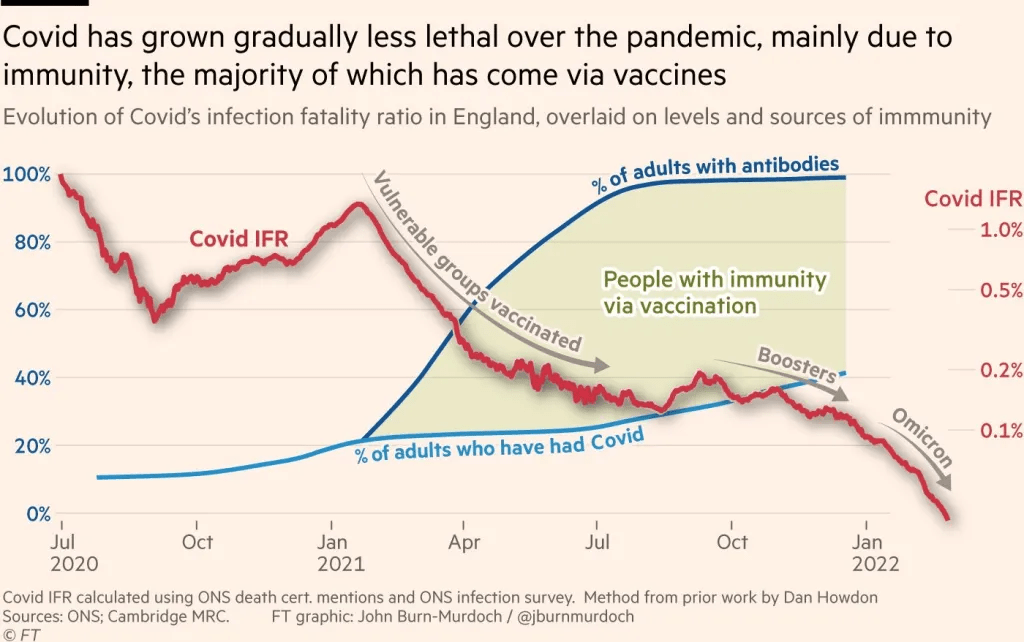
The Financial Times team shared this visualization of how COVID has gradually become less lethal over the pandemic in the UK.
The TLDR: Thanks to immunity driven by vaccines and those who have had COVID, the Omicron wave is trending toward* being just as infectious as the flu in the UK.
There are so many layers of data in this one exquisite graph. A powerful reminder of the impact of thoughtful data visualization.
H/T: Dan Cullum for sharing this on his excellent daily blog.
*PS: I’m hopeful that trend will continue for the new BA2 variant as well.
“I’ll be happy when…” is a sentence that has all the makings of an elaborate trap we create for ourselves.
There’s always a trade-off between the now and the future. Saving money is an example of that trade-off, it is a hedge against uncertainty.
But if those trade-offs come at the cost of creating a sense of perpetual unhappiness and longing for a future that may or may not play out as we imagine (and let’s face it – does it ever?), they’re not worth it. Worse, it is a slippery slope.
“I’ll be happy when” is a trap best avoided. And the best way to avoid it is to pick trade-offs that we’re happy making now.
A misnomer about learning is that the best way to learn is by experience.
It is a misnomer because, while it is incredibly effective, experience is expensive.
The more we can teach ourselves to learn from others’ experience – either by spending time with them or reading something they wrote – the faster we’ll make progress on that learning curve.
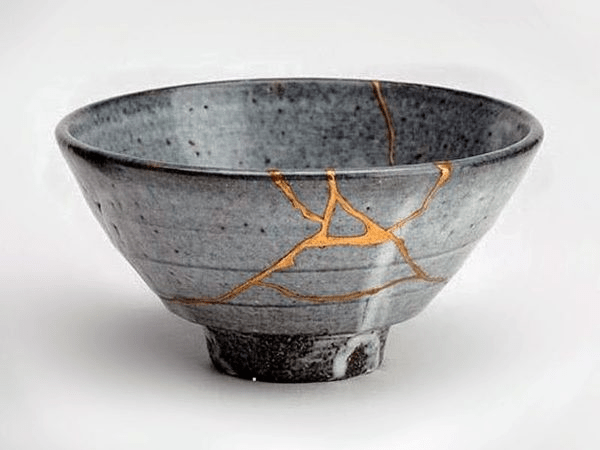
Kintsugi is the Japanese art of repairing broken pottery by mending the areas of breakage with lacquer dusted or mixed with powdered gold, silver, or platinum. The philosophy behind it is that breakage and repair as a key part of the history of an object. So, instead of attempting to hide breakage, Kintsugi draws attention to it.
It is a beautiful way to think about blemishes in pottery… and perhaps in other areas of our life too.
Writer Steven Johnson has been sharing a free newsletter over the past months called “The Adjacent Possible.” I’ve really enjoyed his books on innovation and his newsletter has delivered thought provoking insight too. 2 recent posts that spurred thought:
(1) We need a standard unit of measure for risk (article). This sounds so elementary and is yet so profound. We all think about risk in our daily lives. It is a key factor in all our decision making – especially in the past 2 years. And yet, we don’t have a standard measure.
He then shared an old unit proposed by a Stanford Professor in the 80s called the Micromort and asks a what if question to all of us – what if we used the Micromort to help communicate risks?
As an example, here’s a tweet by Wharton Professor Ethan Mollick putting risks in context.
A simple and powerful idea
(2) The Day Before (article). In yesterday’s article, Steven asks – are we discounting the threat of nuclear war given we’re dealing with an irrational actor? He draws from his experiences writing about pandemics and how few took the possibility of a global pandemic seriously.
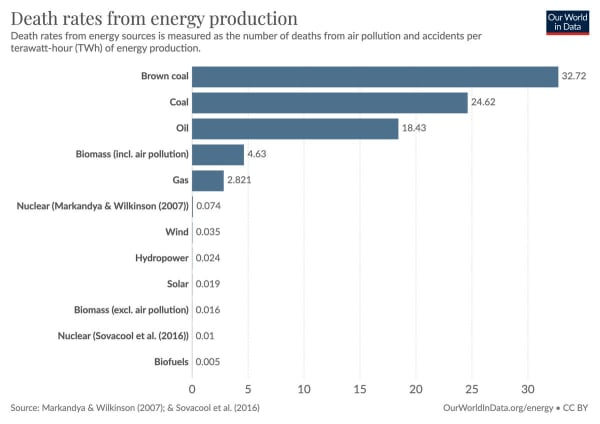
He then shared how we’ve spent decades fighting the wrong kind of nuclear threat – turning our fury on nuclear energy despite it being among the safest sources of energy on the planet and not taking the prospect of nuclear power in the hands of dictators seriously enough.
I chuckled when I heard that the top song on the Billboard 100 was “We don’t talk about Bruno” (video) from Disney’s Encanto.
There’s been a lot of good analysis as to how this happened. There’s a lot of truth to all the trends that contributed to making this happen.
But the one thing that has been undeniable is the impact these songs have had on our households and in households like ours.
It was amazing to see a Disney movie with so many recognizable elements – a deep story, many songs, and a theme that revolved around the importance of family – that still managed to strike a very different chord from many others.
The protagonist was a strong female character – but not a Princess. The songs were intense – thanks to the genius of Lin Manuel Miranda threading together complex rap-like lyrics while moving the plot forward was evident.
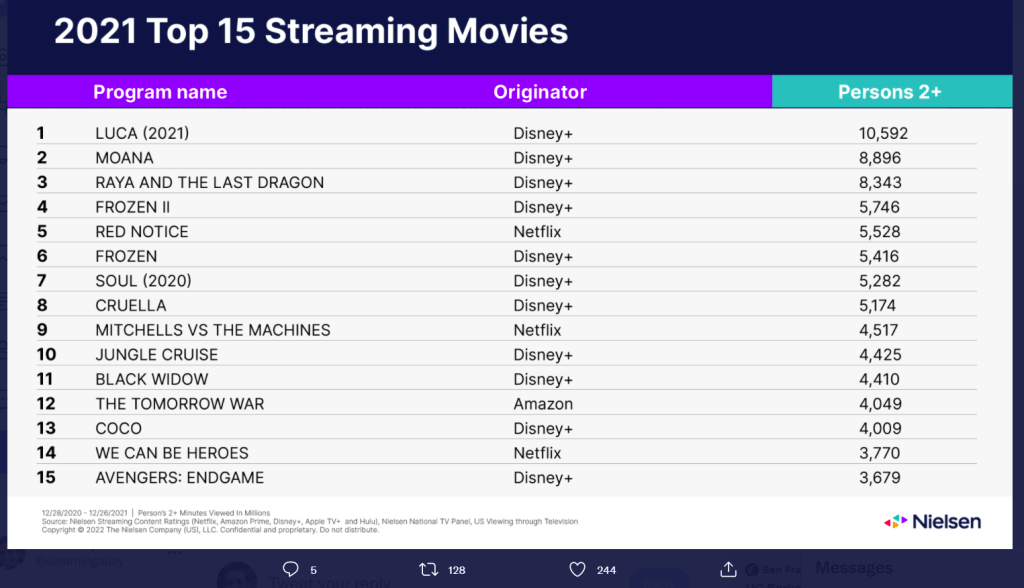
Art, music, and movies have a powerful impact on our culture. And it is always amazing to see Disney hold the bar high by delivering laughs, enjoyment, and thought-provoking content every step of the way. It is no wonder that 11 out of the 15 most streamed movies in 2021 were all Disney (source: Nielsen).
A predictable and worthy side-effect of shipping good product.
An activity I love – and one I don’t do often enough – is to turn on the TV and watch a show by Sir David Attenborough.
In every show, David and his crew painstakingly reveal the secrets of life on the planet. His crew have taught me more about forests, plants, and animals than any science textbook or class I took in school.
We’re currently watching episodes from a series he’s done about Indian forests. I’ve already learnt more about Indian forests than I ever knew growing up in India.
I associate his voice with calm, curiosity, and wonder.
He’s 95 years old now and I don’t know how much time he has with us. But I sincerely hope he’s got a few more shows left in him.