
The fascinating thing about wealth – it doesn’t matter how much flows through your bank accounts, you are only as rich as the amount as you keep.
Category: Everything else
Choosing the next IC PM role – one dimension that matters
A note for new subscribers: This post is part of a series on my notes on technology product management (this is what I do for a living). You might notice that these posts often link to older posts in the series on LinkedIn even though they are all available on this blog. That is intended for folks who only want to follow future product management related posts. Finally, for all those of you who don’t build tech products for a living, I believe many of these notes have broader applicability. And I hope you find that to be the case as well…
——————————————————————————————————-
A quick overview of what we’ve covered on “Notes on Product Management” so far –
- Overall: The IC PM Role, The 4 key skills, Remote + Pandemic PM, 5 Decision Making frameworks/heuristics, Problem finding/solving with executives, Managing psychology
- Skill #1 – Problem finding: Most important skill, Problem statement and hypothesis, Building Strategy, Validating problem statements and hypotheses, Exploration OKRs
- Skill #2 – Selling: Sales and Marketing, Writing for executive audiences, Product executive relationships, Learning to sell
- Skill #3 – Problem Solving: Roadmap, Product specs, Solving for Usability, Solving for Feasibility, PM<>Eng collaboration, Ramps and launch checklist, Design visions
- Skill #4 – Building effective teams: Knowing thyself, Your manager, Product team culture, 5 habits – high velocity product teams, Effective 1:1s, Kick Offs, Effective team meetings
- Managing your career: Getting in – I, Getting in – II, Picking next role (feat. manager) – today’s post
——————————————————————————————————-
Job transitions are a big part of life as an IC Product Manager. There comes a point during the journey of most IC PMs when you need to think about a transition. For many, this happens somewhere between 18 and 24 months within the current role. That tends to be the point when the learning curve begins to flatten.
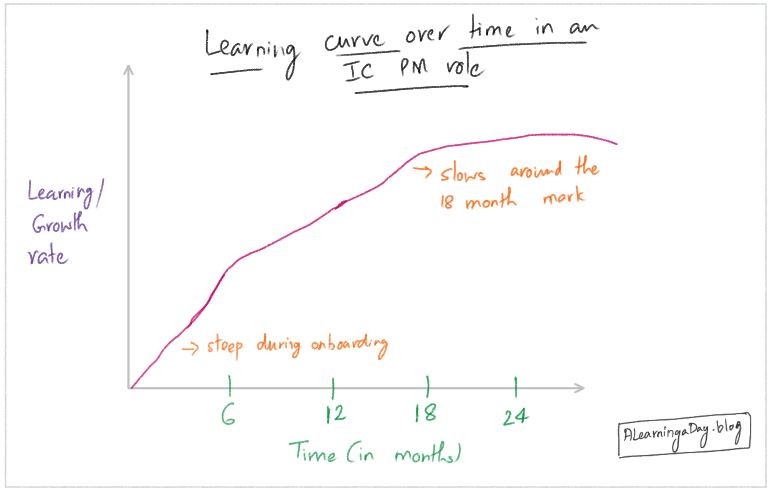
In the first 3-6 months in a new role, we’re still learning about the users/customers and forming an opinion about the highest leverage problems that need to be solved. We build a strategy (hopefully!) and begin executing on it. Then we spend the next 12-15 months attacking these problems and building skills.
And unless the scope of problems we tackle grows rapidly, that’s about the time when the learning curve begins to flatten. That’s when we see an interesting inbound message from a colleague on another team or from a recruiter elsewhere with an interesting new opportunity. How do we go about choosing that next opportunity?
(1) Start with understanding the dimensions of change to consider
Typically, there are a few dimensions where we seek change. And I think there are 3 groups of dimensions that get people excited (note: this isn’t an exhaustive list – just a list of the most common dimensions I’ve observed folks considering) –
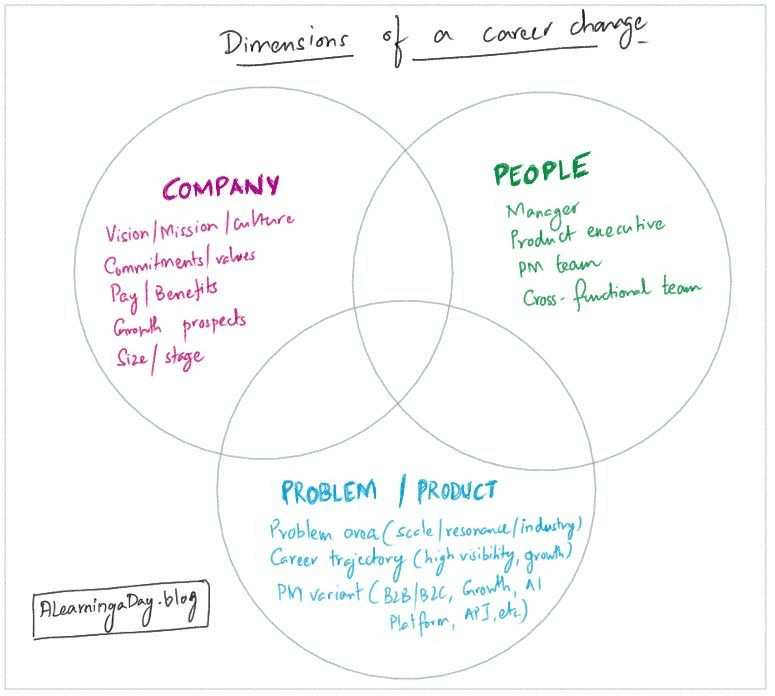
(1) Company:
- Vision/mission/culture
- Attributes/values of a company that stand out – e.g., their commitment to the environment or diversity or so on
- Pay/compensation ranges and philosophy
- Growth prospects
- Stage/size of company
(2) People:
- Good manager – a bad manager is one of the biggest reasons people leave their existing role.
- Good product executive
- Strong PM team/peers
- Good cross-functional team – this sometimes happens when a PM follows a trusted cross-functional partner who made a change
(3) Problem/Product
- Different type of problem area – scale/resonates personally/industry
- Career trajectory – typically via High visibility scope with clear line-of-sight to next promotion
- Attempt a different type of product management – B2B vs. B2C, AI, Platform, Internal products, etc.
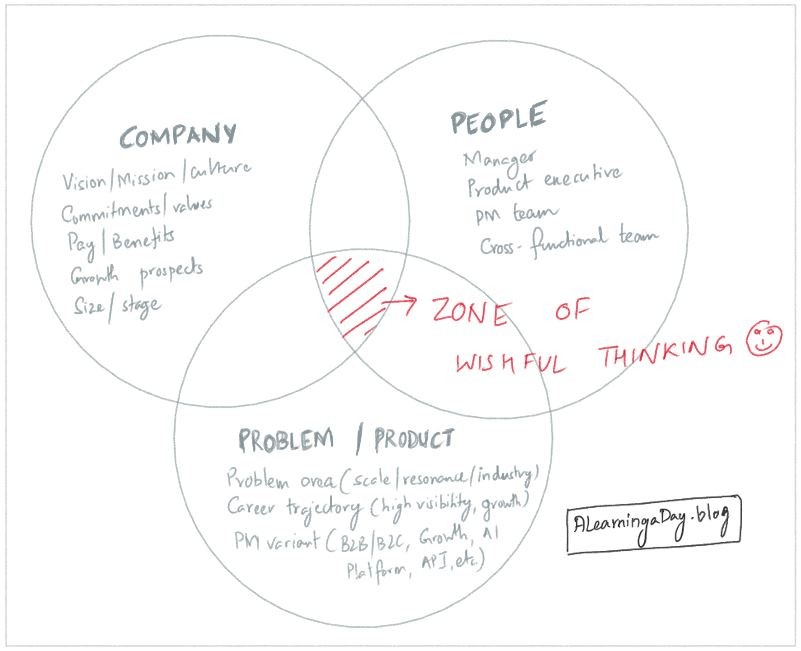
This is the point where you might imagine I’d say that the ideal role is at the intersection of this beautiful Venn diagram bringing together Company, people, and problem/product.
But it’s not. Any such thinking is wishful as it is nearly impossible to find an opportunity at the intersection.
That brings us to step 2.
(2) Pick 2 dimensions and no more than 2 dimensions that matter.
This sounds like a drastic simplification given the many factors I laid out above. In the spirit of picking 2 things that matter, here are 2 reasons why it matters:
(a) When we switch jobs, we’re executing on some career strategy. Every strategy has trade-offs – i.e., a strategy is as much about what we don’t choose as it is about what we choose. And not choosing is choosing.
(b) Picking the 2 things we are optimizing for will help us cut through the noise and confusion that accompanies making a career decision. It provides clarity, helps us have the right kind of conversations with the right people, and eventually will also help us get what I want.
I think of myself as a simplifier and, in most discussions about careers, I used to ask folks to simplify to 3-4 things that mattered. Then I found myself in a conversation with our then-Head of Product who shared this “2 dimension” nugget. He drew out this 2 x 2 on a whiteboard and asked me to articulate what 2 things mattered (see his post for a note from the source)

It took me a few weeks to get back to him on what mattered simply because it takes hard work and self-reflection to get to any type of clarity. But that clarity went a long way when I was exploring my next career move.
(3) Strongly consider picking “manager” as one of the two dimensions
My next recommendation is to strongly consider making one of the two dimensions in your choice to be your future manager. I recognize this is a strong recommendation to make. But it is informed both by my experience as well as from observing many others.
Over the past 5 years, I’ve had the opportunity to speak with PMs who were considering changes in their career. And in some of these cases (I’d estimate ~50% of the cases), the relationship has continued well into their new role – enabling me to understand how the change worked out. I’ve observed 2 consistent patterns:
(a) Most folks prioritize factors like scope and advancement opportunities over the manager they’ll report to – this is especially pronounced amongst those making moves within the same company. Sometimes, this means making an explicit trade-off – “I know x isn’t a great manager. But the scope looks promising.”
(b) The manager trade-off is a trade-off that always makes the “I wish I’d done this differently” regret list later. That’s because managers have a disproportionate impact on multiple criteria on the list once you think about it. They impact scope, growth prospects, compensation, type of product, the cross-functional team, the PM the culture of the company that you experience, and so on. They can even make a big company feel small and agile and vice versa.

It doesn’t matter how amazing the job looks from the outside. Managers make or break the experience. While it is easier to do your research on a manager when you move within your own company, I cannot recommend manager research highly enough if you are moving externally. Take the time to speak to as many folks as possible who’ve worked with this manager and spend time with them in at least one or two conversations after you get an offer.
Next, let’s focus on what to look for.
(4) How to pick a manager – will they help? And can they help?
As we’re inadvertently celebrating the power of great 2x2s, here’s the manager 2×2

Let’s break this down. At a high level, there are only 2 questions that matter when you’re choosing a manager listed in priority order –
(i) Will they help? (care)
(ii) Can they help? (ability)
(i) Will they help (care)
There are going to be times in your career – I hope they are few and far between – when you might need to make a choice that trades off one for the other. My recommendation is to pick managers who want to help you. Managers who care will figure out how they can get you help even if they cannot. For example, they may find ways to get you more time with your product executive/their managers if they believe that will help you grow.
If you believe your manager cares, it is worth understanding if they are reactive or proactive. Here’s the difference once you ask for something difficult (e.g., I want a change in scope):
- A reactive manager will ask you for a bit of time and get to work figuring out options. They will, however, rely on you to keep pushing and reminding them over the next weeks/months to make it happen and keep reacting to your urgency.
- A proactive manager will have probably known you are looking for a change in scope. But once you make your request, they will be all over it. You will receive updates from time to time and know (and feel) that they’ve gotten your back. And if it isn’t a request they’re able to grant immediately, they will also let you know as soon as they know to ensure you have the right expectations.
Proactive managers combine a bias for action with a willingness to be plainspoken to help set the right expectations.
(ii) Can they help? (ability)
In the chart above, I broke this down to 3 levels:
(a) Their influence: Your manager’s influence/trajectory will impact yours. If they’re going places, you will have the opportunity to grow/go with them. A simple way to understand this is to look at the relationship the manager has with their reporting line.
This influence will help them help you when you face thorny issues – either while building product (e.g., misalignment or resourcing) or when building your career (e.g., when you want a change).
(b) Skills: While their influence is the base requirement for their ability to help, the next requirement are their skills. A simple way to understand that is to look at their track record as an IC PM. What did they ship? When you do, you can look for which of the 4 skills they excel at with the evidence:
- Problem finding: Track record of shipping high impact products that solved user problems while delivering strong business impact
- Problem solving: Track record of building well designed/usable/simple products at high velocity
- Influence: Have a reputation for being a great communicator, getting their ideas funded/resourced and/or got promoted quickly without as strong of a product success track recor
- Building effective teams: Their cross-functional partners love them.
Matching the skills they have with the skills you need to build go a long way. It is likely you’ll learn plenty from the time you spend with them – it works great if those are skills you actually want to learn.
(c) Wisdom: This is the toughest/rarest one. It isn’t easy to understand if a person is wise or emotionally mature – so, look out for these cues if you hear them.
I think there are two kinds of wisdom that are particularly helpful to you.
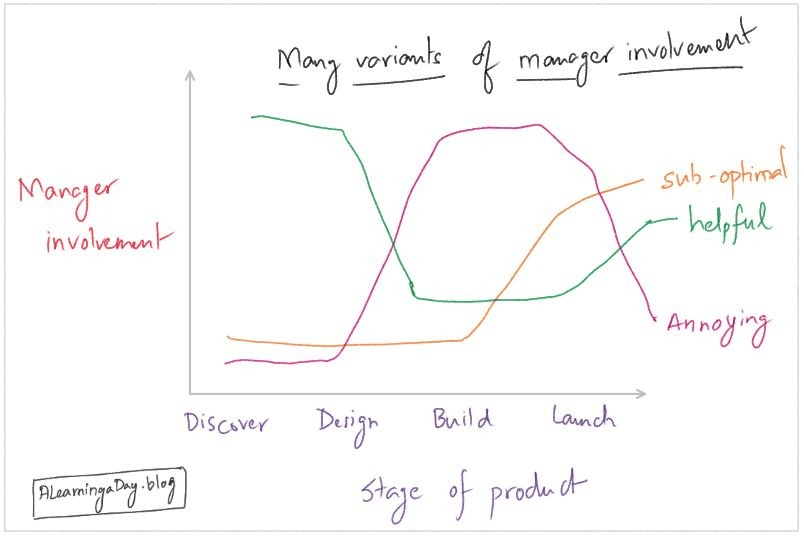
The first revolves around how they help in the product development process. You can understand this by asking specific questions to direct reports. Strong managers tend to be most involved in the beginning and then moderately involved during and after launch to set their reports up for success.
The second is whether they’re the sort of folks who can help you make better life choices. Great manager-direct report relationships are so much more than a line on an org chart. As you work through thorny problems, your conversations will often go well beyond the realm of work. By providing a solid foundation of support for you at work, a wise manager can be a steadying influence in your life. They can give you both the tools (via frameworks and perspective) as well as the confidence to make better decisions.
It is a special thing when this works well. And it is worth optimizing for.
——————————————————————————————————-
A final note – it is worth going through the exercise of figuring out the 2 things that matter to you every 12-18 months. Regardless of whether you choose to change roles/move, the act of exploring what matters to us will help us make intentional choices.
Not choosing is choosing after all.
“We shall not cease from exploration, and the end of all our exploring will be to arrive where we started and know the place for the first time.” | T S Elliot
Q1 look back – self-care
One of my two themes for this year was building a good self-care system. I broke this down into 5 specific areas in order of priority:
(1) Sleep: At least 7 hours every weekday.
(2) Exercise: Close my Apple Watch rings (400 move calories, 30 mins of exercise) every weekday and aim for at least 10 minutes of strength training
(3) Voice: 2 minutes of vocal exercises (inspired by this post)
(4) Food: Aim for fruits every day (in addition to intermittent fasting + diversity of plants)
(5) Books: Do more reading by surrounding myself with books and being more intentional about checking my phone.
I think I emerged from the first quarter of the year with a B+ overall. I had a hit-rate of between 80-90% on sleep, between 90-95% on exercise, ~100% on vocal exercise, ~70% on food, and ~50% on books.
3 reflections –
(a) Apple Fitness Plus was definitely a game changer in helping me exercise better. Getting strength training consistently in has made me feel significantly better. I remain a huge fan of the Apple Watch in general in its ability to transform the act of exercising.
(2) Adding books in areas where I’d normally check my phone has helped me become more intentional about reading.
(3) Performances that were below expectations were a direct effect of days where I didn’t plan my work and schedule well.
Hoping to build on this and do better in Q2.
The circumstance or the response
We either shape the circumstance or our response.
Time spent on anything else – e.g., complaining about the circumstance or attempting to shape it when it is out of our control – is wasted time.
If you think you can shape the circumstance, go forth.
Else just focus on that constructive response.
Absurdly, terrifyingly, insultingly short
“The average human lifespan is absurdly, terrifyingly, insultingly short. But that isn’t a reason for unremitting despair, or for living in an anxiety-fueled panic about making the most of your limited time. It’s a cause for relief.
You get to give up on something that was always impossible – the quest to become the optimized, infinitely capable, emotionally invincible, fully independent person you’re officially supposed to be. Then you get to roll up your sleeves and start work on what’s gloriously possible instead.” | Four Thousand Weeks by Oliver Burkeman
I enjoyed reading Oliver Burkeman’s over the past weeks and thought these two paragraphs – the last 2 in the book – were a great summary of the spirit of the book.
More reflections to follow in the next days.
The Wizard and the Prophet
I started reading The Wizard and the Prophet after reading this post on Seth’s blog. An excerpt:
Mann has given us a deeply researched narrative, a book that will change the way you see just about everything in the natural world and its relationship with humanity. It’s about an epic struggle and mostly, about our future.
It seems to be about two obscure characters of the 20th century, but it’s not. It’s about each of us and the tools we can choose to bring with us to the future. I found myself switching camps every few minutes.
Seth called it his book of the year. And while it is still early in 2022, I think it will end up being mine too.
Charles Mann deconstructs some of the most important issues of our time – including food, water, and climate – and contrasts two approaches to tackling these problems.
The first is the school of sustainability built on the work of William Vogt that asserts that we need to consume less and be more mindful of ecological balance.
And the second is the school of innovation built on the work of Norman Borlaug that focuses on innovation as the way out.
The book is incredible thanks to the way Charles Mann interweaves the story of these two men, the tussle between these schools of thought, and the complex challenges ahead of us on issues like food, water, and climate.
But more than ever, the book had me take away 2 things:
(1) There is no perfect strategy – there are only trade-offs. Both approaches bring trade-offs and there never has been or will be a perfect answer.
(2) When we deal with complex problems that don’t have clear answers, the middle path between the two approaches tends to be the way. That’s because taking the middle path helps us find the relative best of both approaches without necessarily attaching our identity to either.
Wonderfully insoluble problems
“I was peeling a red apple from the garden when I suddenly understood that life would only ever give me a series of wonderfully insoluble problems. With that thought, an ocean of profound peace entered my heart.” | Christian Bobin
Wonderfully insoluble problems indeed.
It resonated. :-)
Two strokes of dumb luck
We experienced two strokes of luck of late. Both could have led to a few hours of hassle – but thanks to some dumb luck, we avoided that.
Misfortunes and bad luck have served up some great learning moments over the years. It is easy to dwell on such experiences and curse our bad luck.
But my journey into stoicism last year reminded me that it is equally important to think about misfortunes that * could * have happened. We are overly prone to taking our good luck for granted.
These two strokes of dumb luck reminded me of just that. It could definitely have been worse.
There’s more to be grateful for than we realize.
Reverse parking
I’m a fan of reverse parking – i.e., backing into a parking space so it is easier to drive out when we are done.
It is a small act of generosity to our future self.
Reverse parking is a concept that has applications in other areas of our life too. Starting and/or ending the work week with a bit of buffer so we get the time to ease in/out is one such example.
Similarly, getting all the tickets and necessary reservations done early for a trip we’ve planned is another example.
There are plenty of opportunities to try out some reverse parking in our lives.
Small acts of generosity to our future selves go a long way.
We have a hole in the floor
I came across this meme and chuckled.

I think there is one pertinent question to ask ourselves – which of these reactions did we have the last 3 times we faced a problem with others at work or at home?
The most useful thing we can do is to be constructive, roll up our sleeves, and take action.
The next most useful thing we can do is to shut up and get out of the way.
Every other reaction is best avoided.

