There’s a great Yellowstone story about the return of the gray wolves. As a result of rampant hunting, wolves disappeared from Yellowstone in the early 1900s. After decades of study, scientists began to understand the role wolves played in the ecosystem as the top predator and realized their absence might be affecting the entire ecosystem.
So, the scientists and park officials decided to experiment reversing this human-driven change. In 1995, they released 31 gray wolves from Alaska into Yellowstone. What followed was pretty extraordinary.
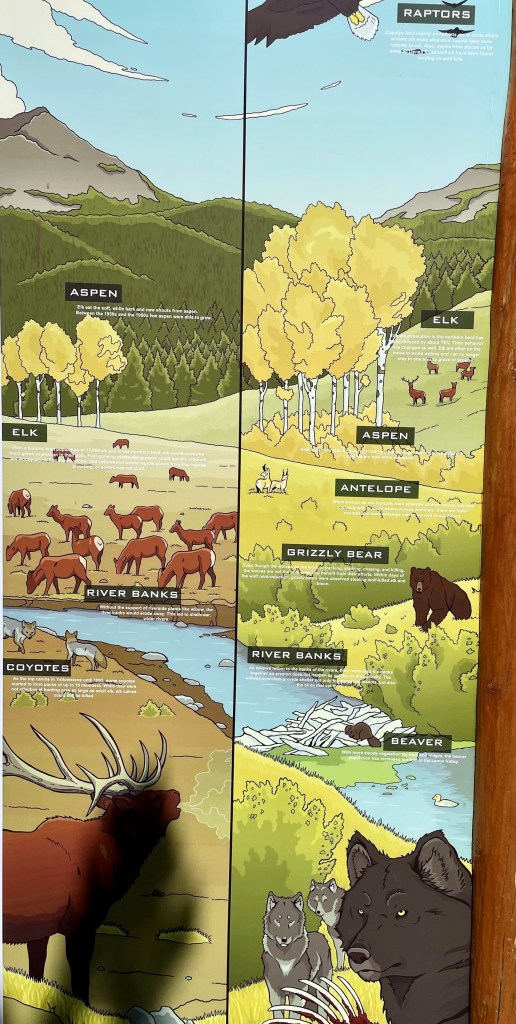
(The text in the picture is small – so, you’ll need to click on it and zoom in)
Prior to the re-introduction the of wolves, the elk population exploded because coyotes were now the top carnivores in the ecosystem and weren’t capable of killing grown elk. The elk were eating the Aspen and all available green vegetation. Without the support of riverside plants, river banks got eroded and led to shallower and wider rivers.
Once the wolves returned, raptors from far away returned to Yellowstone to feed on wolf kills. The northern herd elk population was cut by 75% – enabling Aspen to grow again. There are more antelope again as the wolves don’t hunt antelope. Within days of reintroduction of wolves, grizzly bears were observed stealing wolf-killed elk and bison. And since there are more willow growing near the banks, insects and birds are able to survive. The woody vegetation also helped grow the beaver population ten-fold.
There are so many lessons from the story. The one that stands out to me is the power of interactions within complex ecosystems. First order effects are just appetizers in complex ecosystems. We only truly understand an ecosystem when we are able to visualize the second, third, fourth, and fifth order effects.
This makes the communication of our impact on an ecosystem incredibly challenging. Our default behavior is to look past any immediate effects. Ergo the frustration of every climate scientist attempting to explain the impact of our actions on future climate. Their audience looks up to the skies, points to a minimal change in the weather, and shrugs. This is especially the case when the path to reducing damage is arduous.
But this isn’t just about the world’s climate – complex systems exist all around us. We need to look no further than the economy for a great example of one very few people understand.
“This, then, is the human problem: there is a price to be paid for every increase in consciousness.
We cannot be more sensitive to pleasure without being more sensitive to pain. By remembering the past we can plan for the future. But the ability to plan for the future is offset by the “ability” to dread pain and to fear the unknown.
Furthermore, the growth of an acute sense of the past and future gives us a corresponding dim sense of the present.
In other words, we seem to reach a point where the advantages of being conscious are outweighed by its disadvantages, where extreme sensitivity makes us unadaptable” | Alan Watts
There’s a simple case for consistently prioritizing good quality sleep. When we’re sleep deprived and tired, we make mistakes.
In the best case, we spend a bunch of time attempting to fix those mistakes. In the worst case, our attempts to fix those mistakes result in more mistakes.
Worse still, tiredness makes us feel pessimistic. So, we feel less capable of fixing the very mistakes we made.
The return on investment in prioritizing sleep is significantly higher than it appears on first glance. It is a great example of a high leverage habit as one good choice enables a cascade of better choices.
And, in the long term, it may just be the highest leverage choice of them all.
A simple way to understand how a person perceives their position in the social hierarchy is to see (a) how they treat you when you make a mistake or (b) observe how they behave when they make a mistake.
There’s a caste system / hierarchy / pecking order at work in every part of the world. Some of these are local and some more global. But it always exists – pecking orders (both perceived and real) are a part of how we organize ourselves. And they reveal themselves when mistakes are made in public.
These hierarchies don’t just show up when a waiter makes a mistake in a restaurant, they are present in our lives too. In the past 12 years, I’ve had the fortune of driving in many places around the world. I’ve made my fair share of mistakes – especially so in new places as we figured out the rules of the road (some unsaid) and directions.
But, in all these years, there’s an unfortunate pattern. Whenever I have a bad experience – defined by someone shouting something unpleasant or honking longer than necessary – I know that I’ll look up and likely find an old male of the dominant caste in that specific place.
Understanding this dynamic is helpful for two reasons.
First, it helps put unpleasant experiences into context. There’s no point letting some random stranger spoil our mood.
Second, it helps us better understand our default reactions. We are likely to find ourselves feeling a lot more apologetic in contexts where we perceive ourselves to be lower on the social hierarchy. And vice versa.
A simple guideline for when we ask for something that matters to us – the first no isn’t a no.
No just happens to be the default response. It almost doesn’t matter what we’re asking for – a change in compensation, an upgrade of some kind, or for someone’s time. No is the answer we’ll get 80% of the time.
And, in nearly every case, it pays to ask again.
If we’re able to better modify our ask to something that we think they might be more amenable to, that improves our chances some more.
“I realize that x may not be possible. Any chance we could do y?” works like a charm because it shows we care enough to ask again.
The single best feature of the internet in my book is the ability to get advice from strangers.
A few times every week, I type a random question into the search bar. Sometimes it is a “how to do x”, sometimes it is asking for an itinerary when visiting a place, and on other occasions, it is figuring out where to eat.
I’m never disappointed.
Instead, I’m often amazed at the painstaking detail and thought put into all this guidance.
Knowledge is power. And I’m grateful to all these strangers who take the time to pass it on.