The 1 major project heuristic

I spent most weekends in the 2010s attempting to do too much thanks to a propensity to say yes to too many projects. The result was disappointment on many a weekend as I got far less done than I wanted. My weekend to do lists were far too ambitious.

Occasionally, it meant a lot of pressure on the work week too as I tried to squeeze out time in the evening/early morning.

It wasn’t fun or helpful and this stopped working after we had our second kid (it was on life support after our first).

To counter this, I adopted a simple heuristic in the past couple of years – I only work on 1 major project at any given moment outside work.

There’s no fixed “type” of project. It could be a project related to home, family, side projects, or something else altogether. Some projects take a lot of time over multiple weekends and multiple months before I move on. Some are much shorter.

Either way, the rule has helped inspired a lot of clarity in my decision making. It has helped me go into weekends with clear expectations of what I can get done. And, most importantly, it has made it easy to say no or not now to everything except the project of the moment.

Simple heuristics go a long way in helping simplify our decisions and our lives.

When there is doubt

I had shared a quote a few months ago from Frank Slootman that I was reflecting on today.

“Years ago, I used to hesitate and wait situations out, often trying to fix underperforming people or products instead of pulling the plug. Back then I was seen as a much more reasonable and thoughtful leader — but that didn’t mean I was right. As I got more experience, I realized that I was often just wasting everybody’s time. If we knew that something or someone wasn’t working, why wait? As the saying goes, when there is doubt, there is no doubt.” | Frank Slootman, Amp It Up

Frank Slootman is the CEO of Snowflake and previously scaled both ServiceNow and Data Domain – a rare 3x successful CEO. The insight and experience buried in this quote resonated deeply when I first heard it in April. However, as I’ve been reflecting on it some more, my appreciation has continued to grow.

If it isn’t working, make the call.

When there is doubt, there is rarely any doubt.

A conversation with Seth Godin – coming live this Friday

Long time readers of this blog know that Seth’s blog has been a huge inspiration over the years. That’s aside from the fact that many of you first subscribed to this blog thanks to Seth sharing a link to this blog in his posts over the years :-). TLDR – I’m very grateful to Seth for the inspiration, support, and encouragement over the years.

So, I’m very excited about hosting a conversation with Seth on Friday morning 10am Pacific Time (1pm Eastern Time, 6pm UK, etc.). We’ll be talking about “The Carbon Almanac” as well as Seth’s perspective on careers and leadership. While this is part of a “Speaker Series” event at LinkedIn, we’ll be broadcasting this live globally.

You can register here if you’re interested.

I hope you’ll be able to make it.

Cutting through the noise of opinions

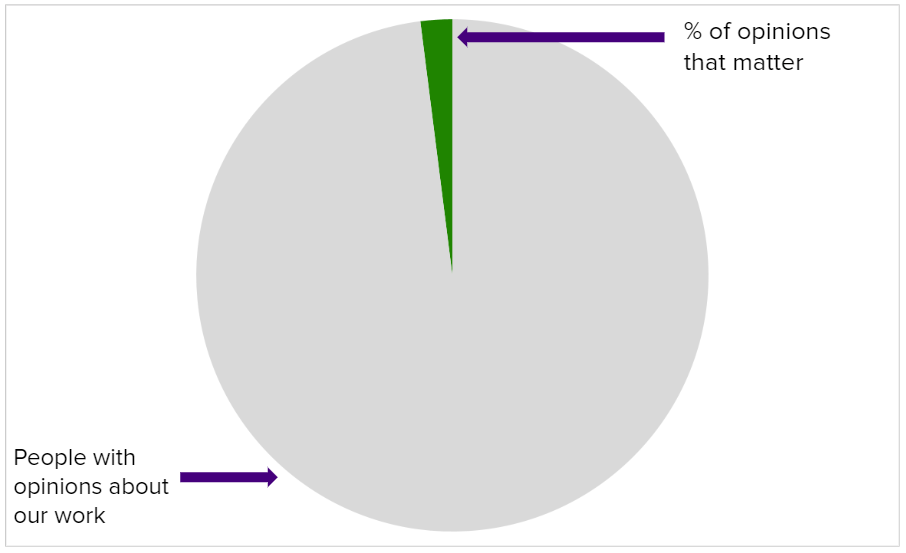
There are always going to be opinions about our work that irritates/annoys/makes us feel inadequate.

Very few of them matter.

There’s always going to be a lot of noise. That’s just a test of our effectiveness and maturity. The noise grows proportional with the size of our ambitions and actions. We can’t get rid of it.

But… we always get to choose what we pay attention to.

All we need to do is be disciplined enough to consistently ask – does this matter?

The question will show us the way.

Mrs. Vanaja Vimal

I didn’t believe I was capable of drawing or writing particularly neatly as a kid. My handwriting wasn’t bad – but it wasn’t good either.

I met Mrs. Vanaja Vimal – a.k.a “Vanaja miss” – in my 8th grade when she introduced herself as our new science teacher. She shared in that class that she expected neat submissions every time – no exceptions.

She then turned around to write her first set of notes on the white board.

I still remember our reaction when we first saw her writing. It was pristine. Almost like someone had typed it out in a cursive font.

She then drew something on the board. Again, pristine. It was clear she meant business.

That year, our science notebooks were significantly neater than all the others.

In time, that experience made me realize that I could write and draw a whole lot neater than I thought. It changed the game.

Sometimes, all it takes is for us to meet someone who has that combination of high expectations (both in what they say and do) and a belief in our ability to meet them.

“Vanaja miss” was certainly one of them.

Face to Face

Venture Capitalist Fred Wilson shared a few of his thoughts on work norms around remote and hybrid work in a post titled “Face to Face.” A few excerpts –

“The covid pandemic taught many of us that we can be productive and our companies can succeed in a fully remote work environment. But just because you can does not mean you should.”

“But even if the way we work has changed permanently, it does not mean that it has changed for the better. I believe that all change has positive and negative impacts.”

“We know that humans are better to each other in person. We know that in-person interaction is more meaningful, we are more present, and we connect in more fundamental ways. So I believe that we must work in the coming years to get out of our offices (or homes) and see each other in person more often.“

“For companies, this means hiring should include a face-to-face meeting. Teams should meet in person regularly. Going to the office should be a regular occurrence for those that live near one.”

“It is time to get back to the office, at least some of the time. It will make for better business. And I also think it will make us happier at work.”


This is an idea that’s been on my mind in the past months too. I’ve experienced situation after situation where an in-person conversation helped us make more progress than we’d have made in hours of video calls.

This is especially on top of mind as I’m coming off an event that brought together folks across various teams across our company. It was an intense 48 hours or so as it involved many conversations – some intentional, some serendipitous.

It is hard to calculate “RoI” / return on investment on these conversations – but, if I had to bet, the RoI is likely to be incredibly positive. These conversations will spark more collaboration and more synchrony across teams than any other mechanism we’d have otherwise deployed.

In industries where it isn’t necessary, we’ll never go back to in-person work 5 days a week. But I don’t think swinging the pendulum all the way to remote is the way forward for everyone either. In roles that rely on deep cross functional collaboration, prioritizing in-person time on some regular cadence goes a long way.

And in roles where that isn’t the case, creating excuses for high quality social interactions from time to time could be the difference between a high performing team and one that is struggling to get going.

Counting another person’s money

A friend shared a great story about NBA superstar Steph Curry. In 2017, Steph Curry had turned in incredible performance after incredible performance to win the NBA title for the Golden State Warriors. However, thanks to a 4 year contract he’d signed in 2012, he was making less than half per season as some of his fellow top NBA players.

When he was asked about this, he said – “One thing my pops always told me is you never count another man’s money. It’s what you’ve got and how you take care of it. And if I’m complaining about $44 million over four years, then I’ve got other issues in my life.”

“My perspective was: ‘Man, I’ll be able to take care of my family with this. Blessed to be able to know I’ll be playing at least in the NBA for four years and see where it goes from there.”

It is easy for us to point to his massive wages and say that it is easy for him to say that. But we are social creatures who compare ourselves to others. It would have been easy for him to put any sense of happiness to death by comparison.

But he didn’t.

His approach reflects an enlightened perspective stemming from a simple and powerful idea – don’t worry about how much other people have.