
The biggest contributor to discontent in otherwise healthy relationships is an accumulation of unspoken and unclarified expectations.
Category: Everything else
Free couch to paid couch optimization
We were going to give a couch away for free recently so it could be reused by someone in need. However, the service we signed up for refused to accept it due to a small stain – a bizarre/myopic policy.
So, we decided to put it up for sale for a small amount on Craigslist. We got a series of quotes and had someone pick it up within 2 hours.
After this happened, my mind wandered for a few minutes to explore another possibility – had I given this away too cheap? Maybe I could have charged significantly more?
3 reflections –
(1) It is amazing how quickly I went from “So glad we could find another home” to “Should I have charged more?” A full 2 days after writing about moving goalposts. :-)
(2) Money is such an easy factor to optimize for. It is so easy to ignore the many intangible trade-offs because, well, they are intangible.
Beware optimizing for things that are easy to optimize.
(3) The best way to think about optimization is to pick your areas in advance. There are very few areas in life that are worth optimizing. For the rest, best to be a “satisficer” and move on.
Money and class
I remember first reading the quote “Money doesn’t buy class” more than a decade ago. It was one of those ideas that I thought I understood.
But I didn’t. I hadn’t interacted with folks with a lot of money up until then.
Over the past decade, I’ve had the opportunity to interact, meet, and get to know – directly and indirectly – people with vast amounts of wealth. And I have come to realize that wealth doesn’t correlate with class. Not one bit.
Wealth simply amplifies what already existed. If there was goodness, wealth brought out a lot of it. If there was insecurity, wealth made sure you could never miss it. And an absence of class stayed as is – regardless of the number of zeros in a bank account.
Money does not and cannot buy class.
Class is earned by emotional awareness and actions that don’t correlate with the accumulation of wealth.
Moving goalposts
I experienced an outcome a few days ago that should have, at least for a while, felt positive. But it didn’t feel that way.
Somewhere along the way, I think I had set my sights on a possible grander outcome. And now that I had moved the goalposts, what I had didn’t feel all that great.
I reflect on this idea from time to time – especially when someone asks for my career/life story. I don’t think I could have imagined the life I lead right now two decades ago. It was the stuff of dreams just a decade ago.
And yet, it is so easy to take it all for granted by simply moving goalposts. I’m here now – so it is natural to spend all my time thinking about how to get there. There’s always a “there” – a good reason to forget about the magic of “here.”
It is human to keep raising our expectations and to thus keep moving those goalposts. It takes a lot of discipline and commitment to nudge ourselves when we do and remind ourselves to not take our current reality for granted.
All that discipline and commitment is worth it though. When we habitually move goalposts, life just becomes a bottomless pit of unfulfillment.
Beware moving goalposts.
The simplest way to waste a day
The simplest way to waste a day is to spend time and energy on areas outside our circle of control.
Spending time within that circle of control do not guarantee progress. We may still encounter frustration and disappointment. But, if keep at it, it all pays off in the long run.
Time spent outside our circle of control, however, doesn’t inspire any forward momentum – now or in the future.
Amazon Music to Amazon Prime
An email came in from Amazon Prime announcing that they’re adding Amazon Music to the Amazon Prime bundle.
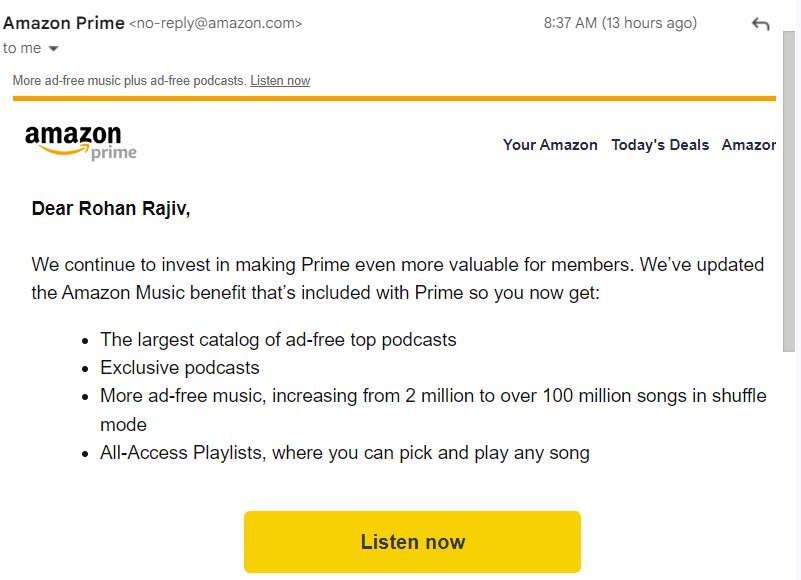
Without knowing anything about the internal rationale, this feels like a smart move.
My guess is that this wasn’t a big money maker for Amazon – likely a rounding error relative to Amazon Prime. And this move enables them to do 3 things at once –
(1) Win customer loyalty – at a time when most subscription services are working on ways to increase prices, Amazon has chosen to go the other way and make an already valuable Prime subscription more valuable.
(2) Simplify their SKU line up and focus any and all sales on the Prime product
(3) Increase the value of the Prime bundle so that it is easier to raise prices on Amazon Prime later. It is likely that increasing the value of the Prime bundle by $1 will give them orders of magnitude better RoI vs. attempting to sell Amazon Music separately.
More is not always better.
Smart.
Dilip Mahalanabis
“I don’t mean this callously, but it is an undeniable fact that if you are interested in getting newspaper headlines, you are better off becoming a mass shooter than inventing a life-saving medical therapy.” | Steven Johnson on the quiet passing of Dilip Mahalanabis.
Dilip Mahalanabis (see more in SJ’s tribute post) was the key figure behind Oral Rehydration Therapy, a revolutionary and surprisingly simple technique that has prevented millions of people, particularly children, from dying of diarrheal diseases like cholera over the past few decades.
RIP and respect.
Making good players great
Great coaches consistently make good players great by (a) putting them in roles they’re best suited to succeed and (b) inspiring self-belief.
Finding the right role is a pre-requisite to great performance – it creates the right environment. Self-belief is the difference maker.
The merchant in Baghdad
“There was a merchant in Baghdad who sent his servant to market to buy provisions. In a little while the servant came back, white and trembling, and said, Master, just now when I was in the marketplace I was jostled by a woman in the crowd and when I turned I saw it was Death that jostled me.
She looked at me and made a threatening gesture, now, lend me your horse, and I will ride away from this city and avoid my fate. I will go to Samarra and there Death will not find me. The merchant lent him his horse, and the servant mounted it, and he dug his spurs in its flanks and as fast as the horse could gallop he went.
Then the merchant went down to the marketplace and he saw me standing in the crowd and he came to me and said, Why did you make a threatening getsture to my servant when you saw him this morning?
That was not a threatening gesture, I said, it was only a start of surprise. I was astonished to see him in Bagdad, for I had an appointment with him tonight in Samarra.”
There are two lessons I thought of when I heard this.
The first is that there’s no point outrunning death. It catches up with us all. Best to make peace with our mortality and make the most of the time we have.
The second is an idea Master Oogway shared in the (likely) most quoted movie on this blog – Kung Fu Panda – “One often meets their destiny when trying to outrun it.”
I’m not a fatalistic person. But we also live in a world where we control little.
And it is good to recognize that from time to time.
Surprise and learning
People learn when they’re surprised.
This simple insight has shaped how I design learning sessions of late. Instead of focusing just on the content, structure, and delivery, I’ve found myself spending time thinking about how to introduce surprise.
Surprises introduce humor, make insights more memorable, and inspire a shift in perspective.
That shift in perspective, in turn, leads to learning.

