
By default, we tend to over-optimize the way we’re playing the current game we’re in and under-optimize the decision involving which game to play.
Author: alearningaday
Attitude reflects leadership
One of the seminal scenes in the movie “Remember the Titans” is when the two protagonists have a heated exchange after training.
Julius: You been doin’ your job?
Gerry: I’ve been doin’ my job.
Julius: Then why don’t you tell your white buddies to block for Rev better? ‘Cause they have not blocked for him worth a blood nickel, and you know it! Nobody plays! Yourself included! I’m supposed to wear myself out for the team? What team?! No, No. What I’m gonna do is, I’m gonna look out for myself, and I’m gonna get mine.
Gerry: See, man? That’s the worst attitude I ever heard.
Julius: Attitude reflects leadership, Captain.
The two end up becoming best friends after this exchange. Gerry becomes the leader the team rallies around and Julius becomes the defensive star.
It is one of those moments that has stayed with me nearly two decades since I first saw the movie.
It reminds me of a simple idea that is so true.
Disgruntled leaders create disgruntled teams. Political leaders create political teams. Constructive leaders create constructive teams. And so on.
The team’s attitude is generally a reflection of its leadership.
NBA shots and optimization
I’ve been a subscriber to “The Growth Equation” – a usually insightful weekly newsletter. In today’s post, Brad had a fascinating note on how data and AI push us down the path of over-optimizing everything.
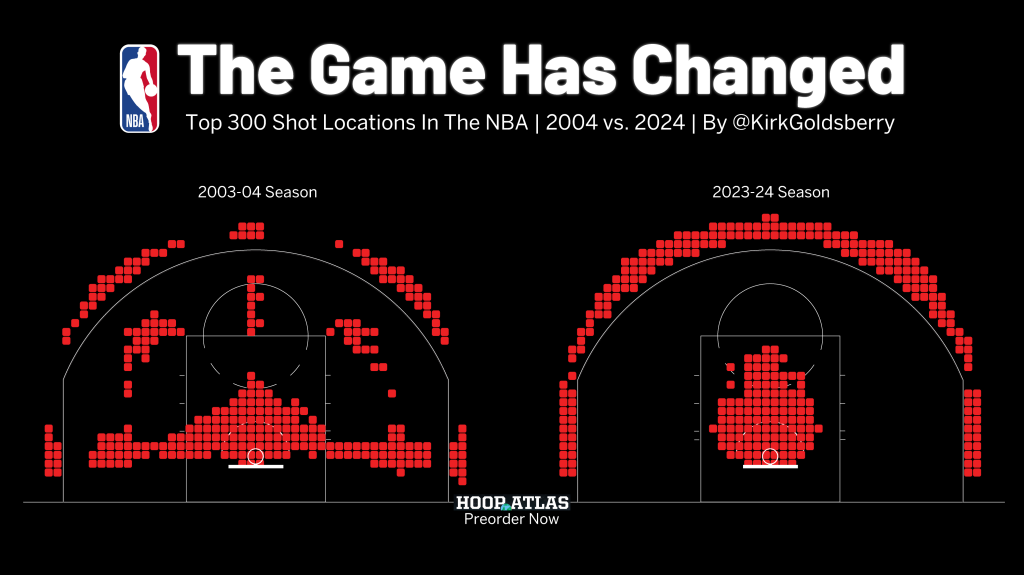
The example I liked was about how NBA players have optimized where to take shots. Thanks to all the percentages involved, shots today are only taken on the 3 point line or in the area right under the basket.
Sports aren’t the only place where we see this shift in emphasis. As writer Derek Thompson has outlined, movies are the same. Over the past few decades we’ve been inundated with sequel and reboot madness. The comic book mega universes, Mission Impossibles, Fast and the Furious 23, and just about every successful kids movie has a sequel. Movie studious fund known quantities. The idea of an original picture has largely gone by the wayside. Why? It’s economics. A known quantity is more likely to be a hit. And hits have an outsized effect. They need the home run to survive. Singles won’t do.
In many areas of life, more knowledge and data has led to optimizing for an outcome. We optimize for hours of sleep, productivity, exercise routines, and our kids sporting activities and academic prep.
But optimization comes at a cost. Baseball is struggling. NBA ratings are down from their peak. The movie industry is in disarray.
When we over optimize, we lose quality. Maybe not in terms of the bottom line, but in terms of things that we don’t regularly quantify, or perhaps that are impossible to measure altogether: qualities like enjoyment, artistry, and meaning.
Think of it like this: right now, I could take an AI bot, train it on all of the best tweets that myself, Brad, or better yet, James Clear, has tweeted. It would then spit out all of this pseudoprofound bullshit designed to go viral. And it would probably work (Just look at tech bros social media right now…where it’s impossible to decipher between what is real and what is a bot—the singularity has occured!). But to me, something is lost there. It’s not truly profound. It’s not engaging with an audience. It’s not testing ideas and learning. It’s synthetic. It might lead to a desired outcome, but it lacks curiosity, intrigue, and enjoyment. If I consumed AI tweets all day, it would turn me into a numb, pessimistic automaton, and train my audience for nonsense that appears helpful but has no meaning behind it, instead of wrestling more nuanced ideas.
It’s the same with the rest of our lives. We optimize our routine for productivity, forgetting that most breakthroughs come when we are mindlessly going on a walk or fiddling around letting boredom work its magic. We optimize our child’s chances at getting the athletic scholarship in soccer by specializing early and paying for a private coach; yet in doing so, we neglect the unstructured play that may seem pointless and inefficient in the short term, but pays off massively in the long haul. When researchers have studied athletes who actually make it to the top, they tend to have more unstructured play than their peers, whereas overly structured sporting activities is tied to fear of failure and burnout.
The point is that optimization often backfires, even for the results we desire.
Indeed.
The Multiplayer game that isn’t
Life is a single player game that looks and feels a lot like a multiplayer game.
Gamer beware.
Stress and the mind’s direction
“The mind can go either direction under stress – toward positive or toward negative: on or off. Think of it as a spectrum whose extremes are unconsciousness at the negative end and hyperconsciousness at the positive end. The way the mind will lean under stress is strongly influenced by training.” | Excerpt from Dune by Frank Herbert
This idea is one I’ve found so true. Many assume our response to stress is hardwired. While it is true that we have default responses, training can transform how we approach stress.
The first step, as always, is awareness.
Write it to debate it
A simple work productivity practice – Before you start debating something, take the time to write out your point of view.
Ideas that aren’t written down are hard to debate because nobody has taken the initiative to put down a concrete point of view that anchors the conversation. Stay away from debates that don’t have a document.
Write it down. It helps move things forward.
Perplexity
Perplexity is quickly becoming my go-to search engine. After ChatGPT’s launch, I found myself using ChatGPT a lot – especially when I was seeking recommendations or planning travel. My usage was roughly 50-50 between ChatGPT and Google/Bing (via Ecosia).
Over time, however, I found myself missing links where I could learn more. And that’s how I fell in love with Perplexity. When I ask a question or search for something, I see the links Perplexity generates its content from. I find myself taking a look at the links often to get a better sense of the validity of the response.
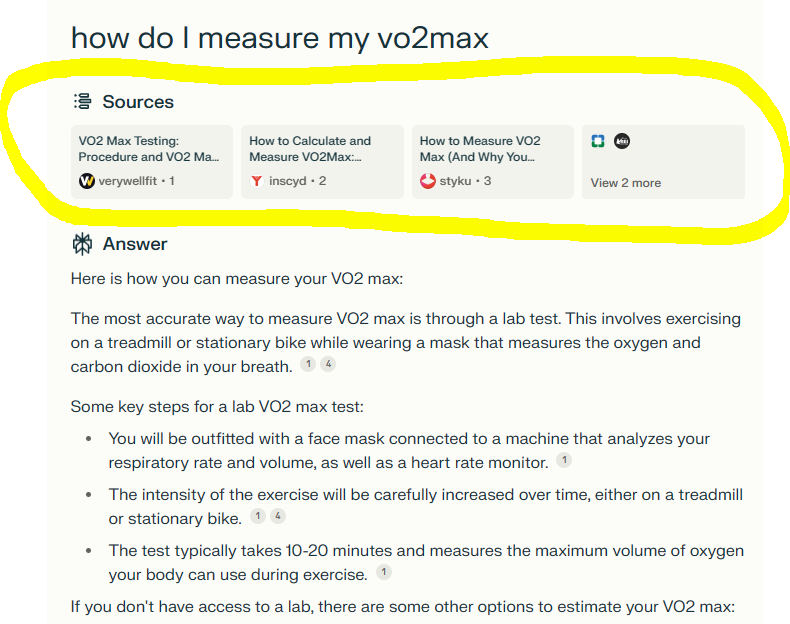
Perplexity has increasingly grown its share of searches. I think my share is roughly 70% Perplexity, 25% Bing (via Ecosia)/Google, and 5% ChatGPT.
I’m excited to see how this evolves.
PS: Perplexity also has a special place in my heart as the Co-founder and CEO is a fellow high school alumnus. Kudos Aravind!
Songs, aspirations, reflections
I was on a drive today where I heard songs from three distinct times of my life.
The first was a song I first heard as a 13 year old. It was my favorite song for a time.
The next was a song I heard a lot as a 16/17 year old as part of a CD I’d burned with my favorite songs from that time.
The final one was from my time as an intern at graduate school. I’d hear this song before pulling into work.
Each of these songs brought back memories about my aspirations from the time. As a 13 year old, I’m not sure what my aspirations were. I guess they had something to do with doing well in my next exam.
As a 16/17 year old, I wanted my university dreams to work out.
And as a graduate school intern, I just hoped I’d get an offer to come back.
All of these hopes worked out just fine. This walk down memory lane reminded me of three things.
(1) It is so easy to take our current life for granted. Often, so much of what we have is the stuff of dreams. I think of this a bunch when I listen to a collection of songs from a time when I just hoped my now-wife would date me. :-)
(2) Happiness is reality over expectations. While it shouldn’t be over-done and acknowledging this isn’t a push for a lack of ambition, it helps to keep expectations low.
(3) Very few problems we’re dealing with will feel significant in a decade.
Gaining perspective – 2 activities
I wrote about the two signs that point to losing perspective recently. Today, I thought I’d cover the two activities that help me gain perspective.
(1) Time out in nature: Getting out to the woods or to the mountains or near the ocean – ideally for an extended amount of time – tends to help me reset. Time out in nature reminds me of my place in the big scheme of things and helps put my problems in perspective.
(2) Writing: Writing is often the balm my soul needs. The act of attempting to make my thoughts coherent often help them become so.
It isn’t complicated once I’ve realized I need to do this. As a rule, becoming aware of the problem is the bigger challenge.
Reactive and proactive language
“It fell” vs. “I dropped it”
“I can’t” vs. “I won’t”
“I am not good at that” vs. “I am not good at that yet.”
We often work through the difference between reactive and proactive language with our kids.
As I do so with them, I find myself realizing how often I choose reactive language myself. And, in doing so, I lose the opportunity to let proactive language bring the accountability and agency that transforms the conversation.

