Last summer, I had the opportunity to spend two days in Lauterbrunnen valley. Beauty is in the eye of the beholder and we all have different ways of perceiving beauty. In my eyes, it was hands down the most beautiful place I’d ever been to.
Snow-capped mountains, stunning green meadows, and waterfalls – Lauterbrunnen valley is, in a word, incredible. It reminded me of Yosemite valley (the topic of another post) – except larger and – against all odds – prettier. Below are a couple of photos clicked on an iPhone.
The name “Lauterbrunnen” translates to “loud springs.” The valley has 72 waterfalls. The most stunning of these – in my opinion – is the Trummelbach falls. These falls are on the inside of the mountain and their power is awe-inspiring.
These falls are made possible by melting glaciers from the tallest Alps – Jungfrau, Eiger, and Monch. At a time when the warming climate is reducing the glacier coverage on this planet, places like this remind us of the importance of finding ways to stop and, hopefully in time, reverse the impacts of climate change.
Both sides of the valley have picturesque car-free villages. I loved the idea of car-free villages. We need more of those.
And, a fun fact, this valley was the inspiration for “Rivendell” in the Lord of the Rings saga.
A study from Raj Chetty et al looked at the long-term impact of kindergarten teachers. The TLDR is that experienced kindergarten teachers have a long-range impact on their student.
They posit that experienced teachers create an environment that results in kids developing better non-cognitive/social skills that tend to have large long-term impact on their well-being.
A good start to school goes a long way. Quite literally.
This poll from Heatmap (original post is paywalled) made me chuckle. In a survey with 2000 American respondents, only 14% said they support Methane gas for electric generation. That makes sense – Methane is the biggest contributor to climate change and is a poor choice compared to some of the others we have today.
However, thrice as many people said they support natural gas.
The kicker is that – despite the natural sounding name – they are both the same thing.
Stand-up comedians are known for breaking up their act into small components (“bits”) and relentlessly testing these with smaller audiences before a big show.
It is a great way to think about shipping products. De-risk the big launch by breaking it up into smaller bits that can help you get early signal.
It is also a great analogy for learning to pitch something. You just have to keep practicing that pitch and take all the feedback you get along the way.
Leading car manufacturers in the past few decades have been concentrated among manufacturers from a few countries like Germany (Volkswagen et al), Japan (Toyota), and the United States (Ford, General Motors). The biggest challenge any incumbents faces is moving quickly when new technology arrives.
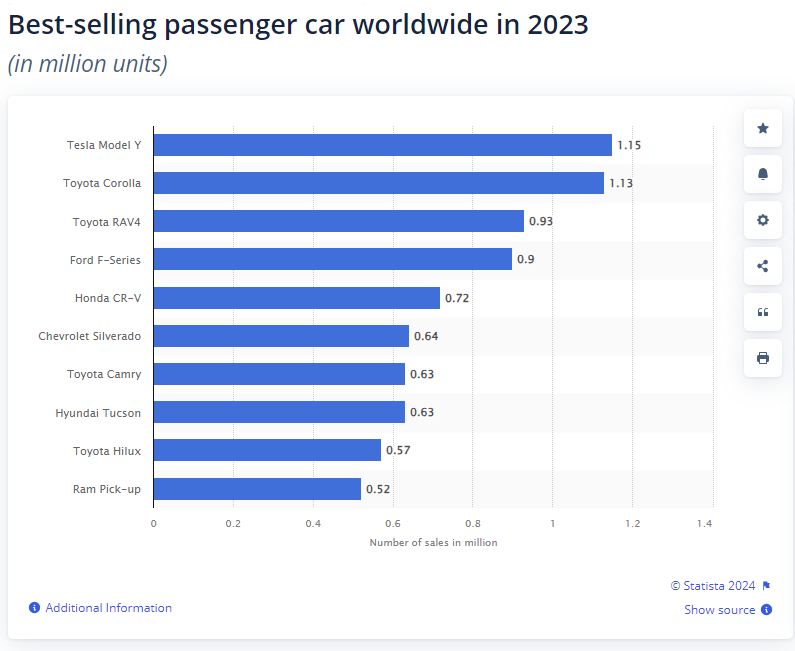
Tesla’s success has been a great example of the incumbents’ failure to respond. In 2023, the Model Y was the best selling car in the world – beating the Toyota Corolla. Tesla reimagined a great driving experience and reaped the results as the undisputed leader in electric vehicles for the past decade.
All this while, we’ve seen the incumbents takes a few steps forward with a few steps back. Call it hubris or a lack of conviction or some mix of both – but they’ve taken their time. So, reading this excerpt in the Exponential View about the progress in China was eye-opening.
China has reduced vehicle costs through economies of scale in manufacturing, allowing prices as low as $10,000 per vehicle. In addition, wages are likely to have increased fivefold since 2008¹. These factors have made vehicles more affordable for China’s middle class. Last year, China registered 8.1 million new EVs. With 120 million factory workers, unlocking domestic demand will create a virtuous cycle of learning and growth for manufacturers.
Chinese cost leadership in EVs is already challenging US and German companies. The Tesla Model 2, cancelled in April, was going to cost $25,000 and the cheapest Volkswagen EV is €36,900 – both well above BYD’s $10,000 Seagull. Tariffs of 100% in the US and potentially of at least 50% in the EU are designed to buy time for incumbent carmakers, but the pressure is on to compete. These companies bear some responsibility for their situation, having defended ICE vehicles rather than embracing the exponential trajectory of battery pricing and EV demand.
The tariffs won’t mean much to China – there are plenty of markets for their cheap vehicles, Brazil, Asia, Africa (and Ethiopia, of course). Even in the UK, I just saw my first BYD in a local neighbourhood in London last week.
The lesson is a cautionary tale of hubris, for Western car makers who doubted the exponential trend sweeping electric vehicles and stepped in too timidly and, possibly, too late.
As fascinating as this case study is, this post isn’t about the car industry.
Instead, it got me reflecting on my own decision making. We all are dealing with versions of this story – in our personal lives, in our career, and in decisions we make at work.
It is so easy to get attached to the status quo – especially when it feels comfortable in the moment. It is best to anticipate the change and move toward it on your own terms rather than get caught reacting to it.
I saw an insightful post/clip from a Jeff Bezos interview where he shared his perspective on stress. He said – “Stress comes from ignoring things that you shouldn’t be ignoring”
“If I find that some particular thing is causing me stress, that’s a warning flag for me. What it means is there’s something that I haven’t completely identified – perhaps in my conscious mind – that is bothering me and I haven’t yet taken any action on it.”
“I find as soon as I identify it and make the first phone call or send off the first email message… Even if it’s not solved, the mere fact that we’re addressing it dramatically reduces any stress that might come from it.”
”People get stress wrong all the time in my opinion. Stress doesn’t come from hard work, for example. You can be working incredibly hard and loving it. And likewise, you can be out of work and incredibly stressed over that.”