Guilt and Shame

Guilt is when we feel we have done something bad.

Shame is when we feel we are bad.

Every once a while, guilt can be useful as it pushes us to take action and right things we’ve done wrong. Shame, on the other hand, does nothing constructive. First, it paralyzes us. Then, it goes on to mess with our sense of self-worth.

It is a fine line between a scolding that says – “Your actions created a mess” – and – “You are a mess.” But, that fine line is capable of inflicting a large amount of damage. I know someone who was made to wear a sign on their chest and walk around in public for a few days in return for a mistake they made. While the purpose may have been to guilt them, this had shame written all over it.

Good people do bad or mean things every once a while. This is especially true for kids who are still to understand the difference. Making them feel shame, sadly, is a self fulfilling prophecy.

Now that we know the difference, we will hopefully recognize it when we see it around us. Most importantly, we’ll be able to use the difference to make sure we steer clear of shaming in our lifetime.

—
HT: Brene Brown

And that’s okay

There’s an important line of self talk before you embark on a new project. The first part of it is acknowledging “This might not work.” And, the second part is saying “And that’s okay.”

This might not work is the acknowledgment that what we’re doing is an experiment. And, experiments may or may not work. “Might” is the key word in that phrase. “Might” acknowledges that tension that requires us to have the courage to dare, to go out on a limb.

But, “this might not work” alone is incomplete. “And that’s okay” is a key half of the puzzle. It requires us to have the confidence to look the “might” in the eye and say – “I’ll be fine.” It asks us to accept that troubles, when they appear, will pass – like water under a bridge.

This complete phrase has a liberating effect. It tells us that we are a lot more than what we do. It helps us grasp the difference between states and feelings. We can feel the disappointment of a defeat and, yet, be content, happy even. We might feel the joy of victory but, yet, enjoy the equanimity.

Rudyard Kipling, in his wonderful poem, “If” said –
If you can make one heap of all your winnings
And risk it on one turn of pitch-and-toss,
And lose, and start again at your beginnings
And never breathe a word about your loss;

If, indeed. It is the sort of game changer that makes it worth a try.

This might not work. And that’s okay.

—
HT: Seth, for introducing me to “This might not work.”

Beavers and rabbits

In 1946, members of the Argentinian navy released 10 beavers to enrich the ecosystem and perhaps kick start the fur trade. Now, beavers have wrecked havoc in Argentina for decades. Unlike trees in North America, trees in South America die when beavers sink their teeth into them. Without a natural predator, they are now a hundred thousand strong. And, Argentina has declared a war on beavers

Australia faced a similar problem when 6 rabbits were introduced for hunting. Rabbits turned out to be an invasive species in Australia.

The obvious lesson here is to beware messing with the delicate balance in nature. There are two other less obvious ones.

First, small things have the ability to mess with the balance in an ecosystem. Nice organizational cultures have been destroyed by a few bad hires. Introduce one person who enjoys politicking more than doing the work and you might not notice much change. However, bring a few and it’ll soon affect the ecosystem.

On the flip side, you might also find yourself in environments where you are the invasive species. In an environment that thrives on the fact nobody asks questions, asking questions might result in the environment rejecting you.

Pay attention to the environment. Some adapt, others don’t. And, while some will work well for you, others won’t. Make sure you choose. And, once you make your choice, pay attention to the changes it undergoes. A change in your environment is sure to have an impact on your life and happiness.

Long held assumptions

We all have long held assumptions.

In my case, from when I was a child, I was told that I must have a fast metabolism. I think it is common to tell folks who remains thin while having a good appetite that that must be the reason. And, I never questioned it.

Over time, it morphed into a fact in my mind. It was no longer just an assumption. This is classic availability bias – you hear it so many times that you start believing it is the true.

A few weeks back, I had the opportunity to take a test to figure out my resting metabolism rate (or RMR). And, my report after the test told me that I was on the lower end of average for my comparison group. Not just average. Below average.

That test reinforced a bunch of powerful lessons. First, it reminded me of the dangers of confusing long held assumptions and facts. Second, testing this long held assumption with a $50 investment was particularly useful. It will help me manage my diet and my weight over time so much better. So, do test your long held assumptions when possible.

Finally, it also beautifully illustrated a fact that we all probably know somewhere deep inside. When it comes to burning calories, exercise isn’t anywhere as effective as leading an active, healthy life. While exercise helps us build muscle and improve our ability to burn calories and be active, there is no substitute to activity through the day. Small decisions like standing during meetings, taking the stairs, walking more often make a bigger difference over the long run than exercise.

Seek out those long held assumptions. They make up our default setting.

Outcome goals versus direction and process goals

Setting outcome based goals isn’t smart. “I will lose 10 pounds” or “I will achieve the highest performance ratings” are the sorts of goals that present more downside than upside in the long term. There’s a lot of great resources that talk about replacing goals with systems. While I think most of that thinking is good, it misses an important point. It isn’t enough, in my experience, to replace outcome goals with process goals. I find that it helps combining a process goal with a directional goal.

As an example, let’s take a weight loss related outcome goal – “I want to lose 10 pounds within 10 months.” The systems/process goal answer to this would be to replace this with some variant of – “I am going to eat healthy and exercise 3 times every week.”

This is a pretty drastic shift and is hard for most people. That’s because we’re replacing the idea of achievement in 10 months to no achievement. Ever. While it makes sense that we must trust in the process, it helps to have markers along the way.

And, as far as markers go, directional goals work great. There are 2 criteria for directional goals –
1. They need to be a range and shouldn’t be super specific. We always tend to over estimate how we’ll achieve in a year while greatly underestimating how much we achieve in a decade.
2. Their time period needs to be longer than the typical outcome goal you might set.

So, an example directional goal for our weight loss example would be – “I’d like to move toward a fitter body with toned muscles and 3-6 pounds lost within the next 12 months.

The idea is to ease the pressure while still giving you something to celebrate. The other benefit of laying down markers is that you can use them to check in on your process. If you’ve made absolutely no progress in 12 months, it is a sign that you need to fix your process.

The principle here is straightforward – any advice that asks you to ditch goals forever and replace them with process isn’t entirely right. It is helpful to over index on process as we all tend to swing too strong the other way. However, the best test of a process is if it is generating good results without you having to think about them. And, directional goals tend to be a great way to bridge that gap.

PS: Doing things well and right takes time.

Ineffective Lectures – The 200 words project

(continued from parts 1, 2, 3, 4, 5)
Anders Ericsson’s research on deliberate practice has been extensively in training elite athletes and musicians. But, what about in universities?

Nobel prize winning Physicist Carl Weiman from Stanford university collaborated with a Post Doc and a Graduate student from the University of British Columbia to experiment with redesigning a Physics course. Weiman believed that Professor centered lectures in universities have been ineffective for centuries and he has been on a quest to make things better.

For this course, Weiman and team focused on teaching skills versus disseminating knowledge. So, they redesigned the class to mimic a fast-paced athletic training session centered around the students. They broke a lecture down into various concepts. Each concept had a series of multiple choice questions that students answered in groups using clickers. They got immediate feedback followed by a short instructor led debrief and then moved to the next concept. The results? A 20 point improvement in attendance and a 15 point improvement in scores.

Weiman conducted the experimented both in UBC and the University of Boulder and both universities have begun redesigning courses to offer this format. How can we apply this in how we teach and learn?

Cognitive scientists have found that learning only happens when you have this intense engagement. It’s almost certainly the case that lectures have been ineffective for centuries. But now we’ve figured out a better way to teach” that makes students an active participant in the process. – Prof Carl Weiman

—
Source and thanks to: Peak by Anders Ericsson, Carl Weiman’s paper on the experiment, ScienceMag’s article
We’ve spent 6 weeks with Prof Ericsson’s work on deliberate practice. Next week will involve a final post providing what might seem like a counter point to his work (but isn’t – spoiler).. And what we might take away from all of this.

What the hell is water

Two fridays ago, a long time reader of this blog shared a speech that she said was her absolute favorite. It was around 4am and I was preparing my introduction for a learning session on values later that morning that I’d helped organize. But, as she said it was her absolute favorite, I searched for a transcript of the video and found it. It was a David Foster Wallace commence speech titled “This is Water.”

I’m glad I did.

The speech is so good that it is impossible to do it justice in one post. So, I thought I’d begin by sharing the short story that he starts with.


There are these two young fish swimming along and they happen to meet an older fish swimming the other way, who nods at them and says
“Morning, boys. How’s the water?” And the two young fish swim on for a bit, and then eventually one of them looks over at the other and goes “What the hell is water?”

The point of the fish story is merely that the most obvious, important realities are often the ones that are hardest to see and talk about. Stated as an English sentence, of course, this is just a banal platitude, but the fact is that in the day to day trenches of adult existence, banal platitudes can have a life or death importance, or so I wish to suggest to you on this dry and lovely morning.


After reading this, I re-wrote my introduction for the session and built it around this story. It is so wonderfully deep and insightful.

Days later, I keep thinking about it from time to time. It is very hard to be 100% conscious and present in this world. When we do manage to do that, we realize that everything we consider normal is nothing short of miraculous. We are all walking miracles. This is incredible. And, it is on us to make it meaningful, to make it count.

This is water.

Values privilege

Values are values only when they costs us money. So, if you care a ton about honesty, you might have to choose to buy all your movies instead of watching them pirated. Watching them pirated might be free. But, we have to trade off whether we care more about honesty or the money.

What happens when we don’t have any extra money then?

Values go out the door.

If you are a family that is struggling to make ends meet, you have no bandwidth to think or care about much else. It is all about survival. And, if it means survival of our group at the cost of another, so be it.

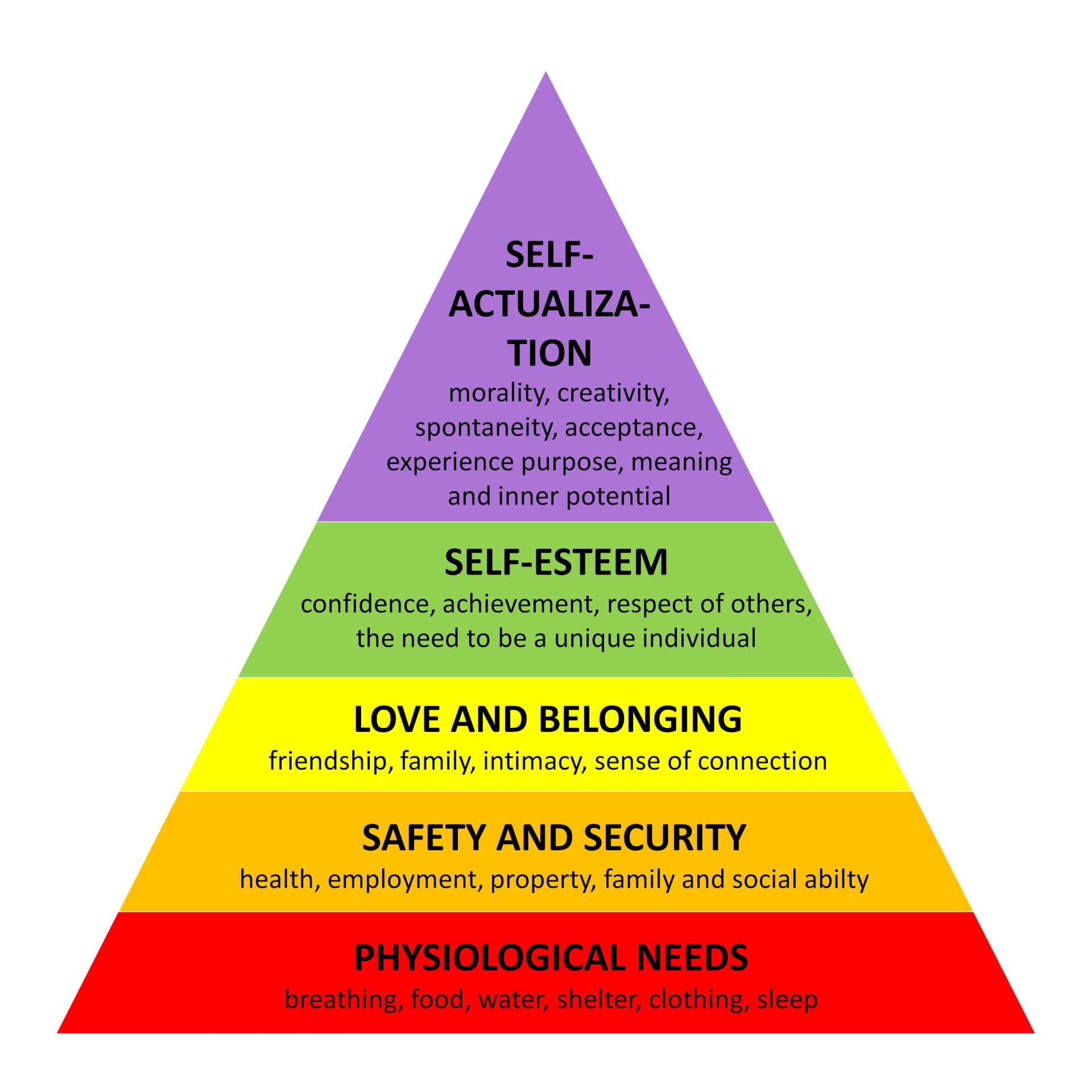
The Maslow’s hierarchy of needs explains this beautifully.

Image Credit: Simply Psychology

If our basic needs aren’t met, then values are a privilege we can’t afford. And, in a world where inequality continues to be on the rise, this will continue to be the case for a growing segment of the population. We will have to find a way to deal with this.

There is no way around it.

Flights to insecurity

We all have insecurities. These insecurities come from wounds at formative times. But, the question remains – are we going to live from a place of wholeness or from our wounds? This isn’t a choice that’s given to us. It is a choice that is earned. To live from wholeness, we need to be able to acknowledge these wounds and choose otherwise. However, even when we do choose to live from wholeness, we will have the occasional flights to insecurity. And, I’d like to make the case that we ought to welcome them.

The other word for wholeness, of course, is confidence. But, confidence is often misunderstood. Seth Godin had a great post a few months ago about widespread confusion around confidence and strength. He called out that we often take loudness, brusqueness, bullying and external unflappability for strength. I clearly remember a time in my life when I have behaved that way. But, I’ve since learnt that real strength lies in the courage to be vulnerable.

And, therein lies the challenge with living from a place of wholeness. We need to be able to summon the courage everyday to care, to put ourselves out there and be vulnerable. Furthermore, it requires us to embrace an approach based entirely on our ability to learn and grow. For, there is no love and care without learning and growth.

Now, even when we do that, every once a while, we’ll find our confidence and wholeness tested. This isn’t just about the times when we get tough feedback about our style. All it might require is a casual question from someone around us that reminds us of our wounds. It’ll be tempting to think nothing of it and move on.

However, I’d urge you (and me) to take a moment, pause and reflect. It isn’t easy to live from wholeness 100% of the time. Every once a while, we drift into living from our wounds. We get ahead of ourselves and lose ourselves. It is only natural. And, these flights to insecurity are gifts – moments that help us save ourselves from ourselves. After we do that, we might conclude that most things are fine and that we have nothing to worry about. But, the chances are that the reflection will prompt some action that will help us massage a few corners that we unknowingly hurt with our edges.

Flights to insecurity are a beautiful thing. They might make us question our wholeness for a little while. But, understanding our wounds and being comfortable spending time with them every once a while is the price we pay to earn our wholeness. And, it is from these questions that thoughtfulness, love and learning emerge.

And, thoughtfulness, love and learning are what we need to make this journey meaningful, to make it count.
Predicting the future

Predicting future events is challenging – yesterday’s result underlined that. It doesn’t matter how much data we have as data alone isn’t a source of truth. Nate Silver and his team at FiveThirtyEight had attempted to caveat their predictions at every stage by calling out the larger-than-usual uncertainty they were seeing. But, in the final analysis, they and many others got the results completely wrong.

Before we get to what happened, it is worth noting that we’re going to hear many step forward and say “See – I predicted it.” That’s normal. It always happens in every exercise that involves predicting the future. In most cases, they just kept believing in an outcome they really wanted. It is easy to just put a contrarian point out there. If it didn’t work, it was contrarian anyway. Now that it did work, it is an opportunity to earn some press. I’d move past that quickly as results aren’t a good approximation for process. And, the lessons are going to be in the process.

Getting back to the issue with prediction, I think a couple of forces made this exercise very challenging. First, fewer people were likely willing to admit that they were voting Republican. Second, it looks like there is a case to be made for serious sampling bias. It doesn’t look like the pollsters were actually reaching a representative sample. Third, the assumption that high turnout would favor the Democrats was completely wrong. And, finally, it seems more than likely that the various polls were influencing each other.

Of course, this analysis is easier in hindsight.

If you work with data on a day-to-day basis, there a couple of takeaways. Firstly, you will never be able to build the perfect model. Treat any exercise aimed at predicting the future as a range of possibilities. Secondly, it doesn’t matter how many of your past models were right. You are only as good as your next one.

Over confidence can be dangerous, often fatal.