I laid out the idea that we don’t spend enough time talking about motives yesterday. Let’s quickly recap the 5 motives.
Achievement: The need to exceed or keep improving one’s performance. (Propensity: Take on solo skill improvement projects, obsessive about badges and winning, etc.)
Affiliation: The need to maintain friendly relationships with everyone. (Propensity: Very likable, avoids confrontation)
Power: The need to influence/have impact. (Propensity: Eager to take leadership, care about reputation, willing to be political, focused on impact)
Note: There’s a dark side to the power motive and it is called personalized power. The dark side is driven by one difference – the impact these folks want to have is all about furthering their own fame at the cost of others.
Autonomy: The need to be self directed. (Propensity: Enjoy having a strong say in defining work and agenda)
Purpose: The need to have a sense of purpose. (Propensity: Always ask why and understand why they’re doing things, conscious of both means and ends)
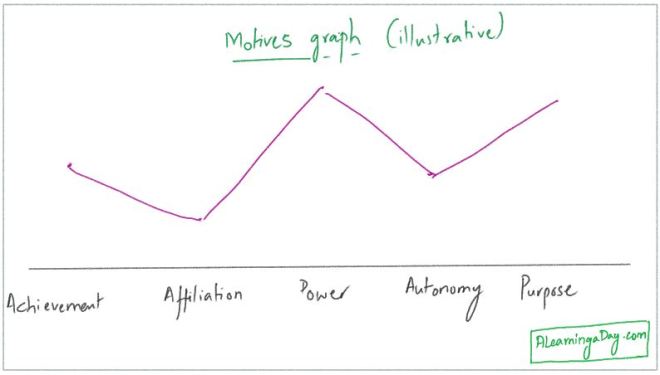
If we had to go with a “High,” “Medium,” “Low” ranking, I would likely be – High on Power and Purpose, Medium on Achievement and Autonomy and Low on Affiliation. So, my motives graph would look something like this –
The important first step is laying out a graph with a hypothesis. It won’t be right at first try. But, you can begin building your awareness about it and adjust as necessary.
Once you build the graph, it becomes easier to understand why you are unable to get some things done. For example, you may be high on the achievement motive but may value authentic connection with people you care about. However, your motives drive you – so, you end up working 100 hour weeks and leave no time for authentic connection.
When your motives and values work together, on the other hand, it feel great because you enjoy it (motive) and it feels important (value).
I value people, learning and impact. I’ve learnt that my low affiliation motive means I only need a small group of people with whom I maintain active relationships. That realization alone was very liberating. I stopped attempting to go to larger events to “stay in touch” and “reconnect” and focused on the small group who mattered.
Similarly, I realized that I’m not high enough on the achievement motive to just learn things that seem interesting to me without a teacher. So, I’ve learned to pick areas that I think will help me have an impact. And, voilà, I find myself with enough motivation to learn more. In addition, learning is a self focused habit while sharing is an others/impact focused habit. So, I make it a point to share everything I learn as it helps me enjoy the learning process.
The point here is that it isn’t smart to fight motives. There are a few cases where you might fight and win by sheer force of will. But, it won’t happen most of the time. We’re better off re-framing what we think is important (e.g. sharing learning versus learning for myself) in a way that it works for our motives.
Motives and values are often in conflict because we don’t take the time to understand our motives. That’s why it is important to understand those forces within us that resist things we want to do. There’s powerful insight in any internal resistance. As we’ve learned today, the resistance is likely just a motive working against something we consider important.
When we talk about making career and life choices, we speak a ton about values. Values are important as they indicate what matters to us. They are aspirational and uplifting.
However, in doing so, we miss the boat on forces that are probably more important – motives. Motives indicate natural propensities – they are what drive or energize us.
I think of the tension between values and motives as the tension between the pre-frontal cortex and the amygdala. Values are what we think we ought to do. And, motives are what we gravitate toward.
The first question, before we understand this tension, is – what are these motives? Prior research on motives by Yale psychologist David Mclelland pointed to 3 motives – Achievement, Affiliation and Power. Power is often viewed as a “dark” word and does have a dark side to it. So, I think of it as a mix of power and impact.
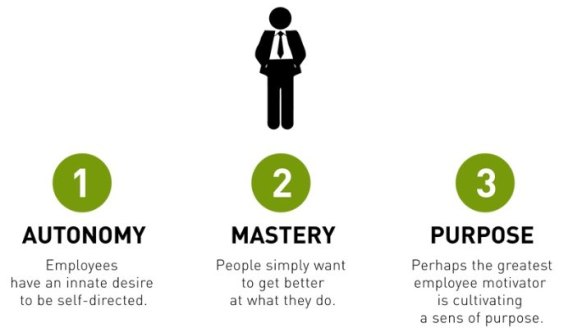
Then, Dan Pink’s excellent book on “Drive” pointed to Autonomy, Mastery and Purpose. (H/T Jon Lee for the image)
Both, separately, made sense to me. But, I hadn’t thought about reconciling these views until recently. A wise (and good) friend and former Professor from graduate school released his research on what makes successful (and unsuccessful) careers in a book. In doing so, he combined the above schools of thought to discuss 5 motives – Achievement, Affiliation, Power, Autonomy and Purpose.
It is one of those simple ideas that completely shifted my perspective on the topic.
The reason having a complete list (to the extent possible) matters is because identifying what your motives are is critical to have a fulfilled, happy life. We all often see a conflict rife in both ourselves and others – we say we really care about something (relationships or learning) but we end up spending our time doing something else (seeking promotions or indulging in corporate politics). That conflict can drive many of us nuts.
And, yet, that is a classic example of the conflict between values and motives. We’ll aim to cover this in detail tomorrow.
Until then, a big thank you to Prof Carter Cast for setting this perspective for me. For a thoughtful, honest and well researched book on how careers are made and unmade, do check out his book “The Right (and Wrong) Stuff.”
Seth Godin had a powerful post (one among many) on his blog about choices the other day that resonated deeply. The post was called “Choosing without Deciding.”
This or that, one or the other, it doesn’t matter.
It’s actually possible that it just doesn’t matter. A choice, but not a decision.
We have to make choices like this every single day. What color, among three colors which are just fine. Which route, between two routes within a rounding error in time taken. Which flight, which table, which person…
Choices don’t have to be decisions.
Decisions come with all sorts of overhead. We put a lot of weight on our ability to make good decisions. We switch frames, put in hard work and even involve emotional wishes about future outcomes. Decisions are fraught. That weight can pay off with a more serious approach, with more diligence, but mostly it weighs us down.
We can save a lot of time and effort by making our meaningless choices effortless. Pick the first one, or the one in alphabetical order or flip a coin. Merely have a rule and make the choice.
I’m serious. Considering ten colleges? Put your favorite five in a hat and randomly pick one. Done. Can’t decide among three candidates for a job and you can’t find a way to choose? Pick the one with the shortest first name. Why not? If you don’t have enough information to make a statistically defensible decision, merely choose.
At the end of the day, you’ll have more resources remaining for the decisions that matter.
It resonated because I didn’t until appreciate this distinction until I read the post. I thought of decisions either as “light weight” or “heavy weight.” And, I’ve been guilty of wasting unnecessary cycles mulling choices that have no consequence and getting irritated with myself for doing it.
This distinction matters because most of us are paid to make decisions. Making even a small proportion of decisions correct more consistently can generate enormous amounts of value over the course of a lifetime.
The takeaway, thus, for me is that there are very few decisions we need to make in a day – use energy and resources to make them better.
Most folks look at investing in crypto in a one dimension fashion. Investing a portion of your financial net worth isn’t the only way to invest in new technology and reap great returns. Investing your time could pay off wonderfully well in the long run too.
And, I’d like to make the case that it is well worth your while to invest in understanding crypto in 2018.
We’re on the brink of something historic…
In his post reflecting on what happened in 2017, venture capitalist Fred Wilson shared the Perez Technological Surge Cycle. This is a framework by Carlota Perez — a Venezuan scholar on technology development.
If you look at the Carlota Perez technology surge cycle chart, which is a framework I like to use when thinking about new technologies, you will see that a frenzy develops when a new technology enters the material phase of the installation period. The frenzy funds the installation of the technology.
2017 is the year when crypto/blockchain entered the frenzy phase. Over $3.7bn was raised by various crypto teams/projects to build out the infrastructure of Internet 3.0 (the decentralized Internet). To put that number into context, that is about equal to the total seed/angel investment in the US in 2017. Clearly, not all of that money will be used well, maybe very little of it will be used well. But, like the late 90s frenzy in Internet 1.0 (the dialup Internet) provided the capital to build out the broadband infrastructure that was necessary for Internet 2.0 (the broadband/mobile Internet), the frenzy in the crypto/blockchain sector will provide the capital to build out the infrastructure for the decentralized Internet.
And we need that infrastructure badly. Transaction clearing times on public, open, scaled blockchains (BTC and ETH, for example) remind me of the 14.4 dialup period of the Internet. You can get a taste of what things will be like, but you can’t really use the technology yet. It just doesn’t work at scale. But it will and the money that is getting invested via the frenzy we are in is going to make that happen.
Fred has been bullish on crypto since he started investing in it in 2017. So, it makes sense that he’s calling it the next phase.
Or, are we?
Let’s consider the counter point — there was an interesting article on Hacker Noon recently that said the blockchain is most likely useless. Below are the headlines —
Everyone says the blockchain, the technology underpinning cryptocurrencies such as bitcoin, is going to change EVERYTHING. And yet, after years of tireless effort and billions of dollars invested, nobody has actually come up with a use for the blockchain — besides currency speculation and illegal transactions.
Each purported use case — from payments to legal documents, from escrow to voting systems — amounts to a set of contortions to add a distributed, encrypted, anonymous ledger where none was needed. What if there isn’t actually any use for a distributed ledger at all? What if, ten years after it was invented, the reason nobody has adopted a distributed ledger at scale is because nobody wants it?
The blogger takes all the use cases discussed so far and takes apart the rationale for a blockchain based solution. It is a fun read. Similarly, “Mr. Money Mustache,” one of the top personal finance bloggers on the internet had a post on “Why Bitcoin is stupid.” In it, he says —
The Cryptocurrency bubble is really a replay of the past: A good percentage of Humans are prone to mass delusions which lead to irrational behavior. This is a known bug in our operating system, and we have designed some parts of our society to protect us against it.
These days, stocks are regulated by the SEC, precisely because in the olden days, there were many, many stocks issued that were much like Bitcoin. Marketed to unsophisticated investors as a get-rich-quick scheme. The very definition of an unsophisticated investor is “Being more willing to buy something, the more its price goes up.”
Don’t be one of these fools.
Reconciling these points of view. Most of us come at problems with a selfish question — what’s in it for me? Or, put differently, is it worth investing in this?
Given this, here’s how I’d break it down. There are two investments we can make in new technology — money and time.
Let’s deal with money. There are tens of thousands of crypto tokens out in the wild. Many of them are nonsensical and some are ludicrous. All save a few will likely go down to zero in value in the next five years. Unless you are a crypto expert, it makes little sense to invest in “Initial Coin Offerings.” And, if you are an expert, you’re likely not reading this post anyway.
There are a few mainstream coins that are in the news — primarily Bitcoin and Ethereum. If you have tens of millions of dollars in net worth, buying a few Bitcoin — assuming it is in the low single digits of your net worth — may be an interesting experiment right about now. But, it’d still be an experiment. Investing in Bitcoin is what institutional investors and Billionaires are putting their money in right about now. So, for most of the rest of us, the time has passed.
In that sense, I agree with Mr Money Mustache’s premise — this isn’t the time to invest in crypto unless you’re open to speculating and experimenting with a sizeable portion of your wealth.
But, calling the blockchain worthless misses the point.
It takes multiple decades for a technology to get mainstream adoption. The foundations of the internet were set in the mid 1960s. Commercial use began in 1989. HTML and the idea of a webpage came by in 1994.
And, yet, it is only now that the consumer internet is mainstream. Businesses, on the other hand, are still moving to the cloud.
So, it might be 6 decades for the internet to become mainstream from when it was conceptualized and it will likely be 3 after promising infrastructure was built. These things take time.
If you want to understand why blockchains matter, think about databases.
We live in a data economy. The largest companies on the planet today own vast amounts of data in centralized databases. Their ability to use this data in more and more powerful ways (using tools like machine learning) is what makes them seemingly insurmountable today.
The core technology innovation underpinning the blockchain has made it possible to have decentralized databases. This was not possible before.
Thus, we can now build networks around these decentralized databases and create new incentive structures. In today’s world, the value of your data goes to a few large corporations. In theory, this would not be the case in a blockchain based world. That’s because anyone who contributes to a network would earn tokens based on a governance system created by the token creators.
Does this mean everything will be decentralized? Probably not. There is still value to centralization in many contexts. But, it doesn’t mean centralization is applicable everywhere either. We live in a world controlled by a few large corporations largely because we don’t have an alternative.
Blockchains promise a world where that might be different. They promise to take us down a path we’ve walked over the past century as we adopted newer pieces of information technology — more democratization and more permission-less innovation.
That’s why they matter.
And, that’s why it is worth investing your time in understanding them better in 2018.
PS: Of course, we’ll be spending plenty of time digging into crypto in future weeks.
Links for additional reading (with 5 of the notes mentioned above)
I’ve been mulling the subject of productivity over the past couple of weeks. As I love boiling things down to simple formulae or mental models, I think productivity = focus x intensity x time.
Since time isn’t unique to us, our individual productivity is a function of focus and intensity. Focus, as I define it, is our ability to do the right things. It is the leadership aspect of productivity and ensures we’re doing things that actually matter. Intensity, on the other hand, is our ability to get the most of the hours we spend. This is the management aspect of productivity and ensures we’re doing things right.
There’s always a tension between the act of leading and the act of managing. Leading is, by definition, focused on a vision or true north. It is characterized by purpose and generally is inspiring.
Management, on the other hand, is all about operationalizing that vision or true north in the best possible way. It requires processes and systems and deals with trade offs. Trade offs are what we need to make when the rubber hits the road.
We see this tension play out in every organization. Leadership owns the grand vision while management owns the execution. When the tension is managed well, the result can be magical. When it isn’t (and it isn’t most of the time), the results are pretty poor.
A key skill in managing this tension is the ability of a manager to set the right expectations. When expectations are set right, targets are set right and the amount of work to get there involves the right amount of stretch. When we engage people with the right amount of stretch, learning, growth and a whole host of powerful things happen.
Of course, when it comes to personal productivity, there is no massive organization with layers of management and leadership.
There is just… you.
The interesting thing here is that this dynamic plays out the exact same way in our own minds. We play leader and manager every day and decide how this conflict plays out. The leader within probably woke up this new year set an inspiring agenda of the many projects to take on and the many areas of personal change absolutely necessary. It is now on the manager to set the right expectations and set us up for success.
Unrealistic expectations on how much we can get done are a perfect recipe for unhappiness and an ensuing lack of focus given the dissatisfaction.
This is why productivity transcends any great hack out there. It is a very personal quest to finding systems and processes that work for the leader and manager within. I came across a quote once that said – “The essence of zen is the ability to focus on one thing at a time.” That is hard to do because productivity is a mental game.
You either learn to master your mind to get what you want done or let it master you.
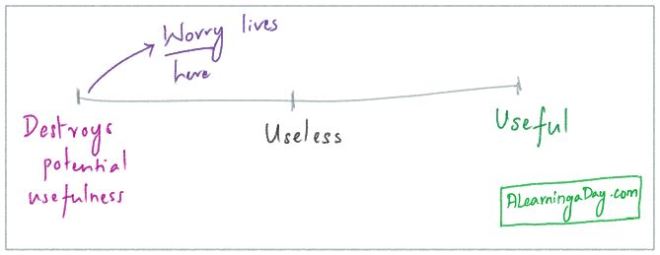
Worry is the opposite of useful. It destroys any potential usefulness. You’d think I’m referring to the word “useless.”
But, I’m not.
Wasting time watching more than 10 minutes of today’s news is useless. Spending more time than you need surfing others’ vacation photos is useless.
Worry, however, is much worse than useless. It is un-constructive, i.e., it doesn’t just waste your time – it debilitates your ability to get anything productive done for a long time.
I took the time to make the case against worry because it is important to understand the size of a problem before you deal with it.
There is no one-size-fits-all solution to dealing with worry. Most folks have their own custom approach. However, it is impossible to deal with a problem you don’t understand. Acceptance follows understanding. And, it is only with acceptance that you can expect change.
The best way to understanding a problem is to write about it. My new all-time favorite nugget about writing is that the word essay comes from the French word “essayer” – which means “to try.” Writing is our attempt to try and figure things out.
This is why the first and most important step to dealing with worry is to write about it. As we write, we figure out what the nature of the beast is. And, this understanding is the basis of our ability to deal with it.
Questions are a useful way to demonstrate intent. The way you ask a question in a discussion, for example, can clearly indicate if you want to contradict, challenge or learn.
However, questions are only good replacements for intent if you don’t have enough context.
If you are meeting an acquaintance who reached out for a favor, “how can I help?” is a good question to ask. Most people tend to be reluctant about asking for favors. So, asking “how can I help” sets the tone and demonstrates that you intend to help. Besides, you only have limited time with your acquaintances. So, it also helps center the conversation.
However, I’ve learnt time and again that “how can I help?” is a poor question in a conversation with a close friend, team member or spouse. Instead, it is best to stay engaged and listen – the opportunity to help will reveal itself over the course of a conversation. If time is limited, a question like “what’s top of mind” works better. That’s because you have a great opportunity to demonstrate intent by just showing up and listening. Asking “how can I help” feels like a lazy, insincere, substitute. Asking “will x help,” on the other hand, works much better because it shows you’ve given possible solutions thought.
Questions are powerful ways to show intent. So, it matters that we’re intentional about how we use them.
The Farnam Street blog has a great post on maker days and manager days.
A manager’s job is to, well, manage other people and systems. The point is that their job revolves around organizing other people and making decisions. A manager’s day is, as a rule, sliced up into tiny slots, each with a specific purpose decided in advance. Many of those slots are used for meetings, calls, or emails. Managers don’t necessarily need the capacity for deep focus — they primarily need the ability to make fast, smart decisions.
A maker’s job is to create some form of tangible value. A maker’s schedule is made up of long blocks of time reserved for focusing on particular tasks, or the entire day might be devoted to one activity. Breaking their day up into slots of a few minutes each would be the equivalent of doing nothing.
The post is worth reading in full. To me, it inspires three questions –
What percent of your job is maker versus manager? (University researchers tend to be >80% makers for example – while executives tend to be >80% managers)
Is your schedule aligned percentages above?
If not, how can you align it?
My approach in the past year involved organizing my week into maker days and manager days. I scheduled 2 maker days and expected to average around 1 maker day in reality (thanks to meetings).
But, as I head into the new working year, I’d like to be more thoughtful about this. So, here’s to that.
Many have been sold an idea that it takes only 21 days to create a new habit. Do something new every day till Jan 22 and you’re set for this year and the next few.
Sadly, it is one of those ideas that does no long term good. It only serves to set you up for disappointment.
I reflected recently on important habit changes I’ve attempted over the past decade and I’ve come to realize that the most valuable of the lot took, on average, 3 years. The first few were infrastructure habits – reading nearly every day, writing every day, sleeping 8 hours, waking up early, and exercising regularly. Over the last few years, they’ve been mindset related habits – defining a purpose and attempting to live in accordance to it and focusing on processes versus outcomes.
I realized this as I reflected on the process I made on the theme for 2017 – engagement. My takeaway was that the progress I made this year involved awareness – or identifying the extent of the mountain I have to climb. I made headway to improving my engagement at work – with a no laptop or leave policy in meetings I chose to attend as an example. But, I realized I’m far from where I’d like to be at home. Similarly, I made significant progress in the specific areas I wanted to focus on – health, information diet and seek to understand and then to be understood. But, then again, I still feel I’ve got a long way to go.
That sounds like a “fail” grade on the report card. But, I realized that this was normal. In each of the previous examples, the first year was all about identification and awareness. The second involved testing solutions and, hopefully, finding a few that work. And, the third involved practicing them.
Habits worth having are 3 year construction projects. They take a lot of patience, many check ins, a lot of re-commitment and kindness – to ourselves. But, there are few things more powerful than being able to look at yourself today and to realize that you have made changes in areas that mattered to you. Even if it takes 3 years, the juice is always worth the squeeze.
I know that isn’t the most exciting or inspiring thought as you think about habits you’d like to work on in the new year. But, it will hopefully set you up for success in the long run.