Violent communication

When I was recommended “Nonviolent Communication” after I asked for resources on productive communication in October, my first reaction was wondering if the book was for me. “Violent” sounded like a strong word.

Then, I heard this passage…

“If “violent” means acting in ways that result in hurt or harm, then much of how we communicate – judging others, bullying, having racial bias, blaming, finger pointing, discriminating, speaking without listening, criticizing others or ourselves, name-calling, reacting when angry, using political rhetoric, being defensive or judging who’s “good/bad” or what’s “right/wrong” with people – could indeed be called “violent communication.”

…and realized I’d found the exact resource I needed.

Putting the lessons learnt from this book into action is going to be one of my top 3 themes for next year – so, plenty more to follow on that journey in 2019. The immediate next step is for a second read of the book over the holidays. :-)

5 reflections on technology from 2018

5 reflections on technology from 2018 –

1. Tech has far outgrown tech. I recently came across the origin story of “ThirdLove.” Heidi Zak, a Marketing Manager at Google, was tired of wearing undergarments that didn’t fit. She was also tired of the sexed up images that came with brands like Victoria’s Secret. So, she started ThirdLove.com to build a more inclusive bra and underwear brand, has grown ThirdLove to 250+ employees, and raised $13.4M along the way. And, as ThirdLove is an e-commerce brand, ThirdLove is considered a “tech startup.”

I remember a discussion with Disqus co-founder Daniel Ha where he made the point that companies which were founded around the time electricity became mainstream called themselves “electric” companies (e.g. General Electric). Over time, however, every company began using electricity and, thus, electricity became a foundation layer.

When we refer to the “tech” industry, we refer to companies that are “internet first.” That is certainly the case with retail companies like ThirdLove and Warby Parker which were built with the internet in mind. It doesn’t mean they won’t have a physical footprint (Warby Parker does) – it just means they started with internet first assumptions. That means they focused first on selling direct to customers online with a low cost distribution model.

But, the new tech company is increasingly focused on the domain of “non tech” companies. As a result, Amazon may have an online retailer when it started. But, it now has a massive physical footprint. Scooter-as-a-service companies like Bird and Lime own scooters. OpenDoor owns homes and so on.

In the next decade, non-tech incumbents across industries will have to find a way to cross the chasm and build with “internet first” assumptions. Or, they’ll lose to an upstart who does.

2. Deep learning may have hit its limits – but its impact will be far reaching. The growing consensus among experts (e.g. Rodney Brooks, Gary Marcus) on deep learning is that we are fast approaching its limits. While that might be true, I think we are still ways from experiencing the impact of full deployment of deep learning in our everyday life. Putting aside the potential Orwellian applications of deep learning (see example of social credit in China), we are just beginning to see the effects of increased automation.

Amazon said the following in a statement about increased warehouse automation – “It’s a myth that automation replaces jobs and destroys net job growth. Automation increases productivity and in some cases increases consumer demand, which also creates more jobs. Automation makes the jobs in our fulfillment center more efficient and allows associates to redirect their focus to other tasks. Since the time we started introducing robotics at Amazon in 2012, we have added nearly 300,000 full-time jobs globally. Our teams work alongside more than 100,000 robots at over 26 fulfilment centers worldwide and we are excited to continue increasing the technology we use at our sites while growing our global workforce.”

Of course, it isn’t just Amazon. For starters, WalMart is testing cashier less Sam’s Club stores and will also be deploying robot janitors in its US stores. The story we’re told is similar to the one told by Amazon – don’t worry, automation only increases the size of the pie. While the story may actually be true for these companies, it is hard to escape the fact that these robots are reducing the overall number of jobs available for humans (see JD.com’s fully automated warehouses).

And, while we can all point to the many jobs we created since the industrial revolution, there is also the fact that there was a painful adjustment period.

Investing in continuous education and re-skilling the workforce should be on top of every political agenda. But…

3. …regulators are clearly skating to where the puck was 20 years ago. Sadly, we saw far too many examples of backwards looking politics and regulation this year. There were two examples of this just in the last week. The first involved a a poorly crafted piece of legislation in Australia that gives the government the right to break encryption for law enforcement reasons without any judicial oversight. And, the second was an exchange between Sundar Pichai and Congressman Smith where the latter claimed he believed individuals could manipulate Google Search results.

Regulators have been lining up to find ways to regulate digital advertising (see: GDPR) – sadly, however, they’ve been doing so in ways that only entrenches incumbents and their approaches to doing business. Ben Thompson had a great post called “Data factories” earlier this year sharing his notes on how we might approach regulating the internet. He explains that users care far less about their privacy than regulators believe. And, instead of enforcing onerous consent procedures, the better approach might be to mandate greater transparency on how user data is actually used. In Ben’s words –

Indeed, that is the crux of the matter: regulators need to trust users to take care of their own privacy, and enable them to do so — and, by extension, create the conditions for users to actually know what is going on with their data. And, if they decide they don’t care, so be it. The market will have spoken, an outcome that should be the regulator’s goal in the first place.

4. Climate change will be the toughest test we face as a species. If you haven’t seen the climate assessment prepared for the US Congress, this thread by Eric Holthaus is a must read. The one word description would be “grim.”

This is an area where we’re in urgent need of innovation. The challenge with combating climate change is that reducing emissions isn’t going to help. For starters, we need commercialized Carbon capture technology that will enable us to capture Carbon Dioxide that is already in the atmosphere.

For all these warnings, the response from most governments has been to do the equivalent of bury their head in the sand. That isn’t going to save them.. or us.

A few months back, The New York Times shared a touching essay by Roy Scranton where he shared the conflicts rife in bringing up a child in a world which seems doomed. He ends the essay by saying this –

Living ethically means understanding that our actions have consequences, taking responsibility for how those consequences ripple out across the web of life in which each of us is irrevocably enmeshed and working every day to ease what suffering we can. Living ethically means limiting our desires, respecting the deep interdependence of all things in nature and honoring the fact that our existence on this planet is a gift that comes from nowhere and may be taken back at any time.

I can’t protect my daughter from the future and I can’t even promise her a better life. All I can do is teach her: teach her how to care, how to be kind and how to live within the limits of nature’s grace. I can teach her to be tough but resilient, adaptable and prudent, because she’s going to have to struggle for what she needs. But I also need to teach her to fight for what’s right, because none of us is in this alone. I need to teach her that all things die, even her and me and her mother and the world we know, but that coming to terms with this difficult truth is the beginning of wisdom.

5. Optimism matters. When I started writing Notes by Ada in March last year, I thought I’d be sharing notes about the the current state of technology. I imagined picking headlines from the week’s news and tying them together. But, the writing process is one of discovery and I learnt that my interests actually lay in the next few decades instead of the next few months.

As a result, I spent a lot more time than I expected learning about climate change as I realized that it is the most pressing technology problem that exists. I also spent time reading about the impact of deep learning on jobs because a lack of jobs means human discontent. Human discontent leads to populist, short term politics. And, any progress toward combating climate change loses with populist, short term politics.

The challenge with all this reading is that it is hard to stay optimistic. You realize very quickly that we’re ways off where we need to be.

But, after a brief period of wallowing in pessimism, I’ve come to appreciate the importance of optimism. There was an interesting note on this from John Arnold in Tim Ferriss’ “Tribe of Mentors” – “Much of one’s attitude toward life depends on their level of optimism. An optimistic person will invest more in him- or herself, as the deferred reward is expected to be higher. “

There have been reasons to be optimistic. Electric vehicles are coming. They are going to spell the death of the internal combustion engine and remake industries. We are beginning to experiment with food production technology that will hopefully end animal farming. But, there is still a lot of work to be done.

Then, last month, a group of scientists from 60 countries came together to agree on a new definition for the kilogram. They agreed to migrate from a definition based on a hunk of Platinum Iridium to one based on the “Planck’s constant” – a value that will stay stable over time. Jon Pratt, one of the leading scientists, said something poignant – “It is an acknowledgment of an immutable truth — that nature has laws to which all of us are subject. And it’s one more step toward a lofty dream — that, in understanding nature’s laws, scientists can help build a better world.”

Witnessing this triumph of science, global cooperation and logical decision making brought a tear to my eye. 

We will need a lot more understanding of nature’s laws in the next decade, a lot more science, and a lot more cooperation in the coming decade.

As I look ahead into 2019, I hope to remain optimistic about our ability to do that.
5 books that might change your mind – 2018 edition

Here are 5 books I read this year that might change how you see the world –

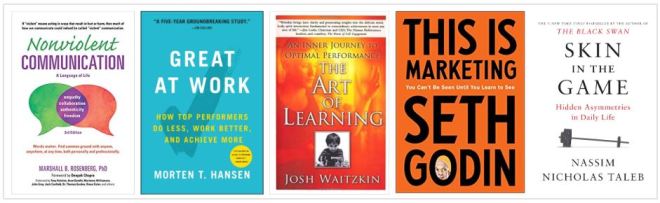
1. Nonviolent Communication by Marshall Rosenberg (my review/notes, Amazon): Putting this book into practice will be my most important theme in 2019. Since the last 7 weeks, it has already made an impact on how I think about communication (and hopefully communicate). It is a “beginner’s guide to communication” of sorts as Marshall Rosenberg explains how communication should be done – with a focus on observation instead of evaluations and by taking the time to articulate feelings and needs. A game changer.

2. Great at Work by Morten Hansen (my review/notes, Amazon): Over the years, I’ve come to realize that the books that resonate the most are those that I read because they are “just in time” instead of “just in case” (H/T Naval Ravikant for that articulation. I was at a place where I was mulling my themes for approaching work better in 2019 and this book resonated deeply. The first principle of the book is “Do less, then obsess” – it is what I need to learn in 2019. I wish I had the opportunity to read this book when I started my first job.

3. The Art of Learning by Josh Waitzkin (my review/notes, Amazon): Josh Waitzkin shares his journey becoming a chess and martial arts champion while articulating his learning philosophy. As someone who obsesses about learning, there were many notes in the book that touched chords deep within. Profound in pars, inspirational in parts, and thoughtful throughout.

4. This is Marketing by Seth Godin (my review/notes, Amazon): Seth’s blog is my favorite blog. Every day, Seth shows up and talks about marketing in a way that is applicable to our businesses, our work, and our life. He explains that we are all marketers because marketing is about driving change in the people we seek to serve. And, doing it well involves showing up, earning trust, and creating tension. In many ways, this book reads like a conversation with Seth on his approach to thinking about marketing. And, in many ways, the experience was very meta – the brand he has created as a result of showing up everyday on his resonates deeply with me. So, I expected the book to make me rethink how I think about marketing at work and in life in 2019 – and it did.

5. Skin in the Game by Nassim Taleb (my review/notes, Amazon): I think of Nassim Taleb as a brilliant jerk. In being who he is, he challenges (provokes?) you to think deeper about ideas you take for granted, pokes holes in research you thought was bulletproof, and brings together ideas from history, psychology, and probability together with impressive skill. You may disagree with him a bunch. But, that’s almost why you have to read his work.

H/T also to When by Dan Pink (my review/notes, Amazon) , The Power of Moments by Chip and Dan Heath (my review/notes, Amazon),

More book resources:

Behaviors in permanent shortage

In practically every organization around the world, there is a permanent shortage of 3 behaviors – great attitude, constructive dialog, and consistent follow up. We are yet to find a CEO or talent leader who claims to have enough of these.

As we think about how we can level up in the next year, it is worth pondering how we might incorporate these behaviors into our day-to-day. Specifically, the questions we might ask would be –

What would it take for me to show up with a world class attitude every day? It might be some combination of enough sleep, healthy body, good relationships, etc.

What would it take for me to master constructive dialog? It might be mastering “Nonviolent Communication.”

What would it take for me to follow up consistently? It might mean designing a better productivity system or the presence of a daily commitment that gives us confidence in our ability to follow up.

The path to standing out may never be clearer.

Investing – To Robo or not to Robo

As you can probably tell from yesterday’s list of personal finance lessons for 2018, I/we don’t use robo advisers like Betterment or Wealthfront.

A debate I’m hoping to settle before the end of the year is whether or not to experiment with robo advisers in 2019. Most of what I/we invest in is low cost index funds on Vanguard. As the key benefit touted by the robo advisers is “tax loss harvesting,” I’m not clear yet as to whether this is worth the 0.25% management fee.

So, this is a question for you – have you had experiences with robo advisers? If so, I’d be curious to hear about your experiences. Please just hit reply if you are receiving this email or write to rohan at rohanrajiv dot com. I’d really appreciate it.

9 Personal Finance Lessons from 2018

My notes to self from 2018 with a focus on everything that happens after the paycheck comes in –

Overall

1. Make sure your expense growth is much slower than your income growth. I shared my expense tracking sheet earlier this year. A new addition to that sheet was a sheet with “yearly math.” This sheet splits income into expenses, taxes, and savings. It is a really simple view and it helps keep focus on an important high level relationship -> grow your income faster – ideally much faster – than your expenses.

Expenses

2. Keep your expenses low by consciously tracking them. This isn’t a new lesson as much as it is an ongoing commitment. I’ve come across many tools that aim to simplify expense tracking but I’ve stuck to my simple google spreadsheet for 8 years now and it has worked great. The act of adding one expense at a time has inspired a level of consciousness that I’d otherwise have missed out on.

3. Spending on experiences has very high RoI. Again, an ongoing commitment.

Savings

4. A high yield savings account is a no brainer. A high yield savings account can yield up to 2% at the moment – far better than the 0% on normal savings accounts even after you factor in taxes. The “downside” in these accounts is the absence of physical banking facilities – so, no downside if you’re comfortable with dealing with your money digitally. :)

Investments

5. Individual stock picking is really hard – if you do it, do it with less than 5% of your net worth. I tried experimenting with it this year – and mostly failed. The second half of the year has been rough on stocks. In many ways, I’m glad for the lessons I learnt this year as I will, hopefully, exhibit better judgment in future years.

One accompanying learning here is to use “limit orders” if you still decide to indulge. If you decide to buy, use target prices to capture the upside/limit your downside. I wish I’d learnt this lesson earlier!

6. Tax loss harvesting. If your picks went sideways, tax loss harvesting might help. :)

7. Manage vests/employee stock purchase plans like cash. There are stories of the employee who held Coca Cola stock/GE stock/Johnson & Johnson stock for decades and watched it multiply 100 fold. For every such story, there are cautionary tales that we don’t hear about where large portions of paychecks disappeared due to market movements. Andy Rachleff has a great post on the Wealthfront blog on the case for treating any equity pay as cash. Like a good poker move, it doesn’t always look right in the short term but it is the right move for the longer term.

8. It can all go to zero. If you put any money into crypto this year, you know what I’m talking about. See above note on tax loss harvesting.

9. Anchor around principles. I’ve come to believe that all investment advice boils down to 3 principles – diversify, be consistent and disciplined, and do your research and pick a strategy that works for you. The Ivy Portfolio and Simple Wealth, Inevitable Wealth were two interesting adds to my personal finance book reading list this year.

Dollars or love per square foot

There are many of us who dream of homes with plenty of space. We dream of space to keep all our “stuff,” to host our friends, to have our family sleep over, and to work on projects we care about. As we think of owning or renting these homes, the metric to optimize for would be dollars per square foot.

As time passes, however, I realize that dollars per square foot matters far lesser than another more important metric – love per square foot. What are the decisions we might make if we maximized for love per square foot?

For instance, we might buy a home in a place we’d love to spend our time even if it limits our career opportunities. Or, we might buy a slightly smaller home so we spend lesser personal time fretting about our finances. Or, of course, we might rent instead of buy because we’re happier with the prospect of having options. And so on.

We’ve all been to homes where we feel an abundance of love. Some are large and some are small. Regardless, homes where there is more love than space are a special sight. Maybe the love per square foot will be a metric we’ll think about as we make that next decision?

Anger vs. tact

In my attempts to figure out the best strategy to motivate my now two year old to work with me, I’ve learnt that anger and tact have opposite effects.

The use of anger looks promising for a short while and then its effectiveness plummets.

Tact, on the other hand, is the gift that keeps on giving. The more you use it, the more you get comfortable with it, and the better you become at deploying it. Thanks to that in-built learning loop, its effectiveness grows over time.

I’ve written plenty about my growing awareness of my natural impulse to fight fire with fire. The turning point, for me, was reading “Non Violent Communication” by Marshall Rosenberg ~6 weeks back. I’ve since noticed a much higher level of awareness of these impulses and been having a much greater appreciation of the importance of diffusing proverbial fire with water with tact.

I’m grateful I came across his work this year and I’m hopeful for a tactful 2019.

Mistakes and good judgment

December marks the beginning of reflection season in our home. And, as I reflect on the mistakes I made over the course of the year, I expect to find myself repeatedly going back to the quote – “Success comes from good judgment. Good judgment comes from experience. Experience comes from bad judgment.” 

There are many ways to account for mistakes – the normal place to start is by marking them in red ink in the “loss” category. But, this quote never fails to reminds me to think of failures in the investment category for the future.

The only mistakes and failures that deserve to be counted as losses are those that we repeated. The rest are investments that will pay themselves forward many times over in the form of good judgment if we invest in learning from them.

So, here’s to that.

The wrong kind of perseverance

Perseverance is defined as the steadfastness in doing something despite difficulty or delay in achieving success. While it is often portrayed in the media as one of those heroic traits that “they” possess and we don’t, there is a big difference between the right and wrong kind of perseverance.

The difference between the right and wrong kinds is on what you are steadfast/stubborn about. The wrong kind of perseverance is stubborn on a solution or a way of approaching a problem. There is rarely a happy ending to these stories as this flavor makes it all about us and how we want things to be done.

On the other hand, the right kind of perseverance involves being stubborn on the problem and flexible on the solution. When we’re focused on solving a problem for the people we seek to serve, we keep experimenting on approaches until we find one that works.

Like most good things, we find the right kind of perseverance when we do things for reasons that require us to get over ourselves.