
A study, Recent discoveries on the acquisition of the highest levels of human performance, evaluated the performance trajectories over time of 34,000 international top performers, including Nobel laureates, renowned classical music composers, Olympic champions, and the world’s best chess players.
The main finding: stressing out and trying to be the best as a kid can make you less successful as an adult. Most top achievers demonstrated lower performance than many peers during their early years.
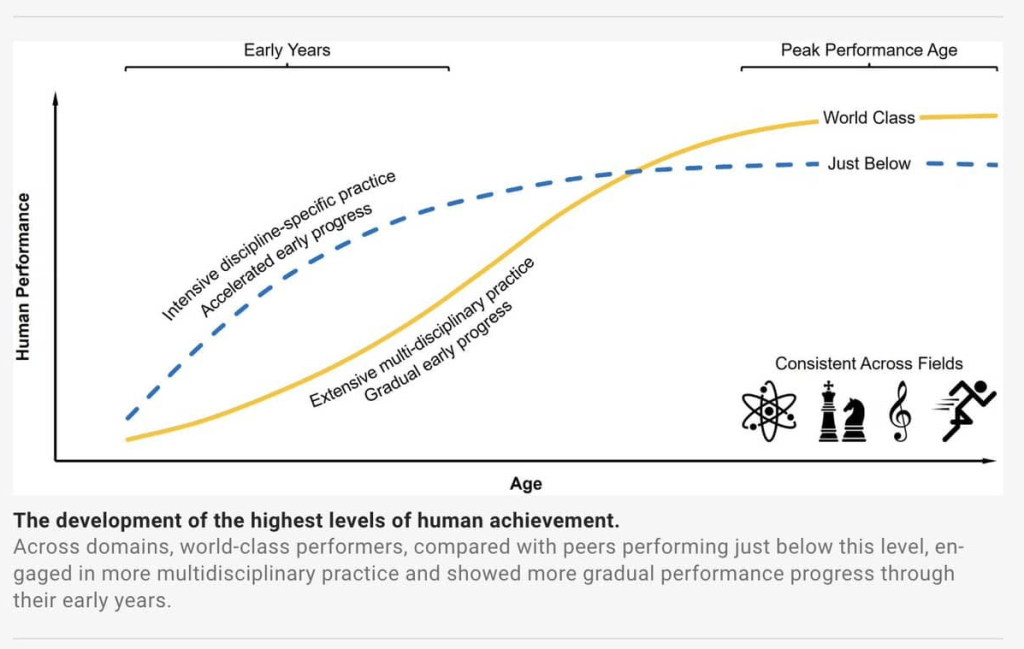
In sport, knowledge work, and academia, the results showed that specialization didn’t result in elite performance. However, it is an overstatement in Chess and classical music.
As Brad Stulberg and Steve Magness share in their newsletter – “The study’s findings mirror one of the main arguments in David Epstein’s excellent book Range – In kind environments (where the rules stay the same and the variables are numbered and controlled), early specialization may prove useful. Chess and musical composition are textbook examples of kind environments. However, in wicked environments (where the rules are subject to change and there are hundreds of interacting variables) then early specialization often gets in the way of later performance. Sport, academics, and science are great examples of wicked environments.
TLDR – if you want the highest performing child, you should push him or her to specialize and be super-disciplined from a very early age.
But if you want to raise the highest performing adult, you should encourage them to explore, not take anything too seriously, and play.
It’s why research on prodigies shows that those who tend to make it have supportive, but not overbearing, parents – because the kid’s intrinsic motivation still has to steer the ship. So even in fields like music composition and chess, you’ve got to tread lightly and let the kid’s obsession propel the path, not yours.
 A Learning a Day