Pericles and Athena

Pericles led Athens during its golden age in the 5th century BC.

He invested heavily in infrastructure – the Parthenon, temples, public buildings that still stand today. He expanded democracy and turned Athens into a cultural center that attracted philosophers, artists, and thinkers from across Greece.

But what struck me most about Pericles was his inspiration from Athena – the goddess of wisdom and strategy.

He espoused a brand of politics built on rationality, thoughtfulness, and strategic thinking. Not rhetoric and appeals to base emotions.

This even showed up in his style as a public speaker – he shunned drama for a more quiet and thoughtful style.

As he became a marginal figure toward his passing, Greece ended up in wars against Sparta that drove them toward ruin. They made wagers driven by emotions that were the antithesis of the decision-making Pericles had championed.

He was clearly so far ahead of his time in his approach.

It got me thinking about the habits needed to periodically channel our inner Athena – stepping back to make decisions rationally – are critical.

Especially in a world designed to trigger our base instincts at every turn.

The three AI bets

AI was one of the topics that dominated the zeitgeist in 2025. There’s so much happening at any given moment and there’s so much more written about it that it’s hard to figure out how to make sense of it all.

That’s especially the case given the tremendous hype around this technology.

I find it helpful to think of AI in terms of three kinds of bets.

The first is working on a foundation model. This involves a select group of labs – for now, that’s Anthropic, OpenAI, Google, Meta, and a few others. The bet here is “superintelligence” – which I think is just a fancy term for an incredibly dependable AI assistant or agent that every consumer will use to navigate the internet and their digital life.

There’s potentially a tremendous amount of money to be made here. This is already evidenced by the billions of dollars of subscription revenue flowing into these systems. Just imagine what happens when you add advertising revenue into the mix and you can see how lucrative this could be for a lab that figures this out.

But ultimately, the game here is providing incredible intelligence in everyone’s pocket and really owning that market. That’s what every lab is racing toward.

Winning consumer attention is challenging and does tend to have winner-take-all dynamics. So, you also have these labs going after verticals (e.g., Anthropic for coding) as a way to hedge their bets. That brings us to the second category.

The second is Applied AI. This is going to be the vast majority of every other company that is building technology for various verticals/industries or functions. Here, the bet is simple – can you use AI to dramatically disrupt/change how things work in that particular industry or function?

Essentially, this is going to create new categories of winners and losers. New category winners who will get there by completely disrupting existing workflows. There are many industries/functions/verticals with archaic, human-heavy workflows that can all be reimagined – many for the better.

And, again, as you can imagine, there’s a lot of wealth creation that can occur here – proportional to the breadth and depth of the disruption.

The final area is AI adjacent companies. These are companies that provide tools or platforms. NVIDIA is an example of an AI adjacent company. So are the cloud providers – Amazon, Microsoft, and Google Cloud – along with fast-growing data and AI tool providers like Databricks and Snowflake.

In all of these, the bet is that as AI use continues, more and more workflows will need these tools, and these tools will essentially take a percentage of the AI economy.

I call these out in these three buckets just because this is the bet you’re making when you invest in one of these companies or when you decide to work at one of these companies. And it’s helpful to be clear about what you’re betting on.

For example, I know someone who was choosing between working at a lab or an applied AI company. It became a lot easier for this friend to figure out what they’d be interested in once the central bet was clarified.

This is not to say that these bets will all work. There are a collection of other factors – whether the energy needed for all this will be built out in time, whether AI will actually disrupt workflows in the timeframe being bet on,, and so on.

They are called bets for a reason.

Best to go in with clarity of thought and eyes wide open.

Wind chills

When you step outside on a winter day, the thermometer might say 20°C or ~70°F. But, if there’s a wind blowing, it’ll feel a lot colder because of wind chills.

It is fascinating to dig into what happens. Our body generates heat and creates a thin layer of warm air around our skin. On a calm day, that layer stays put.

But when the wind blows, it strips away that warm layer. Our body has to work harder to replace it, resulting in us losing heat faster. That’s what the wind chill measures – how cold it feels based on accelerated heat loss.

It is worth thinking about this for a second – we walk around with this invisible layer of insulation that we don’t even know exists.

Our bodies and this world never cease to amaze me.

Dashboard or pipes?

Gokul Rajaram recently shared a post I found insightful. While intended at startup leaders, it is broadly applicable to anyone interesting in building technology products as, simple mental model aside, the central message is “be clear why you exist and measure what matters.”

Sharing in full below – thank you for sharing, Gokul.


Every startup needs to make a choice: is their product a dashboard product or a pipes product?

Dashboard products are used directly and regularly by end users as their primary interface for accomplishing tasks. The goal for these products is to get customers to live in the product. The primary North Star metric for these companies is active users (daily / weekly / monthly, depending on the natural frequency of customer usage for the category). Facebook’s first product (aka Facebook :)) was a dashboard product.

Pipes products are used in the background to process transactions, data, payments, etc, and customers rarely interact with them directly after initial setup. The goal for these products is to for their customers to send as much of their data / payments / etc through them. Their North Star metrics is a volume metric (eg GPV). Databricks’ core product is a pipes product.

Companies can have both types of products in their portfolio. For example, ChatGPT is a dashboard product while OpenAI’s APIs are a pipes product. However, a given product has to determine which camp it’s primarily in.

This choice dictates product development, growth strategy, and org structure. For example, dashboard products require heavy investment in UI/UX polish, engagement features, and retention loops, while pipes products prioritize reliability, throughput, integration breadth, and seamless embedding into customer workflows. Dashboard products have consumer-style growth teams focused on activation and habit formation to grow [DWM]AUs, while pipes products focus on making their product invisible infrastructure that “just works” and on capturing more and more of their end customers’ volume.

Most teams fail by mixing the two too early — chasing DAUs while selling pipes, or overbuilding infra for a dashboard.

Clarity on where value accrues should come before features, metrics, or hiring.

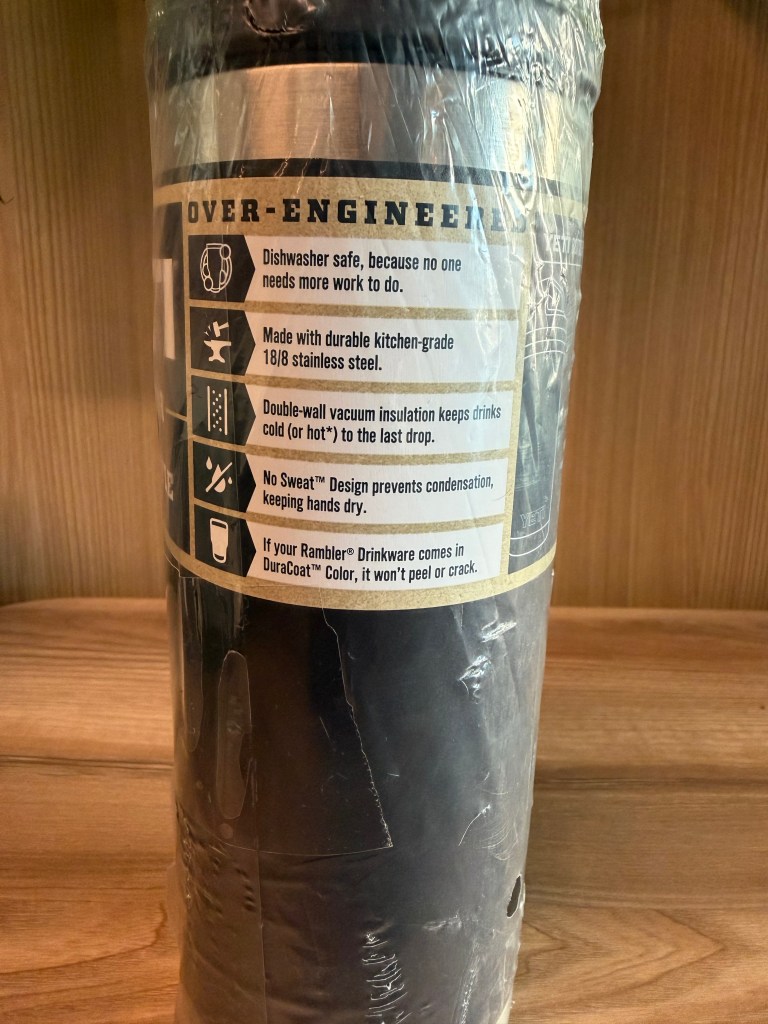
Over-engineered

I carry a water bottle everywhere I go. I recently gifted my favorite bottle – the 18 oz YETI Rambler – and chuckled when I read the sticker.

Over-engineered” – because it is:

  • Dishwasher safe
  • Durable kitchen-grade stainless steel
  • Double-wall vacuum insulated
  • A no-sweat design
  • A DuraCoat finish that won’t peel or crack

Over-engineering usually has a negative connotation. Better to cut scope and simplify usually.

But this note from the YETI team said – “We thought about this more than we needed to. On purpose.

It is a good reminder – when something is meant to be used constantly, trusted, and lived with, over-engineering isn’t wasteful. It’s a sign of respect for the user and a commitment to quality.

The opposite of a good idea is often a good idea.

Lakes and people

A lake can be a stunning blue or an ordinary gray depending on the clouds and the sun and the atmospheric conditions.

People work in similar ways.

A person’s behavior in a social setting or performance in a work environment can change dramatically based on the environment and culture.

A good reminder that the environments we create – at work, at home, in our communities – influence the behaviors we see within them.

Planetarium perspective

I had the opportunity to see a planetarium show the other day. It zoomed us out from the earth to our solar system. To our galaxy. To all the galaxies that we can see – up to 13.4 billion light years away.

And then asked us to imagine the many we couldn’t see.

At the end of this fascinating presentation, the narrator said: “I hope you’re feeling small.”

That captured how I was feeling.

I find it helpful to ponder our own insignificance from time to time. It is a reminder to not take life too seriously and to do the best with what we have, where we are.

In the final analysis, very little is really going to matter. The things we worry about, stress about, waste time being envious about – they don’t register on a cosmic scale.

We get to choose what matters.

Maybe we can choose more wisely when we remember how small we really are.

Rabbits, stoats and second order consequences

When European settlers arrived in New Zealand in the 1800s, some decided to bring rabbits to enable hunting.

That brought with it a second order consequence – rabbits multiply. Really quickly. Soon, they became pests in the fields.

To fix this, a few came up with the bright idea of bringing stoats to hunt rabbits.

And this is where the second order consequences become really sad.

New Zealand evolved without predatory mammals. So as a result, the birds developed mammalian tendencies, and many birds just stopped flying. They found plenty of food on the ground and flying is energy intensive. So unless you really need to fly, why bother?

As a result, many of them stayed on the ground with a typical tendency to either be curious about anything that approaches them. Or to freeze when they are scared (since their predators were in the sky).

This sadly meant that they were easy prey for stoats – who ended up hunting many, many more native birds than they did rabbits.

This has resulted in multiple mass extinction events of native birds in New Zealand.

Over the past 100 years, there have been many attempts at reducing the stoat population. The New Zealand government even has a goal of removing all stoats and non-native predators by 2050 to save the remaining native birds whose populations have been decimated.

Attempts at progress right now include setting up stoat traps all over the place that aim to instantly kill stoats as soon as they are trapped.

But there’s no end in sight – especially because there is a similar story with Possums from Australia. More innovative solutions are going to be needed.

It is worth noting here that the stoats (and possums) are not at fault. They’re just trying to survive in this place that they have come to regard as home too. However, they were brought by human settlers who didn’t think through the second and third order consequences of their actions.

And now both of these are decimating native birds who play a critical role in the circle of life and the ecosystems in New Zealand.

This story is a reminder that there’s so little we understand about nature and ecosystems.

If there’s any hope, it is that we are capable of learning from our thoughtless mistakes (of which there are many).

Hopefully we’ll be able to do that in New Zealand and beyond.

Opposite sides before the trenches

Eighteen months ago, a colleague and I were on opposite sides of a pretty significant disagreement. And it left a mark – the kind where you walk away thinking you’ll never want to have any relationship with said colleague.

It so happened that we were put in a situation immediately after that required us to work together as partners. And, having accumulated scar tissue from our previous experience, we decided we didn’t want to go after incremental change and bet the house on rebuilding our job search and recommendation systems with LLM-powered “semantic search”.

Somewhere along the way, we chose to give each other a real shot. And the deeper we went into the trenches, the more commonality we found in what we were solving for and how we wanted to get there.

The year turned out to be a breakthrough year for us and for the team. After years of struggling with point improvements on search and recommendations for job seekers, we finally had a system that was a step-change better. And, while it will never be perfect, there’s a clear path to continuous improvement.

Through it all, this colleague became the person I communicated with most outside of my wife.

If you’d told me that would happen eighteen months ago, I’d have laughed. It is a turnaround story that drove home a simple, but difficult, lesson – give people the benefit of the doubt.

Or as that old proverb goes, “walk a mile in their shoes.”

When you get the chance to really go into the trenches with someone, to move past surface interactions and see how they show up when it matters, you might be surprised.

And who knows? You might walk away with a best friend you never thought you’d have.