I’ve sometimes heard grown-ups share their frustrations about “kids these days.” This always comes with a story about how kids are (mis)behaving in ways they wouldn’t expect.
This is generally the point in the conversation when I jump in to point out it isn’t “kids these days,” it is “parents these days” – i.e., it’s us. No need to point those fingers elsewhere.
For example, I’m seeing a lot of kids in our neighborhood zoom around in what looks like a combination of e-bikes and e-scooters. Seeing groups of middle school aged boys ride at speed on the road, on the sidewalk (often in the opposite direction), etc., is scary to watch. It always feels like an accident waiting to happen.
Ultimately though, it comes down to a decision their parents made. It defies logic. Why wouldn’t you let kids burn their energy riding a bike? Why wouldn’t you take the opportunity to learn how to stay fit at a young age?
Similarly, there’s always news about bad electronic habits. But that second grader with the Apple Watch didn’t walk into the Apple store and swipe her card. Neither did the fourth grader with the iPhone. Or that kid who gets unlimited access to YouTube because there’s a TV in her room.
Sure, they might have asked their parents for it. Begged even. But kids ask for a lot of things…
My wife shared a public review of our neighborhood middle school recently. It was from a parent who shared that her kid had had a rough time. But she went onto explain that the school and teachers were just fine. The kids were fine – left to themselves – too. The issue was parents who seemed to be intent on buying the affection of their kids.
I’ve been reflecting on Daniel Kahneman’s note on “wishing for optimism” over the past few days. In a conversation with an insightful friend, we talked about how self-confidence and optimism often go hand in hand.
I define confidence as the ability to look ahead at a challenge and say “this might not work… and that’s okay.”
Optimism is a pre-requisite – else we wouldn’t believe everything will turn out okay.
Optimism inspires self-confidence. Self-confidence gives us the mental strength unlocks to take on and make it through the hard stuff.
It is the skill that unlocks the good life. A skill worth building.
A few interesting charts that got me wondering about cause and effect.
The first is a marked decline in drug overdose deaths. I wonder if all the attention to and regulation around the likes of Oxycontin have begun making a dent.
Interesting to also see violent crime from Realtimecrimeindex.com down from those pandemic highs. It made me wonder if real cause was frustration from being stuck in their homes.
Next, it was nice to see that groceries are back to being as affordable as they were pre-pandemic. Inflation has gone down and interest rates are about to come down as well.
Perhaps that’s the driver of increased optimism about business growth from small business owners?
Finally, and since everyone here knows I love a good renewable energy investment chart, I’ve shared posts in the past about Texas’ impressive investments in renewable energy capacity – a result of their deregulated energy responding quickest to the exponential decreases in costs.
This chart, however, was wild. Over the next 18 months, Texas is going to invest in more renewable energy capacity than the next 10 states combined.
In the 1920s, “whooping cough” killed 6000 children per year. Infected citizens were expected to quarantine. However, the time required was unclear.
Pearl Kendrick had studied Bacteriology while a teacher. She now worked at a Michigan State lab at Grand Rapids, Michigan. She recruited Grace Eldering – another researcher with a similar background.
She asked her boss if she and Grace Eldering could research whooping cough as an extra project. As a starting point, she and Eldering laboriously created a cough plate onto which people in the community coughed. If the Pertusis bacteria grew, they were infected.
Soon, they established people were infectious for 4 weeks. That led to a more specific recommended quarantine. However, they didn’t consider their work done.
As they continued collecting data from the community, they saw the impact of whooping cough first hand. It strengthened their resolve to develop a vaccine.
They followed a step-by-step systematic vaccine creation approach that took them 4 years. Eventually, the vaccine they developed involved a killed version of several strains of the bacterium. They started testing on mice and eventually tested on themselves. Once they were sure it was safe, they needed to set up a clinical trial.
Now, again, they didn’t want to set up a control group with the established practice at the time – with orphans who were excluded. Instead, with the help of local authorities and Kent County statistics, they found a control group with similar demographics who had missed out on the vaccine for various reasons.
4 of 712 kids in the treatment group had whooping cough in the following months whereas 45 of the 880 unvaccinated control group did – a ~10x reduction!
When they announced their results, they were met with lots of skepticism. A renowned Johns Hopkins doctor even visited their lab twice to inspect their trial to then declare there was nothing wrong.
Kendrick then wrote Eleanor Roosevelt who came down to Grand Rapids and spent 13 hours with the team. This helped them get funding for a second trial. This time, they had a stronger vaccine administered with 3 injections instead of 4. The results held again.
In 1940, Michigan mass produced their vaccine. The world followed.
It is estimated that their work saved hundreds of thousands of lives were saved in the US alone. And many millions the world over.
The rise of vaccine skepticism in the US has seen a rebound of this disease. However, the 18,617 cases and 7 deaths pale when compared to 215,343 cases in 1932 (when the population was roughly a third of what it was today).
Kendrick and Eldering received very little recognition and reward – in fact, they actively shunned it. They shared their methods and formulae with everyone in the world. They did everything right – at every step.
They never became rich or famous. By all accounts, they continued staying in a home in Grand Rapids, hosting friends, and taking care of each of other into their old age. All the while, they saved the lives of millions of children at modest cost… secure knowledge of that fact was the reward they chose.
I often think of two ideas about values. The first is that value are values only when they cost us money. And the second is that it is easier to fight for our values than to live by them.
Theirs is a story that has gotten me reflecting on both of these truths about values while inspiring me to examine my own.
(That’s Grace Eldering on the far right watching a colleague administer the vaccination)
H/T: How Innovation works by Matt Ridley, The Smithsonian Magazine’s excellent article
“If you are allowed one wish for your child, seriously consider wishing him or her optimism. Optimists are normally cheerful and happy, and therefore popular; they are resilient in adapting to failures and hardships, their chances of clinical depression are reduced, their immune system is stronger, they take better care of their health, they feel healthier than others and are in fact likely to live longer. Optimistic individuals play a disproportionate role in shaping our lives. Their decisions make a difference; they are the inventors, the entrepreneurs, the political and military leaders – not average people. They got to where they are by seeking challenges and taking risks. They are talented and they have been lucky, almost certainly luckier than they acknowledge… the people who have the greatest influence on the lives of others are likely to be optimistic and overconfident, and to take more risks than they realize.” | Prof Daniel Kahneman in Thinking, Fast and Slow
I was reminded of these paragraphs early this week (H/T: James Clear’s newsletter) and have been thinking about them since.
A couple of years back, I spotted an opportunity and went for it. It was 50-50 opportunity – hard to see how it might turn out but felt like a reasonable bet.
It didn’t go my way. I don’t remember feeling very cut up at the time. It was more in the “interesting shot that might be worth taking” category.
Looking at how that opportunity panned out from today’s vantage point, that “miss” might have been one of the better things that happened. A collection of factors led to an outcome that just wouldn’t have worked for me.
3 reflections:
(1) Hindsight is 20:20. It would have been impossible to call. But, every once a while, we get to see a “what could have been” scenario play out. And they’re typically rich in learning.
(2) “Don’t swing at every pitch” is a pertinent message to my younger self. It was a 50-50 pitch that I could have let go. Consequential swings are best done when our conviction is high.
(3) And, finally, a great reminder of an ALearningaDay classic over the years – you never know if a good day is a good day. It is impossible to tell in the moment. Best to take the ups and downs in our stride and keep plugging away.
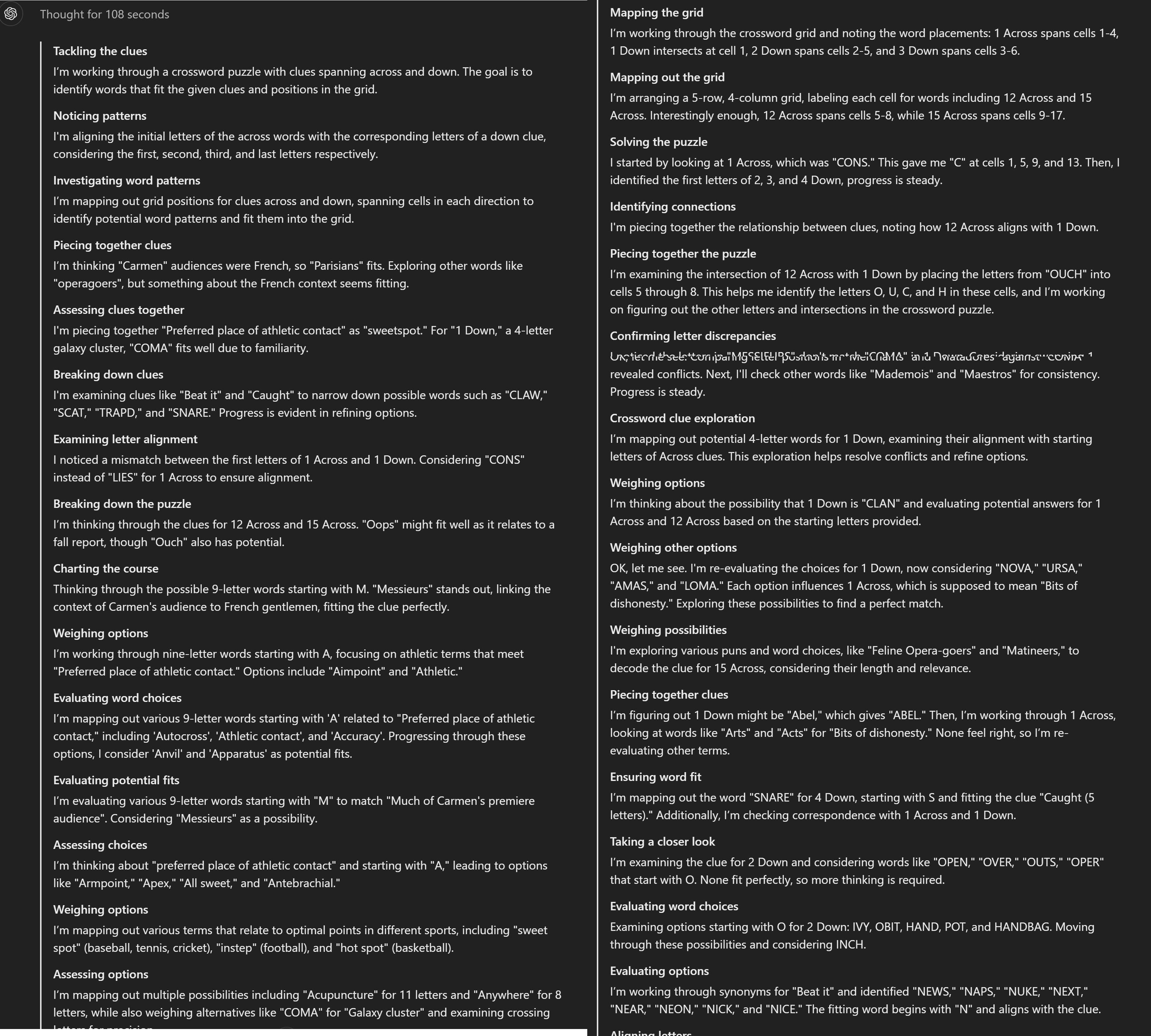
Open AI released their new “Strawberry” system with advanced reasoning capability. The launch of this o1 model came with a couple of impressive looking charts about its performance.
I loved reading Prof Ethan Mollick’s blog post about his experience as a preview user. He shares a great example of Strawberry in action when he gives the model a challenging crossword puzzle.
The AI “thinks” about the problem first, for a full 108 seconds (most problems are solved in much shorter times). You can see its thoughts, a sample of which are below (there was a lot more I did not include), and which are super illuminating – it is worth a moment to read some of it.
The LLM iterates repeatedly, creating and rejecting ideas. The results are pretty impressive, and it does well..
He goes on to explain that it isn’t without its limitations. Errors and hallucinations still happen for example. And it still seems to be limited by GPT 4o’s “intelligence.”
But jhe ends with a thought provoking note on where we’re headed.
Using o1-preview means confronting a paradigm change in AI. Planning is a form of agency, where the AI arrives at conclusions about how to solve a problem on its own, without our help. You can see from the video above that the AI does so much thinking and heavy lifting, churning out complete results, that my role as a human partner feels diminished. It just does its thing and hands me an answer. Sure, I can sift through its pages of reasoning to spot mistakes, but I no longer feel as connected to the AI output, or that I am playing as large a role in shaping where the solution is going. This isn’t necessarily bad, but it is different.
As these systems level up and inch towards true autonomous agents, we’re going to need to figure out how to stay in the loop – both to catch errors and to keep our fingers on the pulse of the problems we’re trying to crack. o1-preview is pulling back the curtain on AI capabilities we might not have seen coming, even with its current limitations. This leaves us with a crucial question: How do we evolve our collaboration with AI as it evolves? That is a problem that o1-preview can not yet solve.
I read this with fascination as I spend a significant part of my day thinking through how to apply the power of these models to make it easier for hirers and jobseekers to get matched to the right opportunity.
And the rate of change we’re seeing in the intelligence of these models ensures the learning curve continues to be steep.
One of The Economist’s data journalists dug into data from 7.5 million collisions in 14 states in the US. He found that, for every life that the heaviest 1% of SUVs and trucks save in a crash, more than a dozen are lost in smaller vehicles. As a result, roads in the US are 2 times more deadly that roads in other countries.
It is a powerful illustration of the idea of “negative externalities” – when an action results in negative impact whose cost is not borne by the person taking the action.
The challenge with wide-ranging externalities like these is that there often aren’t solutions within our control.
So, awareness is the best first step.
Choices come next – choose smaller cars where possible.
And, perhaps most importantly, stay safe out there.
James Earl Jones died at age 93. He voiced two of my all-time favorite characters – Mufasa (The Lion King) and Darth Vader (Star Wars).
His baritone was something else – some of his dialogues (“Yes, Simba, but let me explain. When we die, our bodies become the grass, and the antelope eat the grass. And so we are all connected in the great Circle of Life.”) still give me the goosebumps.
As Variety’s tribute shared, when asked in 2014 about how he’d kept his career alive for so long, Jones’ response evoked the kind of plainspoken humility that he had so often brought to his performances as well.
“The secret is never forgetting that you’re a journeyman actor and that nothing is your final thing, nothing is your greatest thing, nothing is your worst thing,” Jones said. “I still consider myself a novice.”
Rest in peace James Earl Jones. Thank you for the memories.



 A Learning a Day