Stress and the mind’s direction

“The mind can go either direction under stress – toward positive or toward negative: on or off. Think of it as a spectrum whose extremes are unconsciousness at the negative end and hyperconsciousness at the positive end. The way the mind will lean under stress is strongly influenced by training.” | Excerpt from Dune by Frank Herbert

This idea is one I’ve found so true. Many assume our response to stress is hardwired. While it is true that we have default responses, training can transform how we approach stress.

The first step, as always, is awareness.

Write it to debate it

A simple work productivity practice – Before you start debating something, take the time to write out your point of view.

Ideas that aren’t written down are hard to debate because nobody has taken the initiative to put down a concrete point of view that anchors the conversation. Stay away from debates that don’t have a document.

Write it down. It helps move things forward.

Perplexity

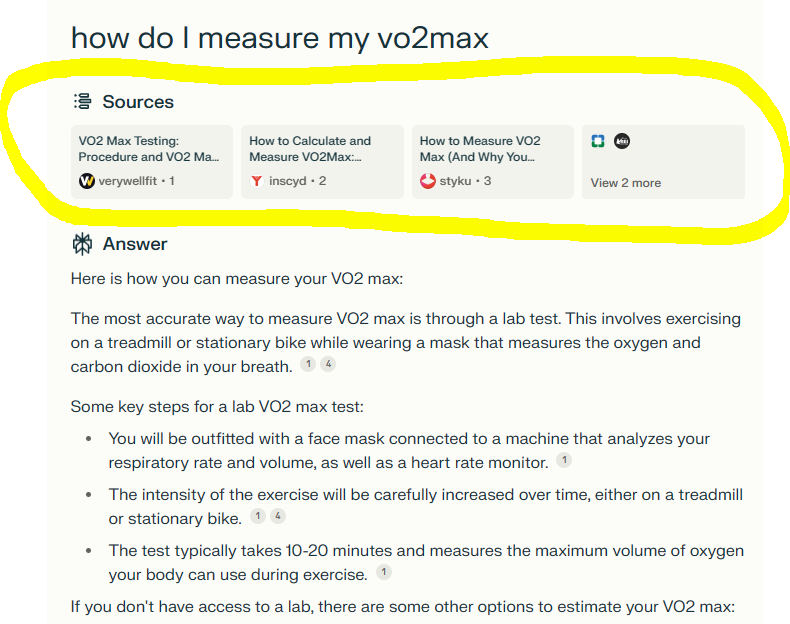
Perplexity is quickly becoming my go-to search engine. After ChatGPT’s launch, I found myself using ChatGPT a lot – especially when I was seeking recommendations or planning travel. My usage was roughly 50-50 between ChatGPT and Google/Bing (via Ecosia).

Over time, however, I found myself missing links where I could learn more. And that’s how I fell in love with Perplexity. When I ask a question or search for something, I see the links Perplexity generates its content from. I find myself taking a look at the links often to get a better sense of the validity of the response.

Perplexity has increasingly grown its share of searches. I think my share is roughly 70% Perplexity, 25% Bing (via Ecosia)/Google, and 5% ChatGPT.

I’m excited to see how this evolves.

PS: Perplexity also has a special place in my heart as the Co-founder and CEO is a fellow high school alumnus. Kudos Aravind!

Songs, aspirations, reflections

I was on a drive today where I heard songs from three distinct times of my life.

The first was a song I first heard as a 13 year old. It was my favorite song for a time.

The next was a song I heard a lot as a 16/17 year old as part of a CD I’d burned with my favorite songs from that time.

The final one was from my time as an intern at graduate school. I’d hear this song before pulling into work.

Each of these songs brought back memories about my aspirations from the time. As a 13 year old, I’m not sure what my aspirations were. I guess they had something to do with doing well in my next exam.

As a 16/17 year old, I wanted my university dreams to work out.

And as a graduate school intern, I just hoped I’d get an offer to come back.

All of these hopes worked out just fine. This walk down memory lane reminded me of three things.

(1) It is so easy to take our current life for granted. Often, so much of what we have is the stuff of dreams. I think of this a bunch when I listen to a collection of songs from a time when I just hoped my now-wife would date me. :-)

(2) Happiness is reality over expectations. While it shouldn’t be over-done and acknowledging this isn’t a push for a lack of ambition, it helps to keep expectations low.

(3) Very few problems we’re dealing with will feel significant in a decade.

Gaining perspective – 2 activities

I wrote about the two signs that point to losing perspective recently. Today, I thought I’d cover the two activities that help me gain perspective.

(1) Time out in nature: Getting out to the woods or to the mountains or near the ocean – ideally for an extended amount of time – tends to help me reset. Time out in nature reminds me of my place in the big scheme of things and helps put my problems in perspective.

(2) Writing: Writing is often the balm my soul needs. The act of attempting to make my thoughts coherent often help them become so.

It isn’t complicated once I’ve realized I need to do this. As a rule, becoming aware of the problem is the bigger challenge.

Reactive and proactive language

“It fell” vs. “I dropped it”

“I can’t” vs. “I won’t”

“I am not good at that” vs. “I am not good at that yet.”

We often work through the difference between reactive and proactive language with our kids.

As I do so with them, I find myself realizing how often I choose reactive language myself. And, in doing so, I lose the opportunity to let proactive language bring the accountability and agency that transforms the conversation.

Near-miss

I nearly lost my phone recently. Thanks to the staff at the restaurant where I left it, I got it back within 30 minutes.

Alls well that ends well and all that.

The incident got me thinking about the counterfactual. What if that hadn’t happened?

We were traveling during that time. It would have been a painful few days without the phone. And it would have been an expensive mistake too.

By all accounts, it was a near-miss. A near-miss that helped me improve my processes (I’m more careful and will be for the foreseeable future) and that has made me more grateful for the fact that it was a near-miss and not a miss.

My biggest takeaway -> near-misses don’t get enough credit.

And make the most of them when they happen, we should.

Losing perspective – two signs

There are two tell-tale signs I’ve come to associate with losing perspective. They are:

(1) Obsessing about things outside my control

(2) Losing the ability to laugh about the circumstances

It is amazing how much of an impact these behaviors can have. Together, they can take out the joy and make us feel stuck. That, in turn, further perpetuates these behaviors. Before we know it, they become habits.

Just not the good kind.

When I find myself stuck in these thought patterns, I’ve come to realize that the only way out is to hit reset. It takes time and space to observe these behaviors, recognize them for what they are and what they’re doing to us, and attempt to work through the root cause.