
“I like to think that one day you’ll be an old man like me talking a young man’s ear off explaining to him how you took the sourest lemon that life has to offer and turned it into something resembling lemonade.” | Dr K, This is Us
It resonated.
“I like to think that one day you’ll be an old man like me talking a young man’s ear off explaining to him how you took the sourest lemon that life has to offer and turned it into something resembling lemonade.” | Dr K, This is Us
It resonated.
“While we are free to choose our actions, we are not free to choose the consequences of those actions. Consequences are governed by natural law. They are out in the Circle of Concern. We can decide to step in front of a fast-moving train, but we cannot decide what will happen when the train hits us.
We can decide to be dishonest in our business dealings. While the social consequences of that decision may vary depending on whether or not we are found out, the natural consequences to our basic character are a fixed result.
Our behavior is governed by principles. Living in harmony with them brings positive consequences; violating them brings negative consequences. We are free to choose our response in any situation, but in doing so, we choose the attendant consequence. “When we pick up one end of the stick, we pick the other.”” | Stephen Covey, The 7 Habits of Highly Effective People
I think of this idea* from time to time. Natural consequences – both good and bad – don’t always play out in short order or the timeline we might expect.
But, over a long enough horizon, they do.
When we pick up one end of the stick, we pick the other.
*I was about to start this post with “One of my favorite ideas from Stephen Covey’s 7 Habits is….” I paused because I find myself saying that often. Another reminder of many of the sheer depth of impact the book has had on me.
For a long while, my first action in the morning was to turn off my alarm, pick up my phone, and begin reading email.
I didn’t like the email behavior. It didn’t improve my mental state and degraded it on many days. So I attempted to figure out good replacement.
Over the past 2 years, I’ve made it a point to remind myself of a set of principles most mornings – stored in my phone’s Notes. In theory, ideal behavior would be to start by reading that set of principles, getting up, and then getting to email.
After many such attempts, I declared bankruptcy, stopped attempting to reinvent the wheel, and followed the many wise souls who replaced their phone alarm with an alarm clock.
It’s been a month. The alarm clock is fine but the new routine it enables – with the phone out of the bedroom – is great.
Sometimes, it’s best to burn the bridges and move onto trying something different.
I started reading “Sonic Boom” – the story of Warner Brothers Music’s incredible thirty year run where they shaped the music industry via artists like Jimi Hendrix, Madonna, and Prince.
I don’t know much about the music industry – certainly not much about the industry in the 70s and 80s. I also can’t remember how this book ended up in my collection. But I love scrappy origin stories – so maybe that explains it.
I’m in the part of the book where Warner Brother’s Music is still the scrappy upstart hustling to prove viability. And one of my favorite anecdotes about the ethos of the group was their insistence that their focus was to not make hits.
Instead, they were run top-down by an ethos of trying to make great music. Even when they failed commercially, the question the team was asked was – “Was it good?”
As simple as this sounds, it is so hard to do consistently – especially when you’re under pressure to prove viability or to drive growth. The typical path is to just over-optimize your way to mediocrity. But, if like Warner Bros, you’re focused on making great products, the hits will follow.
Good outcomes follow good process in the long run. It is definitely one of those ideas that is easier to preach than practice.
When Warren Buffett lectures at business schools, he says, “I could improve your ultimate financial welfare by giving you a ticket with only twenty slots in it so that you had twenty punches – representing all the investments that you get to make in a lifetime. And once you’d punched through the card, you couldn’t make any more investments at all. Under those rules, you’d really think carefully about what you did, and you’d be forced to load up on what you’d really thought about. So you’d do much better.” | Poor Charlie’s Almanack
I love this advice. I wish I’d heard it earlier. But I sure am glad I’m hearing about it now.
Fewer things with more conviction is great advice for investing…/ and life.
After a run of a few months of near-weekly 70 minute soccer games, I took a break for 6 weeks. I remember how it felt toward the end of that spell – I was getting through the games with ease and had plenty left in the tank. There was a game where I spent over 20 minutes in Zone 5. No problem.
Getting back today, however, was brutal. I was feeling out of breath within a few sprints. It took a while to feel any semblance of flow or fitness. It served as a great reminder of just how quickly things can degrade.
Everything degrades. Even a piece of software that is just supposed to run the same piece of code degrades over time. Nothing runs in isolation – something changes with a dependency and the whole system comes down in time.
Our mental health definitely degrades over a period. Vacations/scheduled breaks are a great way to get the required amount of maintenance in.
Our fitness degrades too. In this case, I haven’t been away from exercise for 6 weeks. I’ve just been away from long bursts of high-cardio workouts. The speed of degradation caught me off-guard.
It is important to periodically take stock of the speed of degradation of the things that matter to us. That way, we can get ahead of rapid degradation and ensure we’re running maintenance regularly.
Especially important when it comes to our health.
By default, we tend to over-optimize the way we’re playing the current game we’re in and under-optimize the decision involving which game to play.
One of the seminal scenes in the movie “Remember the Titans” is when the two protagonists have a heated exchange after training.
Julius: You been doin’ your job?
Gerry: I’ve been doin’ my job.
Julius: Then why don’t you tell your white buddies to block for Rev better? ‘Cause they have not blocked for him worth a blood nickel, and you know it! Nobody plays! Yourself included! I’m supposed to wear myself out for the team? What team?! No, No. What I’m gonna do is, I’m gonna look out for myself, and I’m gonna get mine.
Gerry: See, man? That’s the worst attitude I ever heard.
Julius: Attitude reflects leadership, Captain.
The two end up becoming best friends after this exchange. Gerry becomes the leader the team rallies around and Julius becomes the defensive star.
It is one of those moments that has stayed with me nearly two decades since I first saw the movie.
It reminds me of a simple idea that is so true.
Disgruntled leaders create disgruntled teams. Political leaders create political teams. Constructive leaders create constructive teams. And so on.
The team’s attitude is generally a reflection of its leadership.
I’ve been a subscriber to “The Growth Equation” – a usually insightful weekly newsletter. In today’s post, Brad had a fascinating note on how data and AI push us down the path of over-optimizing everything.
The example I liked was about how NBA players have optimized where to take shots. Thanks to all the percentages involved, shots today are only taken on the 3 point line or in the area right under the basket.
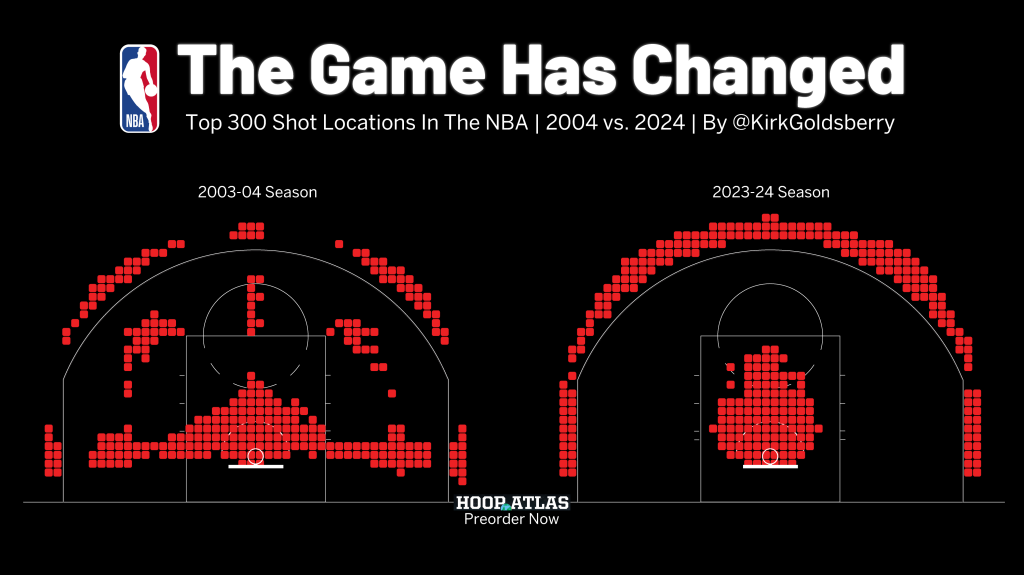
Sports aren’t the only place where we see this shift in emphasis. As writer Derek Thompson has outlined, movies are the same. Over the past few decades we’ve been inundated with sequel and reboot madness. The comic book mega universes, Mission Impossibles, Fast and the Furious 23, and just about every successful kids movie has a sequel. Movie studious fund known quantities. The idea of an original picture has largely gone by the wayside. Why? It’s economics. A known quantity is more likely to be a hit. And hits have an outsized effect. They need the home run to survive. Singles won’t do.
In many areas of life, more knowledge and data has led to optimizing for an outcome. We optimize for hours of sleep, productivity, exercise routines, and our kids sporting activities and academic prep.
But optimization comes at a cost. Baseball is struggling. NBA ratings are down from their peak. The movie industry is in disarray.
When we over optimize, we lose quality. Maybe not in terms of the bottom line, but in terms of things that we don’t regularly quantify, or perhaps that are impossible to measure altogether: qualities like enjoyment, artistry, and meaning.
Think of it like this: right now, I could take an AI bot, train it on all of the best tweets that myself, Brad, or better yet, James Clear, has tweeted. It would then spit out all of this pseudoprofound bullshit designed to go viral. And it would probably work (Just look at tech bros social media right now…where it’s impossible to decipher between what is real and what is a bot—the singularity has occured!). But to me, something is lost there. It’s not truly profound. It’s not engaging with an audience. It’s not testing ideas and learning. It’s synthetic. It might lead to a desired outcome, but it lacks curiosity, intrigue, and enjoyment. If I consumed AI tweets all day, it would turn me into a numb, pessimistic automaton, and train my audience for nonsense that appears helpful but has no meaning behind it, instead of wrestling more nuanced ideas.
It’s the same with the rest of our lives. We optimize our routine for productivity, forgetting that most breakthroughs come when we are mindlessly going on a walk or fiddling around letting boredom work its magic. We optimize our child’s chances at getting the athletic scholarship in soccer by specializing early and paying for a private coach; yet in doing so, we neglect the unstructured play that may seem pointless and inefficient in the short term, but pays off massively in the long haul. When researchers have studied athletes who actually make it to the top, they tend to have more unstructured play than their peers, whereas overly structured sporting activities is tied to fear of failure and burnout.
The point is that optimization often backfires, even for the results we desire.
Indeed.
Life is a single player game that looks and feels a lot like a multiplayer game.
Gamer beware.
 A Learning a Day