
“I’m a white belt.”
“That’s amazing. I’m a black belt. But a black belt is simply a white belt that never gave up.”
Heard at a Jiu-jitsu dojo recently.
Such a beautiful sentiment
“I’m a white belt.”
“That’s amazing. I’m a black belt. But a black belt is simply a white belt that never gave up.”
Heard at a Jiu-jitsu dojo recently.
Such a beautiful sentiment
If we’re not able to get a group of thoughtful people to align on the right way forward, first check their incentives. It is hard for someone to understand something that they are paid not to understand.
If incentives are aligned, focus on getting to shared context. Assuming shared context is often the biggest mistake we make in attempting to get a group of people rowing in the same direction.
Technology analyst Ben Thompson recently referred to an article he wrote from 2016 called “The Curse of Culture“. In it, he took apart Microsoft’s complacency about the phone and former CEO Steve Ballmer’s insistence to cling onto a Windows-centric view of the world.
It fell to Satya Nadella to change the culture. His first public event was introducing Office for the iPad. Ben made an insightful observation on Satya’s move – “This is the power CEOs have. They cannot do all the work, and they cannot impact industry trends beyond their control. But they can choose whether or not to accept reality, and in so doing, impact the worldview of all those they lead.”
It is a beautiful way to think about what leadership. My go-to definition for leadership these days is (aptly derived from Satya as well) – creating clarity of vision, bringing relentless constructive energy, and building teams and systems that deliver exceptional results.
But you can only create the right vision if you are aware and accepting of reality. Ultimately, our ability to see things as they are instead of how we’d like them to be is among the most foundational things we do in any leadership role – at work and in our lives.
There’s a powerful graph that illustrates the importance of safety capacity by explaining how waiting time goes up with increased resource utilization.
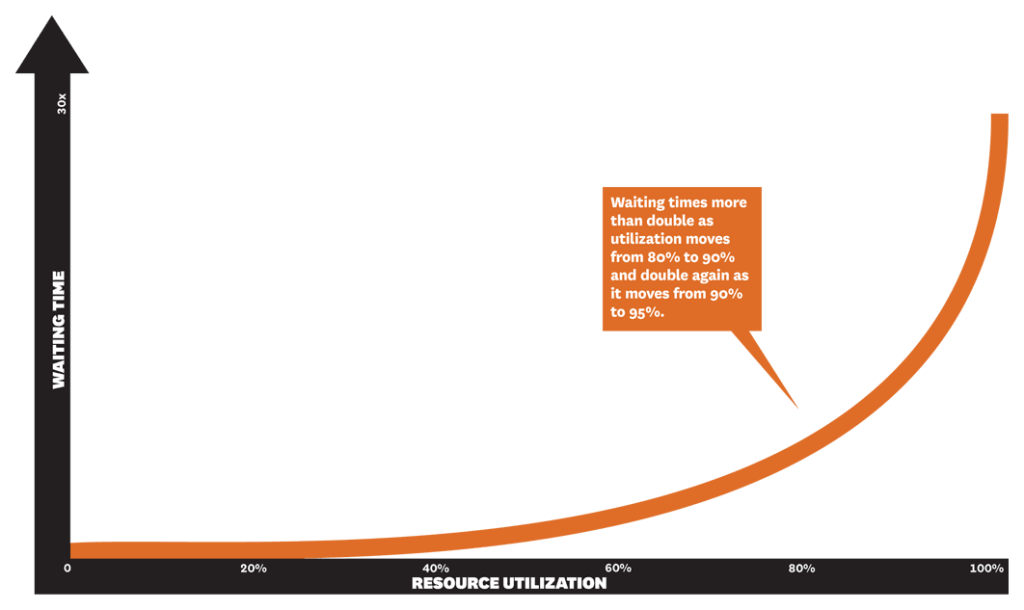
Imagine you have a solitary cashier at the checkout machine. This graph explains that waiting times are going to more than double when the cashier is busy 80% of the time. It doubles again if his utilization goes up 90%.
Why? Because delays can be easily caused by sudden fluctuations in the queue. If a large family brings a massive order, everyone behind them in the queue will simply have to wait. So, if a retailer runs their operation with their clerks at 100% capacity, you can be sure that the customer experience will suck.
The same goes for our lives. If we organize ourselves such that we always find ourselves running at 100% capacity, it is inevitable that things will go awry. Work doesn’t arrive at a constant rate – an emergency project is bound to show up and, if we’re running with no safety capacity, that will be a problem.
Additionally, we’ll never have the bandwidth to deal with other sorts of fluctuations that may occur outside work – an injury, a family member that gets sick, a friend that needs help, etc.
Always build in safety capacity.
If the trade-offs aren’t feeling painful, the strategy is likely not clear enough.
Painful trade-offs don’t guarantee a winning strategy. But they at least point to one that we have a chance of executing well on.
I heard about a special event at the Grammy awards. Tracy Chapman joined country singer Luke Combs for a joint rendition of Chapman’s superhit “Fast Car.”
After Luke Combs’ cover of “Fast Car” made waves in the past couple of years, I thought it was such a lovely gesture on Tracy Chapman’s part to perform the song as a duet.
There was so much that was special beyond the song itself – Luke Comb’s obvious respect, Tracy Chapman’s casual elegance, and the many artists including Taylor Swift standing and singing-along.
A class act.
“Perhaps the most valuable result of all education is the ability to make yourself do the thing you have to do, when it ought to be done, whether you like it or not.” | Thomas Henry Huxley
It resonated.
I was in a conversation recently where I clarified what I wanted to pursue and what I expected would ensue. As the conversation continued, we realized that the things that people often pursue – money, titles, etc., – work best when they’re in the “ensue” bucket.
That brought me right back to this passage from Viktor Frankl’s incredibly wise “Man’s search for meaning.”
“Again and again, I therefore admonish my students in Europe and America: Don’t aim at success – the more you aim at it and make it a target, the more you are going to miss it. For success, like happiness, cannot be pursued; it must ensue.
And it only does so as the unintended side effect of one’s personal dedication to a cause greater than oneself or as the by-product of one’s surrender to a person other than oneself. Happiness must happen, and the same holds for success: you have to let it happen by not caring about it. I want you to listen to what your conscience commands you to do and go on to carry it out to the best of your knowledge.
Then you will live to see that in the long-run, in the long-run, I say(!), success will follow you precisely because you had forgotten to think about it.”
On a daily basis, life and work can feel tough.
Moments when we feel everything is going great are few and far in between.
On most days, it just feels uphill and against the wind.
On days like these, it is worth reminding ourselves that airplanes take off against the wind, not with it.
I have been a Morgan Housel fan for over a decade. He’s gone onto earn deserved praise for his exceptional writing style that mixes powerful anecdotes with timeless wisdom about investing and life. So, I was excited about reading “Same as Ever.” Here are 7 lessons that resonated:
(1) The world isn’t crazier than it was before. With 8 billion people, crazy things every day are inevitable.
(2) Calm plants the seeds of crazy. If stocks keep going up, the market is going to get too confident. That, then, will lead to a crash.
The world is calmer and safer than ever before – primarily because of the progress we’ve made against deadly diseases thanks to vaccines. But that made us over-confident and thoroughly unprepared for a pandemic. And so on.
Every time this (recession, pandemic, etc.) happens, we will feel the pain of the wound. The wounds will heal but the scars will last.
(3) Slow progress among a barrage of bad news is normal. Bad news is about what happened, good news is invisible because it is about things that didn’t happen. Improvements in heart disease at 1% per year for 70 years saved 25 million Americans. It’d never make the headlines any given year. But, over 7 decades, it is massive.
(4) Plan like a pessimist, dream like an optimist. The key is surviving the short term to make it to the long term.
(5) It’s supposed to be hard.
In 1990, David Letterman asked his friend Jerry Seinfeld how his new sitcom was going. Jerry said there was one frustrating problem: NBC supplied the show with teams of comedy writers, and he didn’t think they were getting much good material from them.
“Wouldn’t it be weirder if they were good?” David asked.
“What do you mean?” Jerry asked.
“Wouldn’t it be strange if they could all just produce reams of hilarious material day after day?”
Recalling the conversation a few years ago, Seinfeld laughed and told Letterman: “It’s supposed to be hard.”
(6) The grass is greener on the other side because it is fertilized by bullshit. You only get the smell when you come close enough. This idea might have been my favorite.
(7) Incentives are the most powerful force in the world.
 A Learning a Day