Optimizations and comfort zones

One way to measure if we’re stuck in our comfort zone is to look at all the projects we’re betting on for the next 6 months and ask ourselves – what percentage of these are optimization projects with guaranteed outcomes?

If we’re pushing ourselves, more than 50% of what we’re betting on will have unknown risks/rewards.

The pull approach to new habits

The default mental model many of us have with new habits is to brute force our way in. That means committing to doing it starting tomorrow and then never breaking the streak.

This is a complete fine strategy.

Until we do break the streak for a few days. Then we do it again. And it gets harder and harder to summon the willpower to take the brute force approach each time.

An alternative approach I’ve come to appreciate is to approach new habits with a lot of patience. Try to start tomorrow. But if you miss, let that miss sink in.

If it is a habit we care about (if we don’t, it won’t last anyway), each miss will get us thinking about the system we need to get things on track. And it’ll increase our intrinsic motivation to do so.

This “pull” approach to forming habits takes a lot longer to take off.

But once it does, it has a way of staying airborne a lot longer.

Marinate

When we receive feedback, it is tempting to look for ways to respond. Do something, say something, etc.

Often, the most effective thing to do is to simply let it marinate.

Sit with it, let it soak, and see how things feel after a period of time.

That feeling is often different from our initial response/reaction. The time and distance from the stimulus often gives us the space to be constructive and figure out what we want to learn from it.

Characteristics of conversations

Two characteristics of conversations about new or undiscussed ideas among great partners –

(1) Nobody cares about interruptions. Respect is both assumed and ever-present.

(2) Every new idea is an opportunity to build. It may either refute a previous point or build on it – but the keyword is opportunity. Nobody cares about holding back – why would you do that with people you trust? Nobody cares about who suggested the idea either. Again, why would you do that with people you trust? The conversation is often both the means to the end and the end itself. Winning is playing.

Few conversations are truly great – in that you feel the respect, trust, and energy flow. And few people – those great partners – manage to consistently deliver on great conversations.

Cherish them, we must.

Playing different (stupider) games

“Always be clear about what game you’re playing” is an idea that’s been top of mind over the past couple of years. I keep a page in my OneNote book titled “The Game I’m Playing” and update it every 6 months.

The goal of the page is to remind myself of my approach to key decisions – career, personal wealth, etc. It is a simple and periodic way to recommit to playing long-term games.

I think it is important to be clear-headed about this because it is easy to be distracted by others who’re playing different – often short-term – games.

To that end, I came across a thought-provoking post by Kyle Harrison, a venture capitalist about games in investing and building companies. The whole post is worth reading in full as it touches on a variety of topics (including the hype around AI companies) – it has a great conclusion.

In the world of building and investing in companies, there are a LOT of different games at play. The only way to avoid finding yourself playing a stupider game is to look around and understand the games that everyone else is playing. And adjust accordingly.

I think the conclusion applies well beyond building and investing in companies. It applies to careers and to life as a whole.

Know what game you’re playing. Calibrate with the games you see around you to make sure you’re avoid playing stupid games.

Sports and drama

Following Manchester United is my guilty pleasure. I have less time these days for said guilty pleasure. But I manage to find ways to follow all news closely, watch most highlights, and catch at least a few of the big weekend games.

I was reflecting on this “pleasure” after watching a late loss to Arsenal yesterday. It was a close game – one lost on fine margins. This typically kickstarts a period of “depression.” I stay away (relatively) from watching highlights and/or reading football news until our next win. Then I get excited. And the cycle repeats.

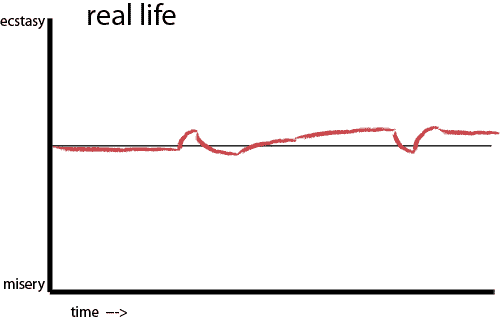
Whenever I think of this cycle, I’m reminded of Derek Sivers’ excellent post about drama after a talk by Kurt Vonnegut.

Vonnegut contrasts the emotional arc of a story like Cinderella…

…or a common disaster story…

…with that of our life.

Derek’s takeaway is profound

Our lives drift along with normal things happening. Some ups, some downs, but nothing to go down in history about. Nothing so fantastic or terrible that it’ll be told for a thousand years.

“But because we grew up surrounded by big dramatic story arcs in books and movies, we think our lives are supposed to be filled with huge ups and downs! So people pretend there is drama where there is none.”

That’s why people invent fights. That’s why we’re drawn to sports. That’s why we act like everything that happens to us is such a big deal.

I’ve thought about this a lot over the years. As time has passed, I’ve appreciated folks who take a “no drama” approach to life. And I think I’ve made progress over the years to that end myself.

Except, of course, when I indulge in my quota of this while watching/following premier league football.

Or maybe because of it?

The sweetest bread

Dimitris shared this Greek parable in response to a post recently.


Once upon a time it was a wealthy king, so wealthy that he had everything he wanted. He had everything and he was considered to be a happy man until he started suffering from a strange anorexia and had no appetite to put anything in his mouth. Gradually he was weakening, and became grumpy and weird. Many doctors went to see him but none of their remedies could make the king feel better. The king’s anorexia lasted for long, and he was becoming thinner and thinner day by day. He wanted nothing to eat at all.

One day, a poor white-haired old man passed by the palace accidentally. He was
wise and knew remedies. He was told about the king, and went to see him. “Did you get tired, my king?” he asked. “What do you say, my doctor, ‘the king says “All day lying on my throne I do nothing at all.” “Do you have worries and cares for your people?” “No, far from it. I live carefree, and I don’t care about anyone! ” ” Did you ever wish to have something and you couldn’t have it?” ” Nor even that! I am, a king and what I seek , I always have it…”

The elder thought for a while, and then turned towards the king and told him: “Listen, my King: As I see, you have nothing serious.What is to blame for and you have no appetite to eat is the bread they give you in the palace! Order your people to bring you the sweetest bread in the world! If you have this, you will be healed!”

On the same day the king gave orders to his palace bakers to knead and bake “the sweetest bread of the world!”. All bakers throughout the kingdom worked hard in order to make the sweetest bread! They kneaded with sugar and cream all sorts of bread and they bring them to the palace for the king to taste them. But none of those breads make the king eat. He thought they weren’t good enough or they smelt awful. So he didn’t want to eat any of them. Until one day, the king lost his temper and sent his men to find and bring the old man to the palace. So it happened.

“I’ll hang you since you tricked me!”, the king shouted at the wise man when he saw him.”Why, my king?” asked the old man. “Because the sweet bread, you said did nothing to me!”. “Nah?” The old man said. “It seems that the bread kneaded for you, was not as sweet as it should have been!” The king was again ready to get very angry, but he saw the old man that was thinking of something, and stayed calm.

“Listen, my king,” says the elder after a while. “If you want to try truly the bread that will heal you, you have to come with me for three days only and do what I tell you. If you do not get well, you are free to behead me ”

And the king, my son, willy-nilly, agreed to go along with the strange old man. He wore himself poor clothes and old shoes and took a stick in his hands and went secretly from the palace, away, and went to the plain, where the old man was sitting in a hut in a field studded.

At dawn, the old man gave the king a scythe and says: “Come to reap! ‘. And the king started reaping and it was boiling hot. At night, as they were exhausted they slept deeply.

The next day, early in the morning, the elder awakened King and says: “Get up now, get all these fagots, to thresh them in the thrashing!”. The king carried on his back more than the half fagots,and then all day, he thwacked them until they made a wheat pile and they put it in a poke. And throughout the day they were so pale, hungry, and both of them, just drank some water from the cistern, which was near the hut. At night as they were exhausted again they slept deeply.

On the third day, at dawn, the old man awakened his King: “Wake up,” he says, “Now we must go our wheat to the mill in order to grind it! Take it on your back, because I can’t do it, and let’s go there on top of the mountain where the mill is.” What could the king do, since this was the agreement? He loaded the sack on his back, and tired as he was, he carried it to the top. Now he began feel hungry, but he still said nothing.


They ground their grain and they came back to the hut at noon, the king was loaded with the flour again.”Come to knead” the old man said. He divided the flour into ten pounds, threw it in the tub and made the king knead. Then he sent him to the forest in order to cut down wood, and late in the evening they prepared the oven to bake 3-4 loaves of bread. Now the king was really hungry and he was waiting until the loaves were ready. But when the smell started coming out of the oven the King was feeling more and more hungry.”I’m too hungry,” said the king. “Wait and you ‘ll eat!” answered the old man.

Soon the loaves were ready, steamed and browned. As a hungry wolf, the king grabbed the loaf, cut it with his hands and began to eat. But he swallowed even the first mouthful, his face turned red with joy and shouted: “Yes! This is the sweetest bread of the world! Even if I didn’t put any spoon of sugar in the dough!”

Then the old man smiled and said : “My King, you should know that sugar in this bread was your sweat to make it. Now you are free to go back to your palace. From now on you should work hard and you’ll see that you’ll never lose your appetite again.”


It resonated.