Yellowstone National Park

We’re learning a tremendous amount about our impact on the planet. And it is really easy to get down about what’s happening. The earth is as hot as it has ever been. Arctic ice is melting at a scary pace – the number of animals and humans around the world facing adverse weather is on the up.

My philosophy when it comes to thinking about this is to embrace reality and deal in hope. And one way I become more hopeful is when I think about the many people around the world who get to experience incredible sights. For every 10 who sees something spectacular, I’m hopeful 3 contemplate the challenges ahead, and 1 takes systemic action.

The US National Park system is one of those avenues of hope. They do fantastic work protecting some incredible sights. And perhaps none more incredible or wondrous than Yellowstone National Park.

Yellowstone National Park, established in 1872, was the first national park in the US and (likely) the first in the world. One way to make sense of this fact – it must have taken something wondrous for man to stop plundering nature and think about conservation. Yellowstone National Park is indeed all that.

There are so many incredible facts about Yellowstone National Park. One that sticks with me is that it has more than half the world’s known geysers and geothermal features. It is also the equivalent of the Serengeti in North America with free-roaming herds of bison, elk, bears, and wolves.

There are three things that stayed with me from our visit to Yellowstone National Park.

The geysers are wondrous. This geyser “Grand” erupts up to 200 feet for 9-12 minutes every couple of hours. And, of course, there’s the Old Faithful that faithfully erupts every 45 minutes.

The sights from the geothermal features are incredible – they need to be seen to be believed. The greatest of them all is the Grand Prismatic.

And then the wildlife. The Bison roaming around are majestic and nimble (they possess ridiculous acceleration). And there are few sights more amazing than seeing a North American grizzly bear playing with her cub off the side of a road. We spent a couple of hours just transfixed – watching another mom and son pair playing.

The word that best describes Yellowstone National Park is wondrous. Its uniqueness inspires wonder and appreciation for our world.

(One more in a newly formed “Our world is awesome” series: Grand Canyon National Park)

Timing the market

I first invested in the market just over a decade ago. I was two years out of school, was fortunate to have savings, and thought it was time to do something with said savings.

I read a few books on investing – by the likes of William J Bernstein and Ramit Sethi – and learnt about index funds. I didn’t live in the US – so I needed to find a place that traded the corresponding ETFs or Exchange Traded Funds. I also didn’t know anything about this and didn’t know anyone in my circle of friends who was doing this.

So I reached out for help to a wiser friend I’d gotten to know and also ended up exchanging notes with the wonderful Derek Sivers. As part of this, I had a memorable exchange with Derek when I asked – how do I know I’m investing at a good time?

He explained that he had debated entering the market in 2009. Someone had told him to wait to see if the market went down further. It never did. His net worth would have been incredibly high if he’d just invested instead of waiting two years. I remembered a quote in William J Bernstein’s book – “Time in the market beats timing the market” – and decided to take the plunge.

I ended up having to sell all my investments just about two years into my first plunge to pay for graduate school. I remember feeling so grateful for these investments – 2013-15 was a good time to be invested in the market. Those investments were one of three things that helped me/us get out of graduate school debt free. The other two were a second-year tuition scholarship and my wife’s income.

It took a couple more years to build some liquidity before investing in the market again. And as I look back over the past 6 years, I realize I’ve had a knack of timing my sales at the worst possible time.

For a brief period in 2019, I thought I’d invest in individual stocks. A few months in, I realized that this wasn’t for me. Funnily, the two stocks I’d decided to invest in were Nvidia and Amazon. I sold them both at a loss as I exited the single stock game.

Both have done more than fine since.

As I was on my way out of the self-managed game, I finally decided to work with Vanguard’s managed services. However, I still held onto the index funds I’d invested in when I was going it alone. And as I was looking back at my history this past weekend, I realized I went on a simplification spree and went all in on the managed services in mid-2020.

Those indexes did phenomenally well in the 18 months since.

I share this because, well, this is a learning blog. And where would the learning be without spectacular failures such as these?

But I also share this because that adage – time in the market beats timing the market – has been true in the past 10 years. The investments I’ve consistently contributed to and then left untouched for long periods of time have done the best. The only requirement with these was to contribute to them regardless of whether the market is up or down. And I’ve managed that.

There is no guarantee a simple index fund approach will work forever – past performance doesn’t guarantee future performance. But we’ll deal with that when it comes.

For now, I’m left to reflect on some of the hard-won lessons the market has taught me – both about the market and myself. Ultimately, all of this comes down to finding an investment approach that works for us. I’ve learnt that playing the market is a game that is best left to others.

Much like writing on this blog, I work best when I work with consistency, equanimity, and time.

The true cost of owning something

The true cost of owning something = cost of purchase + cost of maintenance/insurance.

Too often, we make decisions just based on the cost of purchase. On average, that works out fine because maintenance/insurance costs are often correlated to the cost of purchase.

However, there are items – sometimes in the same category – whose maintenance costs are negative relative to others that are cheaper but cost much more to maintain.

There’s a great quote that says the true cost of owning something is the amount of life we exchange for it. That exchange often shows up in unaccounted ongoing costs.

The lesson – pay as much attention to what happens after we purchase something as we do to the purchase itself.

Doing hard things

I came across this post about “Doing hard things” that I thought I’d copy in full.


When a precocious yet nonconformist teenager asks why they need to learn calculus, what should you say? 

You know they will never use it in adulthood, outside of certain career choices.

You could say, “It’ll help you get into college,” but then they’re left wondering why college cares if you know calculus. And once they’re in college, maybe you could say, “To get a good job,” but why would a potential hirer care how you did in multivariate calculus if your job doesn’t require any knowledge of calculus? 

I was one of these annoying students. I had the capacity to do well in school but never cared to because I never heard a good answer to this line of questioning. I never understood the point of truly learning the material in hard classes that you’re never going to use in the real world, and I assumed I could goof off and do the bare minimum and get away with it.

But I recently realized there is a very good reason to take Calculus. It’s to prove you can do hard things. 

The ability to do hard things is perhaps the most useful ability you can foster in yourself or your children. And proof that you are someone who can do them is one of the most useful assets you can have on your life resume. 

Our self-image is composed of historical evidence of our abilities. The more hard things you push yourself to do, the more competent you will see yourself to be. If you can run marathons or throw double your body weight over your head, the sleep deprivation from a newborn is only a mild irritant. If you can excel at organic chemistry or econometrics, onboarding for a new finance job will be a breeze. 

But if we avoid hard things, anything mildly challenging will seem insurmountable. We’ll cry into TikTok over an errant period at the end of a text message. We’ll see ourselves as incapable of learning new skills, taking on new careers, and escaping bad situations. The proof you can do hard things is one of the most powerful gifts you can give yourself.

My goal with our kids is to avoid lying to them as much as possible. I won’t tell them that calculus is super important or even that grades are super important. The truth is, they aren’t, so long as you have other plans. Calculus is a great way to prove you can do hard things if you have no other proof to show. But if you’re learning programming and building apps in your free time, or winning soccer championships, or writing a novel, then you are doing hard things. Probably harder than Calculus. 

This is also why there’s so much survivorship bias and bad advice in the “C students hire A students” trope. Most C students are not doing other hard things instead of school. They’re just goofing off, so they end up working for the A student.

But some C students are getting C’s because they’re obsessed with other projects. Hard projects. And that obsession with doing hard things lets them blow past their Excellent Sheep peers over time. So if you have a C student who’s obsessed with something hard, you probably don’t have to worry. If they’re getting high and watching TikTok, well… 

I don’t particularly care what grades my kids get once they start school. But I do care that they consistently prove to themselves they can do hard things. If Calculus is how they want to do it, fine, but there are many, many more options.

And if you’re not someone who knows they can do hard things, find a way to prove it to yourself. Build a habit, learn a skill, create something, whatever it is that turns your default stance on challenges from “that seems hard” to “I can figure it out.”

Create proof you can do hard things.


This is a beautiful articulation of an idea that resonated deeply.

I’d argue that this is the single biggest gift you get when you go to good schools and companies – you surround yourself with peers who habitually do hard things.

Flawed framing

I find myself remembering a George Carlin rant about the notion of “saving the planet.” He laments about the natural self centeredness and arrogance evident in the way we frame that idea.

The planet was here long before humans evolved. And it’ll likely be around long after.

As he correctly points out, it isn’t the planet that needs saving. It is us.

While Carlin made a compelling point through his incisive wit, it got me thinking about how our own self centeredness has us framing problems all wrong.

Too often, we attach false narratives and spot patterns that don’t exist.

When in doubt, re-examine the frame.

And, going right back to Carlin’s rant, perhaps we’ll make progress on climate if we focused on a story that involves saving ourselves.

6 things – the Exponential view and optimism

My favorite paid subscription is Azeem Azhar’s Exponential View. There are two parts of this subscription I like best – a collection of charts every Wednesday and a curated list of interesting research/technology articles every Sunday. Here, for example, are links that caught my eye today.

(1) Meta’s open source Large Language Model (LLM) is as good as GPT 3.5.

The availability of a high quality LLM as an open source tool will change the landscape. Again.

(2) The price of polysilicon – a key input in solar modules – is down 78% this year. Solar is going to continue getting cheaper.

(3) We’re still early days in the mass adoption of electric vehicles. Norway, which leads the world, with 21% of its vehicles being electric, has some fascinating data on passenger car fires. ICE/traditional cars were responsible for 35 out of 10,000 passenger car fires. The same number for EVs was 4 – nearly 9x better.

(4) We may finally have a drug that slows down Alzheimers.

(5) Canada trialed a new work permit directly targeting US H1-B holders. They hit their capacity of 10,000 applications in 2 days. #TalentWars.

(6) An energy startup, Fervo Energy, has shared a statement claiming the first every scalable geothermal energy breakthrough.

What I appreciate about this newsletter is that they don’t shy away from talking about the realities of the challenges we face – especially around the nature of the climate crisis. Those realities are hard to ignore at a time when we’re shattering all sorts of heat wave / temperature records.

For example, it is true that Coal consumptions was the highest this year in a while.

But it is also true that coal consumption is plateauing with growth in coal flattening.

However, this isn’t enough. Fossil fuels are still 82% of the world’s energy supply.

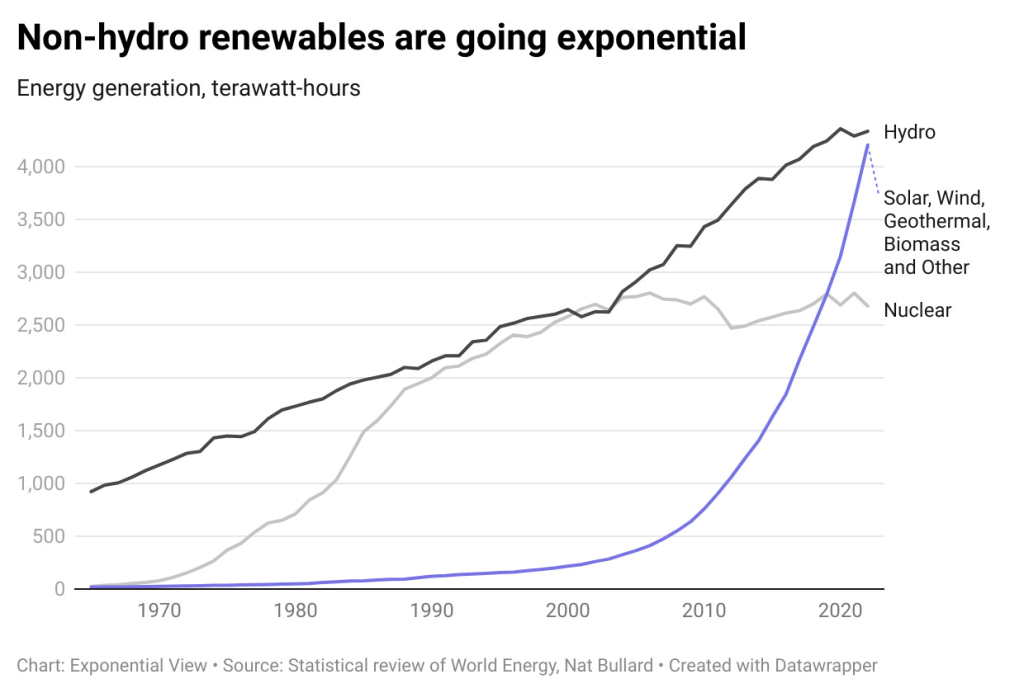
But, on the bright side, the rate of growth of renewables powered by solar and wind is amazing to see. And exponential growth will mean significant changes in our mix in the next two decades.

In their words – “Renewable energy is poised to be this engine of growth. It is on a 60-year exponential growth curve. Solar energy, for instance, is growing at the fastest rate ever seen for any energy technology. China’s progress exemplifies this: it is on track to double its wind and solar capacity by 2025, five years ahead of its 2030 target. Renewables are ready for lift-off, and we love that here at Exponential View.”

This explains why I appreciate Azeem and team’s work. They do a good job of both embracing reality while dealing in hope.

And, as these notes above show, there are plenty of reasons to be hopeful and optimistic.

Long term devices

I occasionally see or hear comments about device upgrade cycles. These comments assume our devices are not built to last more than a couple of years.

My experience tells me otherwise. Our iPad is approaching its seventh year anniversary. My personal laptop is a year or two older than that.

Both devices are functioning just fine.

Maybe upgrade cycles are more for us than our devices?