Angled parking spots are great. They make it easy for us to drive straight in.
Perpendicular spots – especially those that don’t have much room between rows of cars – require a different approach. Attempting to drive straight in and adjust is an exercise in pain.
Instead, we’re better off –
(a) turning into the next parking spot – stopping behind the parked car (b) backing up and straightening (c) and driving into ours
Perpendicular parking spots are a great metaphor for things we want on a day-to-day basis.
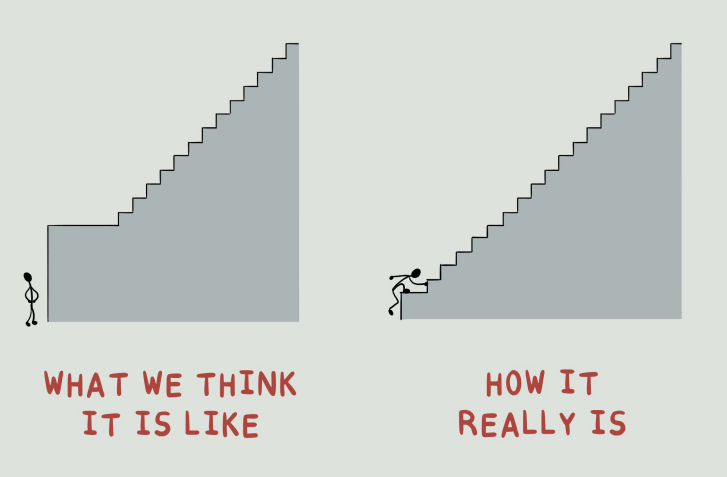
We can’t just walk in and get what we want. Instead, we need to take others into consideration, do some amount of zigging and zagging and even take a step or two backward to eventually get it.
The simplest way to understand if a team is aligned on the problem they’re solving is to ask every member to write out the problem statement and then share it with the group.
It is amazing how much downstream angst this simple exercise saves.
Jim Sinegal, cofounder and CEO of Costco, tells a story that embodies the values he’s helped build into his company.
Back in 1996, he often recounts, Costco was doing a brisk business in Calvin Klein jeans priced at $29.99. When a smart buyer got a better deal on a new batch of the jeans, company guidelines calling for a strict limit on price markups dictated a lower price of $22.99.
Costco could have stuck to the original price and dropped seven extra dollars a pair straight into its own pocket. But Sinegal insisted on passing the savings on to customers, because he saw the company’s focus on customer value as the key to its success.
The story continues to be told in Costco’s hallways today. It vividly conveys a message about the company’s values—one that resonates, in part, because it’s aligned with the personality of its author. Sinegal answers his own phone, draws an annual salary of just $350,000 (a fraction of what most big-company CEOs earn), and has signed an employment contract that’s only one page long—all of which means less cost for customers to absorb.
I’m always intrigued by the stories that are told in companies with unique value propositions. Low-cost retailers have a consistent theme in their stories. Amazon, in its early days, told stories about Jeff Bezos using Ikea doors as desks. Wal-Mart had similar founder stories as well.
It is a great reminder that the culture we intend to create is a function of the stories we tell vs. any set of well-crafted words we share and put out there.
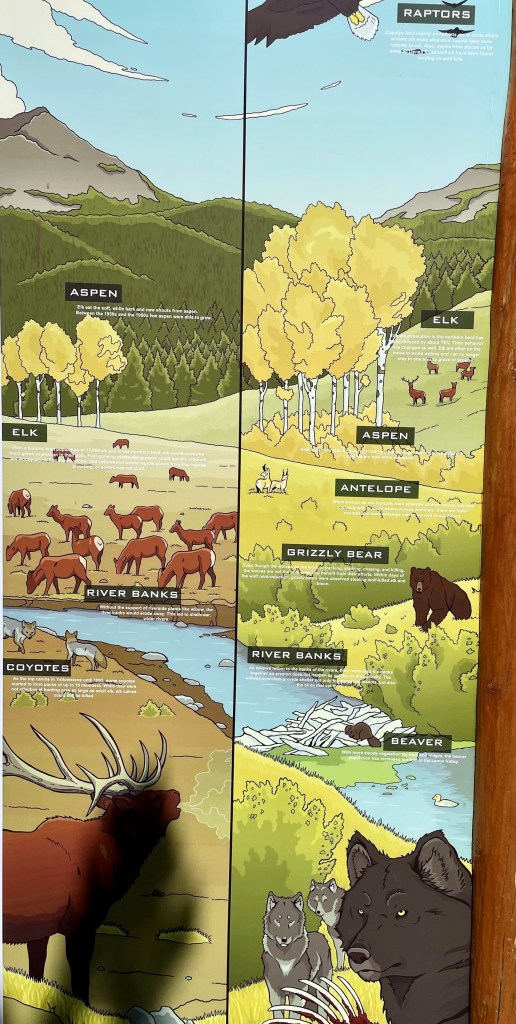
There’s a great Yellowstone story about the return of the gray wolves. As a result of rampant hunting, wolves disappeared from Yellowstone in the early 1900s. After decades of study, scientists began to understand the role wolves played in the ecosystem as the top predator and realized their absence might be affecting the entire ecosystem.
So, the scientists and park officials decided to experiment reversing this human-driven change. In 1995, they released 31 gray wolves from Alaska into Yellowstone. What followed was pretty extraordinary.
(The text in the picture is small – so, you’ll need to click on it and zoom in)
Prior to the re-introduction the of wolves, the elk population exploded because coyotes were now the top carnivores in the ecosystem and weren’t capable of killing grown elk. The elk were eating the Aspen and all available green vegetation. Without the support of riverside plants, river banks got eroded and led to shallower and wider rivers.
Once the wolves returned, raptors from far away returned to Yellowstone to feed on wolf kills. The northern herd elk population was cut by 75% – enabling Aspen to grow again. There are more antelope again as the wolves don’t hunt antelope. Within days of reintroduction of wolves, grizzly bears were observed stealing wolf-killed elk and bison. And since there are more willow growing near the banks, insects and birds are able to survive. The woody vegetation also helped grow the beaver population ten-fold.
There are so many lessons from the story. The one that stands out to me is the power of interactions within complex ecosystems. First order effects are just appetizers in complex ecosystems. We only truly understand an ecosystem when we are able to visualize the second, third, fourth, and fifth order effects.
This makes the communication of our impact on an ecosystem incredibly challenging. Our default behavior is to look past any immediate effects. Ergo the frustration of every climate scientist attempting to explain the impact of our actions on future climate. Their audience looks up to the skies, points to a minimal change in the weather, and shrugs. This is especially the case when the path to reducing damage is arduous.
But this isn’t just about the world’s climate – complex systems exist all around us. We need to look no further than the economy for a great example of one very few people understand.
“This, then, is the human problem: there is a price to be paid for every increase in consciousness.
We cannot be more sensitive to pleasure without being more sensitive to pain. By remembering the past we can plan for the future. But the ability to plan for the future is offset by the “ability” to dread pain and to fear the unknown.
Furthermore, the growth of an acute sense of the past and future gives us a corresponding dim sense of the present.
In other words, we seem to reach a point where the advantages of being conscious are outweighed by its disadvantages, where extreme sensitivity makes us unadaptable” | Alan Watts
There’s a simple case for consistently prioritizing good quality sleep. When we’re sleep deprived and tired, we make mistakes.
In the best case, we spend a bunch of time attempting to fix those mistakes. In the worst case, our attempts to fix those mistakes result in more mistakes.
Worse still, tiredness makes us feel pessimistic. So, we feel less capable of fixing the very mistakes we made.
The return on investment in prioritizing sleep is significantly higher than it appears on first glance. It is a great example of a high leverage habit as one good choice enables a cascade of better choices.
And, in the long term, it may just be the highest leverage choice of them all.
A simple way to understand how a person perceives their position in the social hierarchy is to see (a) how they treat you when you make a mistake or (b) observe how they behave when they make a mistake.
There’s a caste system / hierarchy / pecking order at work in every part of the world. Some of these are local and some more global. But it always exists – pecking orders (both perceived and real) are a part of how we organize ourselves. And they reveal themselves when mistakes are made in public.
These hierarchies don’t just show up when a waiter makes a mistake in a restaurant, they are present in our lives too. In the past 12 years, I’ve had the fortune of driving in many places around the world. I’ve made my fair share of mistakes – especially so in new places as we figured out the rules of the road (some unsaid) and directions.
But, in all these years, there’s an unfortunate pattern. Whenever I have a bad experience – defined by someone shouting something unpleasant or honking longer than necessary – I know that I’ll look up and likely find an old male of the dominant caste in that specific place.
Understanding this dynamic is helpful for two reasons.
First, it helps put unpleasant experiences into context. There’s no point letting some random stranger spoil our mood.
Second, it helps us better understand our default reactions. We are likely to find ourselves feeling a lot more apologetic in contexts where we perceive ourselves to be lower on the social hierarchy. And vice versa.







 A Learning a Day