My posts from yesterday and the day before turned out to be perfect in setting the stage for today’s post.
If you have an extra 3 minutes today, I would recommend the headline statements from the IPCC’s report. And, yes, I’d recommend reading this before reading a summary elsewhere :-).
It is a synthesis of 14,000 studies on climate change by over 750 scientists. If you have an extra 10 minutes, skim through the charts in the 42 page summary or see one of the many articles summarizing the work (like this one on ArsTechnica).
We’ve known about this for a while now. What is new is the level of confidence in the extent of the challenge we face and the path forward.
We’ll soon need to talk about possible solutions and things we can do on an individual level. But, the first step might just be to sit with this incredible piece of work for a bit, talk about it with people we work with and care about, and develop a shared understanding of the task that lies ahead.
PS: I titled the post “That IPCC report” because I’m sure it is how we’ll remember this report. It is seminal.
Gabon is a unique country. It is one of only 11 countries on the planet to be termed an HFLD or “High Forest Low Deforestation.” 88% of the country is a tropical rainforest with an average deforestation rate of less than 0.1% in the past 30 years.
These rainforests are an incredible source of biodiversity. But, beyond that, they’re also critical to rainfall across Africa.
The challenge ahead is maintaining that low deforestation rate. Gabon managed that with urbanization supported by oil exports. But, with oil reserves running low, the country needs a way out of it.
Given how important its forests are to all of Africa, Gabon is looking to diversify its economy without disturbing its forests. So, they’re testing a new “results based emission reduction payment” as part of the Central African Forest Initiative. In 2019, Norway committed to pay $150M to Gabon to protect its forests.
As long as Gabon continues to be Carbon Dioxide positive – they currently absorb 100 million tons above their annual emissions – they would qualify for these payments (more here).
It received its first $17M payment this year.
It’s likely not enough. But, it is a start and it was heartening to see this.
I first wrote about COVID-19 on Mar 1, 2020. It was at a time when coverage on the Coronavirus was still a fringe phenomenon. A combination of an insufficient healthcare system, the politicization of everything, and a leader who didn’t believe in science led me to believe (and share) that the US would be among the most dangerous places on the planet.
Every once a while, I make a prediction based on current data that I hope won’t be true. This is the case with every post I write on the climate crisis. That was one of them.
We now have just over 614,000 deaths reported. Assuming reports are understated by ~40%, we’ve probably crossed the 1M mark. Or ~700,000 deaths per year. As a comparison, the deadliest war in the last 100 years (World War II) led to ~100,000 deaths per year. In terms of the % of population, the World War II casualty list impacted 0.07% of the US population. The equivalent number for COVID-19 is ~0.2% or 3x.
It has been a brutal 18 months.
It could have been a lot worse if it weren’t for the vaccines. When the vaccines came, it looked like the end of the pandemic might be near.
Why, then, are we seemingly back to where we began with the Delta variant?
COVID-19 has been a fascinating exposition of human nature. One such idea I’ve been thinking about is belief systems.
So, what are belief systems? They are an all-or-nothing set of beliefs that people in our tribe believe. The combination of our desire to belong and the internet’s ability to isolate us into our tribes has made it easier than ever for us to find a belief system and then ensure we dig our heels in.
For example, here are a few statements related to the pandemic.
(1) The Trump administration did a great job betting on vaccine technology.
(2) The Biden administration followed up with a nearly world-class rollout.
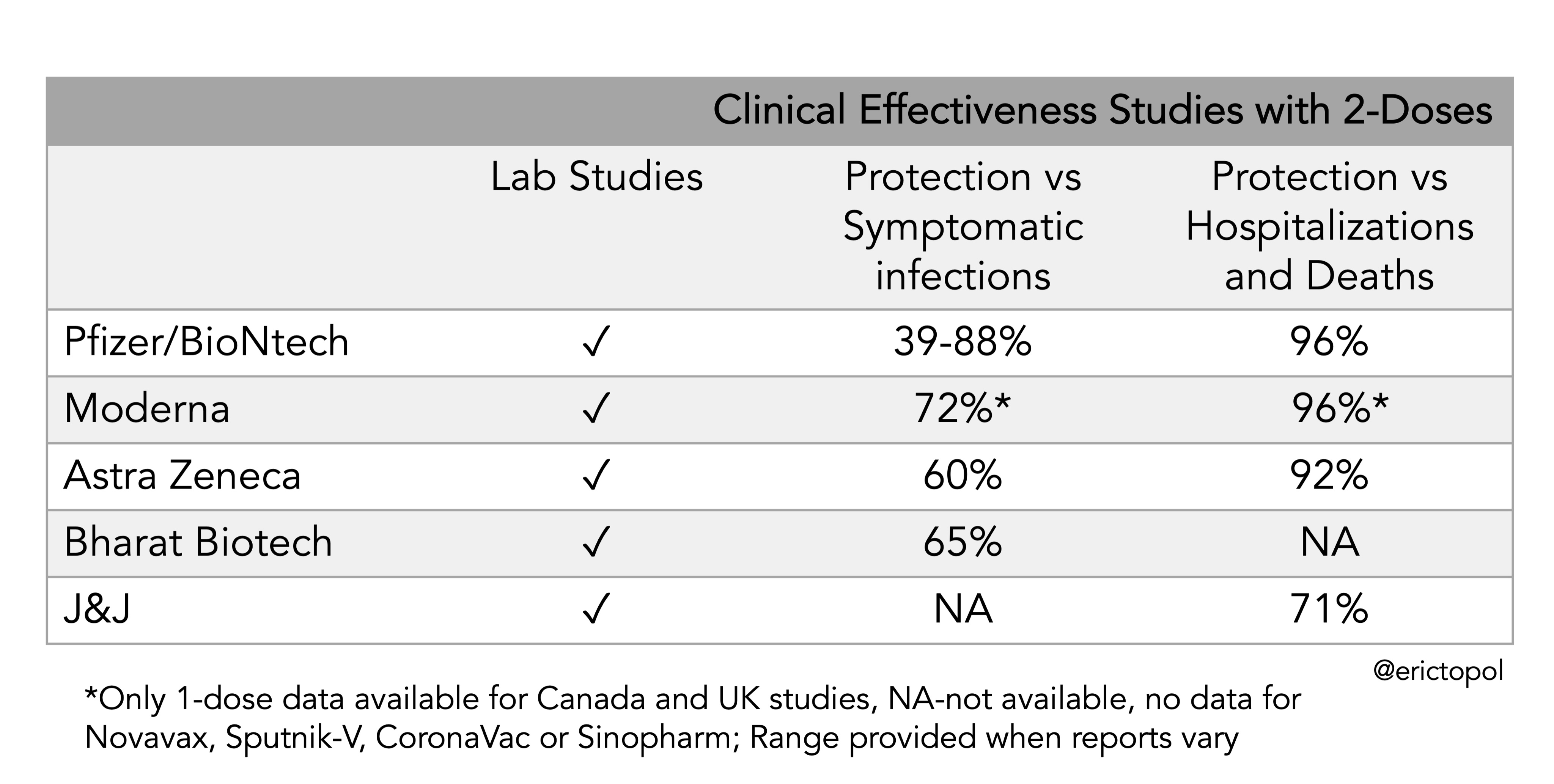
(3) The vaccines have been incredibly effective in preventing deaths even with the mutation / Delta variant (sadly, infections will be on the up). Outside of ~5M folks who are immunocompromised, there’s a reason these vaccines are being strongly recommended. The force is strong on these.
(4) COVID-19 was likely a result of a lab leak from Wuhan Institute of Virology. China has understandably blocked any real investigation into the matter (because that’s what China does). However, our collective intellectual curiosity on why it happened and what we can learn – perhaps the most significant event in the past century – has been a disgrace.
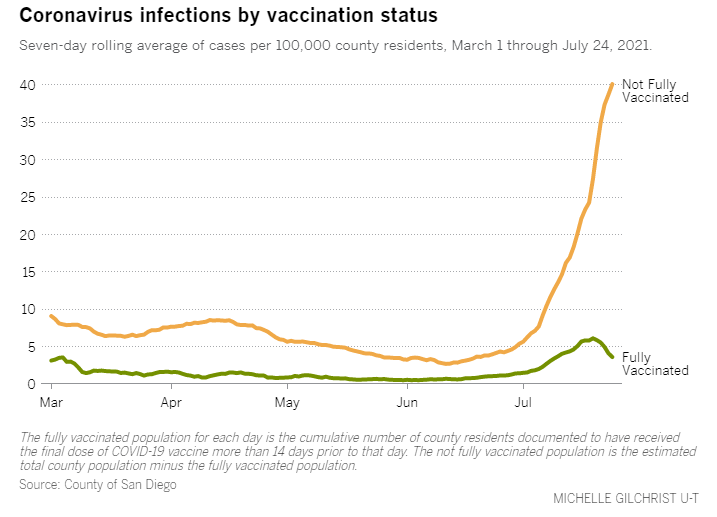
(5) The Delta disaster, sadly, is a crisis affecting the unvaccinated. I thought this San Diego Daily Tribune’s chart was simple and effective. We need more of these sorts of visualizations.
(6) Misinformation on said vaccines is often a result of a lack of understanding of ratios and our proclivity to find comfort in anecdotes over data. When over 2.75 billion people have been vaccinated, there are going to be many such anecdotes. In the US for example, 125000 vaccinated folks still came down with COVID-19. Even at 0.8%, we’re looking at large numbers. Anecdotes are plentiful.
(7) As trial data is only limited to the last year, we will never know the long term impact of these vaccines. We have reasons to believe the side effects, if any, are minimal. We do need to weigh this possibility vs. getting COVID-19.
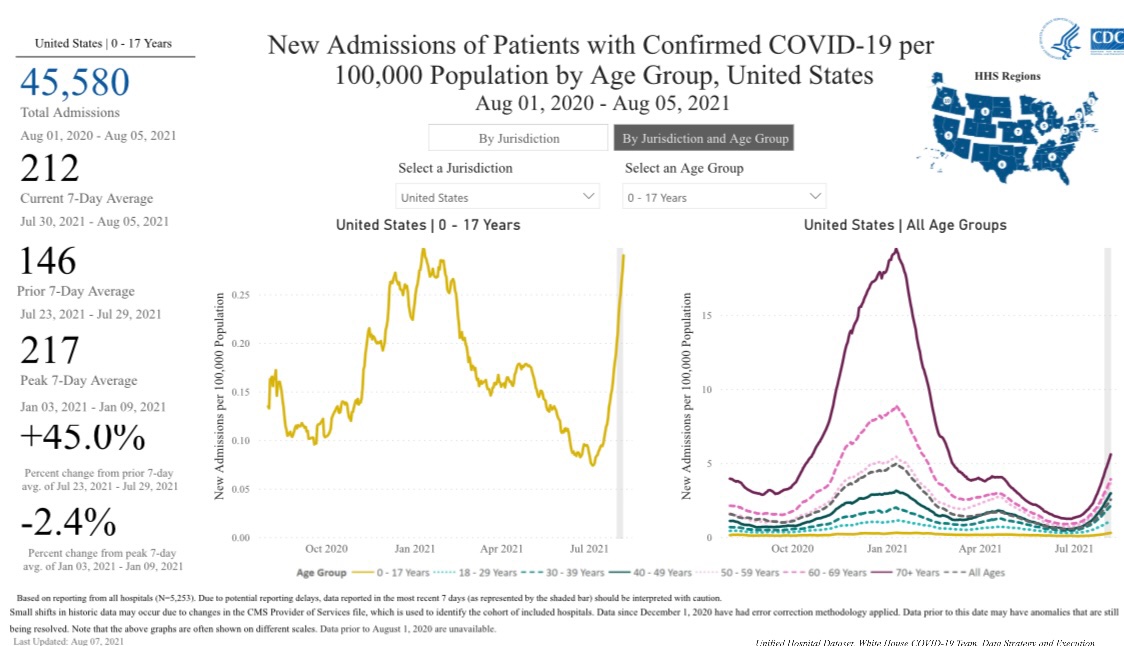
(8) The Delta variant has changed the nature of the pandemic for children. Hospitalizations are trending up significantly. A vaccine for children was not urgent a few months ago. That has changed.
(9) It is frustrating to see pharmaceutical companies focused on the Booster. While the booster is important in the long run, it is far more important to get vaccines in the hands of countries that don’t have them. If not, the risk of the next mutated variant keeps going up.
Depending on the belief system, you will find groups that agree with some of these and vehemently disagree with the rest. How could you, for example, give the Trump administration any credit if you believe in vaccines? Or, how could you believe in vaccines and scientists if you agree COVID-19 was the result of a lab leak? And so on.
There are all sorts of definition problems at play of course. For example, the folks who decry scientists and use that to decry science don’t understand science (this post is a fascinating exposition into the topic if you’re interested).
But, at the heart of this all is the the power of belief systems.
I’ve shared a few times that COVID-19 is a warm-up act compared to the likely impact of climate change. And, if we will have learnt anything from this pandemic when this is likely behind us in ~2 years, (and I hope we will have), it is the importance of understanding the importance of belief systems in enabling change.
Qatar’s Mutaz Essa Barshim and Italy’s Gianmarco Tamberi are among the top high jumpers on the planet. They both recovered from bad injuries to compete in the Tokyo Olympic games.
In the finals, they cleared an impressive 2.37m each. It was now time for a “jump off.” This meant they would go head-to-head one jump after another – till somebody lost.
That’s when Barshim asks the referee – “Can we both have golds?”
“It is possible” – the referee responds
The two look at each other, shake hands, give each other hugs, and celebrate.
It is a beautiful moment. A moment where they chose to go for a “win-win.” No egos involved – just a wonderful celebration of mutual respect and a reminder of what matters.
You can watch the exchange here – starts at 4:00. It is wonderful.
“Asking why teaches you to see how things got to be the way they are. Asking why also puts us on the hook – it means that we’re also open to being asked why, and it means that at some level, we’re now responsible for doing something about the status quo.” | Seth Godin, The Practice
The reason this is so is because a good discussion about “why” inevitably leads us to ask – “why not?”
And, the “why not” question is the precursor to change.
How much we have to say when making an argument – in both written and verbal communication – is often inversely proportional to the depth of our thinking on the subject.
Clarity flows from rigorous thought and examination. And, brevity flows clarity.
Proteins are fascinating. They are long and complex molecules that perform numerous tasks in the body like building tissue/muscles and fighting disease. Their purpose is dictated by their structure – which folds like Origami into complex and irregular shapes.
Understanding protein structure would enable researchers to synthesize proteins that can do all sorts of tasks. We could design better medicines, create virus-resistant crops, or break down waste.
But, protein’s complexity made it very hard for researchers to understand a protein’s shape. Determining a protein’s structure sometimes was the fruit of an entire researcher’s P.hD. If they got lucky. So, after decades of work on protein structure, we only had 180,000 protein structures in the public domain.
Then, Deepmind announced that their AI was able to product accurate predictions of DNA structure. They then released 350,000 protein structures across 20 organisms – for free. And, the kicker was that these structures include predictions for 98% of all human proteins.
That. is. insane.
This is such a giant step that it will take a few years for researchers to make sense of this data and figure out practical uses. But, make no mistake, this is a massive leap.
In ten years, we’re going to look back at two leaps over these two years – with the coming of mRNA and the advent of protein folding – as leaps that changed medicine.
I loved this note from Deepmind’s CEO – “From the beginning, this is what we set out to do: to make breakthroughs in AI, test that on games like Go and Atari, [and] apply that to real-world problems, to see if we can accelerate scientific breakthroughs and use those to benefit humanity.”
Happiness = (Time spent being grateful for what we have) / (Time spent thinking about what we don’t have)
Implications of this theory:
(1) The more the gratitude, the more the happiness. This follows the idea that it isn’t happy people who are thankful, it is thankful people who are happy.
(2) Reducing time spent thinking about what we don’t have can have an infinite impact on our happiness if we can bring it down to zero.
Nitin sent along this article about the health benefits of strawberry leaves a few months ago.
He explained that he, like most people, used to remove the leaves of the strawberry before eating it. After he learnt about all the antioxidants in the leaves, he now eats them whole and has grown to love how they taste.
It got me thinking about how I learnt to remove strawberry leaves. No one taught me how to eat a strawberry. At least not that I remember.
I must have seen someone else remove the leaves at some point and just assumed that’s the way a strawberry must be eaten. And, now that I’ve become aware of the assumption, it has changed how I look at the leaves of a strawberry.
So goes the process of learning. We start with some assumptions about ourselves and the world. Someone or something makes us aware of them and then helps us understand that we can change them. And, if we choose to do so, we learn.
It isn’t easy to change assumptions. It is much easier to attempt to find information that confirms them.




 A Learning a Day