Bird by Bird

I came across this lovely story shared by Anne Lamott – a writer.

“Thirty years ago my older brother, who was ten years old at the time, was trying to get a report on birds written that he’d had three months to write. It was due the next day.

We were out at our family cabin in Bolinas, and he was at the kitchen table close to tears, surrounded by binder paper and pencils and unopened books on birds, immobilized by the hugeness of the task ahead.

Then my father sat down beside him, put his arm around my brother’s shoulder, and said, ‘Bird by bird, buddy. Just take it bird by bird.’” 

It resonated.

Values and virtues

Values are what we believe. Virtues are beliefs that we pursue or embody.

Values don’t need to show up in our actions. Our virtues, on the other hand, are based on what we do,

As what we do is who we are, our values matter a whole lot less than our virtues.

So, it is worth asking ourselves – what are our values? And, do they show up in our lives as virtues?

(H/T: “What You Do is Who You Are” by Ben Horowitz)

Permanent confidence and challenges

I was reminded of a passage about confidence from Carol Dweck’s “Mindset” recently.

“Parents think they can hand children permanent confidence—like a gift—by praising their brains and talent. It doesn’t work, and in fact has the opposite effect. It makes children doubt themselves as soon as anything is hard or anything goes wrong.

If parents want to give their children a gift, the best thing they can do is to teach their children to love challenges, be intrigued by mistakes, enjoy effort, and keep on learning. That way, their children don’t have to be slaves of praise. They will have a lifelong way to build and repair their own confidence.”

I had two reflections as I re-read this. The first is that this is just as applicable to adults as it is to kids.

And, the second is a reminder of how grateful I am to this blog (and, by extension to all of you) for continuing to inspire me to write about my own challenges, mistakes, effort, and learning. It has been, and continues to be, a life changing experience.

Coronavirus (COVID-19) PSA

Elad Gil wrote an excellent post synthesizing much of what we know about the Coronavirus. His intended audience was start-up founders – but most of what he’s shared is broadly applicable.

I’ve also copied sections 1, 2, and 5 of the post below.


The Coronavirus outbreak (note the disease is officially named COVID-19 and the virus SARS-CoV-2) is catching many technology startups unprepared. The second community transmitted case of the virus in California, with no known ties to others, was just reported in Santa Clara county. New cases were also reported Friday night 2/28 in Washington State and Oregon.

Below is a brief summary of some of the data behind the outbreak as well as what I have seen larger companies quietly adopt. I have also been on a number of small group calls with some of the epidemiologists working on this, so passing some of this on. These calls were under Chatham House rules. Hopefully this is useful for startups not in the loop.

  1. What is happening?

In December 2019, cases of a new respiratory virus emerged in Wuhan, a major city of over 10 million residents in the Hubei region of China. Although information on this disease was initially suppressed by the Chinese government, the WHO was contacted on December 31, 2019 and a new virus was identified on January 7th. The first non-China cases were identified on January 13 in Thailand and January 16 in Japan. On January 23rd Wuhan was placed on lockdown by the Chinese Government. The virus is a coronavirus, which is a family of viruses that cause SARS and MERS, but also are endemic in people. Humans have at least 4 coronaviruses already that cause 10-30% of all seasonal colds.

At this point, over 80,000 people[1] are infected with the new COVID-19 virus and 2700 dead (mainly in China). Many epidemiologists believe these numbers from China are underreported by up to an order of magnitude, and it may be closer to 800,000 people infected in China alone.

There are major outbreaks happening in Korea, Italy (locked down 50,000 people in 12 small  towns), Japan (Prime Minister asked people work from home and 38,000 person Tokyo marathon cancelled), Iran (deputy health minister infected and cases spread across middle east), and other countries.

  1. What should we expect?

Despite the WHO’s assurances that things can still be contained, every epidemiologist I have spoken to thinks the virus has broken out and will spread around the world. Many think >20% or more of humanity will be infected due to a lack of baseline immunity and therefore herd immunity for this disease (as an example, the 2009 H1N1 flu infected 16% of all humans)[3].

Data on the virus is quite preliminary. So far the following appears to be true (you can also play with primary data here):

  • Most cases are mild. Most estimates suggest 80% of COVID-19 cases are mild and feel roughly like a flu. Estimates I have seen suggest that roughly 10-15% of cases will be more significant and may necessitate hospital visits (see also) with 1-3% potentially needing an ICU. The concern of many governments is the peak number of cases that occur in a given moment. For example, if 1,000 sick people show up overnight to a hospital that hospital would be overwhelmed. Many of the social engineering policies (shutting schools etc.) are focused on spreading infectious cases out over time, so hospital infrastructure can deal with all the sick. The higher death rate in Wuhan versus rest of China may reflect a local collapse of healthcare infrastructure.
  • Death rate: The reported death rate has hovered around 2% but may in reality be 0.2% to 1% depending on country and healthcare system. Many estimates tend indicate an overall expected mortality rate of ~0.5% globally.  The current existing fatality rate is biased upwards by Wuhan cases dominating the mix (which are closer to a 3-4% death rate and make up most cases). It is possible the virus is being undertested for in China / rest of world driving the real death rate down (as many more people are infected than is reported).
    • “”My sense and the sense of many of my colleagues, is that the ultimate case fatality rate … is less than 2%,” Dr. Anthony Fauci, director of the National Institute for Allergy and Infectious Diseases, told CNN’s Jim Sciutto on “New Day”. “What is likely not getting counted is a large number of people who are either asymptomatic or minimally symptomatic, so the denominator of your equation is likely much much larger.”” Source.
    • Outside of Hubei and in China, the death rate in other regions has averaged around 0.7% when I have run it on primary data. Wuhan, where most cases are, has been in the 3-4% range likely due to a collapse in healthcare infrastructure in the region.
    • Outside of China, the death rate has averaged around 0.6% when I have run it on primary data. This is now getting confounded by Iran, which has a higher reported death rate – probably due to dramatic undercounting of cases.
  • R0 value: The spread rate of the virus seems to be well over 2 and likely ~3. This means for every person infected at least 2 to 3 more get the disease. This compares to the flu at 1.5 or so.
  • Incubation period. Realistically, the incubation period (time from infection to symptoms) appears to be under 14 days and likely 5 to 7 days for the majority of people. People appear to be infectious rapidly after infection, potentially as soon as 12-24 hours. Many experience only mild conditions early, which increases spread rate of the disease as people go to work or otherwise continue with life unchanged.
  • Elderly & pre-existing conditions. The elderly and people with preexisting conditions appear especially susceptible to disease and severity or death. It is possible the elderly are susceptible largely because they are more likely to have pre-existing conditions. In contrast, very few cases have been reported in young children.

In general, much of the western world’s policy to COVID-19 appears to be one of delaying arrival of the disease. In particular, delay the disease so that:

  • We are out of flu season and free up hospital beds and healthcare infrastructure.
  • We have more time to prepare in terms of diagnostic tests for the disease and potential treatments.
  • We can work on a vaccine.

If the disease makes it to the US (or your country) the government may enact techniques to decrease spread. This usually means cancelling gatherings, sporting events, schools, or other situations in which groups of people will aggregate. It is possible your movements will be restricted (for example, the 50,000 people locked down in Northern Italy).

  1. Expect A Second Wave

In many epidemics disease course follows two waves. In wave one, an initial infection happens followed by governments tightening movements, shutting schools, and in general decreasing the spread of the diseases. Controls are eventually relaxed (people need to work, kids need to go to school etc.) and then a few months later a second wave of the disease hits and infects a subset of the people who were not infected in the first wave. Eventually, enough people get sick, develop antibodies, and there is a strong enough herd immunity in the population to decrease future out breaks in size.

1918 Spanish Flu had two predominant waves of virus spread.

2009 H1N1 flu in the UK had two waves.


If you’re feeling anxious about COVID-19, I hope having some of this info helps. If it doesn’t, it may be helpful to seek help from a medical professional as well.

Premium Subscription Gifts – Follow up

I shared the post below a few days ago and wanted to follow up as I’ve just closed the form.

The big change this year is that we’ve gone from 30 requests to 77. While this is a nice opportunity for me to e-meet so many of you for the first time, it is also substantially more than I expected.

The next step is on me – I will need to find ~50 colleagues/teammates who’ve still got subscriptions they can give away. I expect to have an update for all who submitted the form by Mar-15. And, I will do my best.

Finally, for the many of you who took the time to share context or write lovely thoughtful notes, thank you. Much appreciated.


I work at LinkedIn. Our vision is to provide economic opportunity for every member of the global workforce. One of our initiatives is called the #plusonepledge where every member of the LinkedIn team helps someone in their network with finding economic opportunity – finding a new job, a new contract, a new client, and so on.

As part of this initiative, I am able to gift 6 months of free LinkedIn Premium Careers subscription to 4 folks who are actively seeking a new opportunity. For example, LinkedIn Premium could be helpful if you’d like the ability to get in touch (selectively :)) with recruiters and hiring managers of jobs you believe you are a fit for.

After posting this last year, I received ~30 requests and ended up requesting (and receiving) help from a bunch of wonderful colleagues. I intend to do the same this year and will do my best to share these subscriptions with as many of you as possible – on a first come, first serve basis.

My only request is that you fill this form by Fri, 2/28. I’ll aim to get back to you by mid-March.

Job seeking is a tough process and, if you choose to use one of these subscriptions, I hope it’ll help you in some small way. If it doesn’t, I’d appreciate feedback on what we could have done better too.

Market dips and perspective

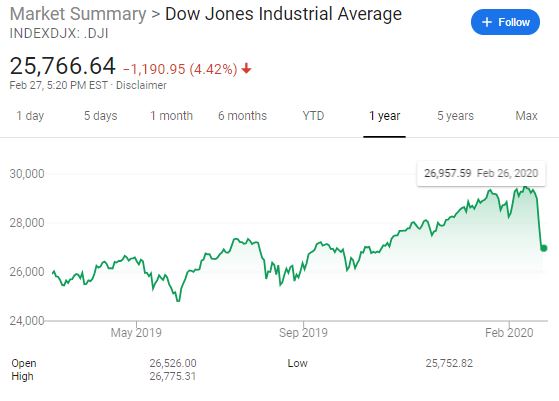
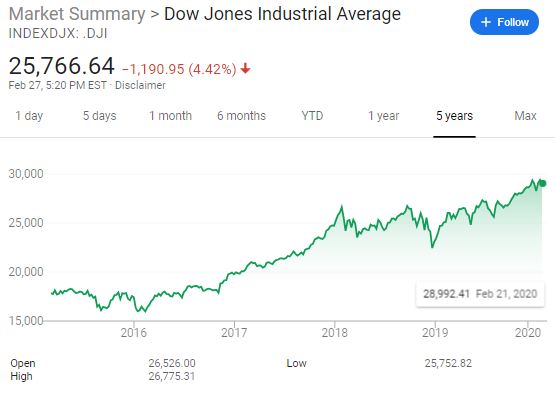
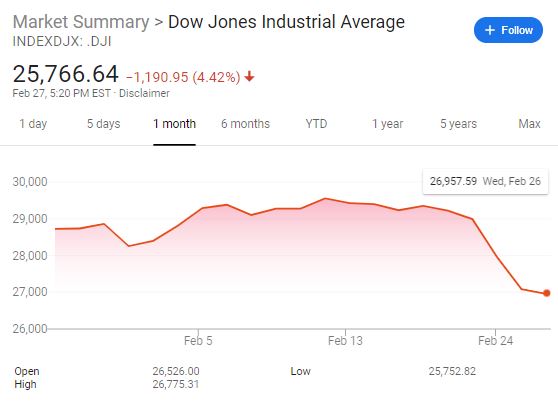
There has been a lot of news about markets falling in the past two days. So, I looked up the Dow (or the Dow Jones Industrial Average) on Google yesterday.

When you look at a 1 month view, you can clearly see the steep fall.

You see it clearly in the 1 year view as well. However, while the fall is certainly steep, we also notice that it is still higher than the starting point.

When you shift to a 5 year view, however, the fall is barely a blip.

This is not to say it will continue to be a blip. No one really knows how long this will last or if we’ve hit the bottom. We all may have guesses and, in some cases, more informed hunches – but that’s about it.

This post isn’t about all that speculation though.

Instead, as I looked at these views, I realized that they hold a powerful lesson in perspective. When we experience a really bad day, it is worth zooming out and getting some perspective.

Something that feels particularly bad right now may just be a tiny blip on a 5 year time horizon.

Misalignment to alignment – starting with the document

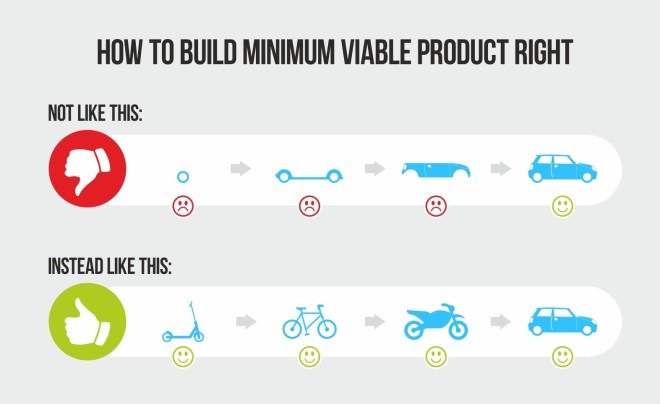
When we try to move a group of folks from misalignment to alignment, we have two primary tools at our disposal – documents and meetings. And, I’ve come to realize that the optimal way to use these tools is to start with the document before attempting to bring people together with a meeting. The optimal process looks something like this.

3 reflections –

1. Starting with the document/memo ensures none of the context setting is left to chance. The document lays out the problem we’re trying to solve and what we need to believe to build a solution that works (i.e. our hypothesis).

2. A good document sets the stage for productive conflict. There is no avoiding conflict – instead, it is important to view the energy that conflict generates as healthy and channel the energy toward creating the best possible solution. Then, document the progress again, meet if necessary, and repeat until all major open questions are resolved.

3. Bringing a group together without doing the work of creating a good document and, on the flip side, keeping the group discussion asynchronous for too long tend to replace the misalignment with mistrust. And, needless to say, it is much harder to recover from mistrust.

The diagnosis that changed everything

I recently heard of an acquaintance on a stellar career path who was diagnosed with a difficult terminal illness.

Of course, everything changed following the diagnosis. The stellar career trajectory didn’t matter anymore.

Most of us are guilty of taking far too many things for granted as we work through our day-to-day.

Good health is likely top of that list.

Notes by Ada and too good to be true

For a while between 2017-2019, I wrote long ~monthly posts on technology as part of a project I called “Notes by Ada.” Inspired by Ada Lovelace, this project prodded me to expand how I thought about technology and the biggest problems we needed to solve.

If it wasn’t for writing for two years, I don’t think I’d have formed the perspective I hold on the importance of solving for climate and employment in a world where the connection between labor and capital is breaking as well as a whole host of other topics. Writing, as always, was both powerful and clarifying.

Over time, however, this project became hard to keep up. Each long form article needed a lot of research and this research was time away from the family on weekends. And, after kid #2 came along, this approach became untenable.

Just as I was beginning to think about winding this project down, my MailChimp subscriber updates email began showing unexpected activity. Suddenly, 30-40 folks were signing up every day for a few weeks. I tried emailing a couple of these folks to ask where they heard about this project. I had shared on Medium and LinkedIn but this felt too good to be true. No response.

So, I finally ended up writing a post on the climate crisis to see whether I’d hear from a few folks. I ended up getting a collection of “I never subscribed. Please unsubscribe” responses.

That hurt.

All my notes are opt-in only for good reason. I have no intention of forcing my notes on anyone. There are no big pop ups on any project asking you to sign up. If you do, you hopefully do so because you believe there’s value. And, if you don’t, that’s also understandable. We only have so much time and attention in a day.

Anyway, it turned out that there was some Russian bad actor who just dumped a bunch of these emails into a Mailchimp form that didn’t have double opt in by default.

It turned out to be the final nail in the coffin for that project. But, it also helped me (re)learn two important lessons.

If you have a project involving a subscriber list, use double opt in. (And, if you don’t, beware of the risks.)

And, second, if it feels too good to be true, it probably is.