Anti-intellectualism and racism – revisited

I shared a post about my reflections on the US Presidential race around this time 4 years back.


Fearing and, thus, hating someone who is different from us is a natural emotional response from a brain wired for life in the forest fighting other warring hunter gatherers. Racism, as a result, is a natural part of our humanity. We are all racist and discriminatory. If it isn’t based on color, we discriminate based on religion, education, sexual orientation, nationality, caste, etc.

The relationship between education and discrimination is a fascinating one as it is one that is underlined with a lot of tension. The reason for this tension is that an educated mind is one that treats every belief as a hypothesis that needs to be tested. Galileo Galilei, one of the fathers of the scientific method, discovered this was an issue in 1610 when he faced the ire of nearly every institution that mattered. The church, arguably the most powerful of those institutions then, took nearly 500 years to declare him innocent.

The essence of discrimination is blind belief. Education, thus, is dangerous as it shakes its foundations of discrimination. As a result, a key part of the oppressors playbook is to control the education its citizens receive. If you can fake education, i.e. pretend to educate while not really teaching the scientific method, people will never find out.

Until they do, of course.

This is why the Brexit was a damning verdict for anyone concerned about the state of the world today. It wasn’t because the Brexit was the absolute wrong result. There is a case to be made that it was a good result for both sides in the long run – that Britain will benefit and that the EU will treat it as a wake-up call to right the many issues inherent in its structure. The issue was the way it happened. It happened without the voters really understanding why they were doing what they were doing. It happened without any debate of the real long term issues. It was a classic anti-intellectual process and it was as good as a bunch of fearful people voting yes for xenophobia.

That is also why the November election in the United States is critical. It is becoming increasingly clear that the beliefs that drive the Republican party in the United States is not that of smaller government, but one of cultural disillusionment. It is also becoming increasingly clear that “make America great again” seems to just be a different version of “make America white again.” There are a lot of direct effects of the Republican nominee becoming President but probably none as powerful as the brand of anti-intellectualism that he espouses.

The key part of the Donald Trump message is simplicity. It is a clear action plan that involves shutting down borders, breaking ally agreements and building walls. These simple steps will put an end to the death, gloom and destruction. Leaving aside facts about violence and the like, this sort of simplicity ignores that one thing that makes debate necessary – nuance. Or, to use a more fitting term, trade-offs. Good decision making requires an understanding of trade-offs. Good decision making requires spirited debate and an understanding of nuance. But, discussing nuance isn’t what won Trump the Republican primary. It isn’t what he is about. He makes decisions based on his gut and data is for losers. Well, life can be relatively simple when you are born into a brash household in the top 1%. It isn’t that simple for everyone else and it is certainly not going to be simple when you govern in an interdependent world.

This is one direct effect, however. The full list is long. The most important indirect effect, in my assessment, is that I think his coming to power will sadly reverse the trend on discrimination and racism. The facts on violence and discrimination tell us one thing for certain – as bad as things seem, they have only been getting better and are better today than ever before. However, the moment we give up our willingness to debate, we indicate that we are open to flexing our discrimination muscles. It is a recipe for bigotry – an intolerance toward those who hold different opinions from us. If we are intolerant toward different opinions, can you begin to imagine what the future holds for people who look different from us?

This indirect effect is beautifully summed up in a line from a comment I shared following the Brexit – “But, can anybody tell me the last time a prevailing culture of anti-intellectualism has led to anything other than bigotry?”

When indeed…


It is a post I’ve thought about more often than I’d have liked in the past 4 years.

Never more often than during these few days, however.
Remembering training wheels

I shared a post about training wheels three years back.


Training wheels sound so great in concept. After all, they remove all the risk from learning to ride a bike.

But, they don’t work.

It turns out that removing all the risk of losing balance doesn’t teach us the most important ability required to ride a bike – how to balance. And, that, in turn, also means we don’t actually learn to ride the bike. Worse, it hinders our ability to learn without training wheels.

Risk and reward go together. Falling down is an important part of learning. And, we only make progress when we embrace the possibility of a fall.

Why, then, do we use training wheels? Fear of failure.

And, that’s thanks to a misunderstanding. You see, failure is not the falling down, it is the staying down.


I remembered this post as we began teaching our kids how to ride bikes 3 weeks ago. We used training wheels just to show our older child how much fun pedaling a bike could be.

We then took away the training wheels, pedals, and let her use her bike as a balance bike. She started by walking with it, progressed to quick strides, and soon figured she could rest between strides by balancing.

A few days later, we added the pedals back today and away she went.

Risk, doing, falling, learning, progress.

They all go together.

Fewer meetings – short and long term solutions

Advice posts/columns recommending fewer meetings often tend to emphasize the importance of saying no, mandating quiet hours, and using asynchronous channels to minimize meetings.

While these are helpful as short term band-aids, they do little in the long term because they don’t solve for the root cause – a lack of clarity within the working team.

The most effective long term solution I’ve found is to learn to write better documents, build better spreadsheets, and create crisper slides.

One clear and concise doc or slide deck typically saves 100+ hours (sometimes even 1000+ hours) of meeting time.

Competition and abundance

One of the fascinating truths about life is that competition exists in everything we do.

If we’re running a business, we have to deal with competitors.

If we’re attempting to find a job, we have to compete with other applicants.

And, of course, dating is a competitive sport too.

So, competition is an ever present – in all the areas that tend to count anyway.

And, yet, the other side of this truth is that we are significantly better off when we ignore its existence.

The intent here isn’t to deny reality. Instead, it is to view it with a different frame – a frame which focuses on the fact that most games are not zero sum games.

And, choosing to focus on the abundance makes us happier people and, often (perhaps surprisingly), better competitors.

Control in theory vs. practice – consumer product research

Every once a while, I observe myself using my iPhone and realize how much control I would want on my phone in theory/if I was asked and how little I need in practice every day.

It speaks to the challenge of getting predictive insight from conversations with users in consumer products where so much of the behavior is subconscious.

By asking questions that draw attention to a particular action or need, we unintentionally move it from the subconscious to the conscious.

And, in doing so, we lose its predictive value.

Schrodinger’s cat.

Solar’s future is insanely cheap

Clean Energy Investor Ramez Naam shared an excellent post on his blog recently titled “Solar’s Future is Insanely Cheap.” He made 4 points in this post –

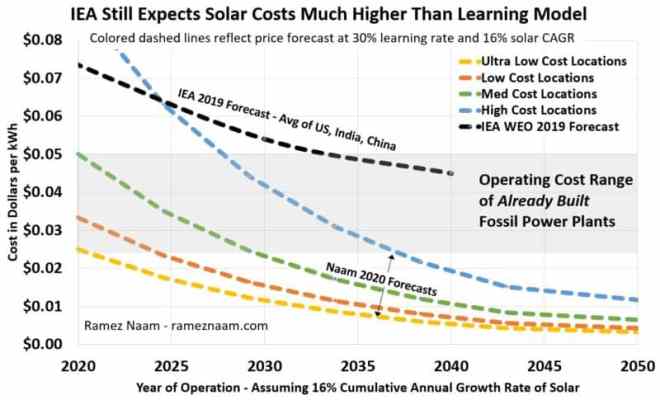
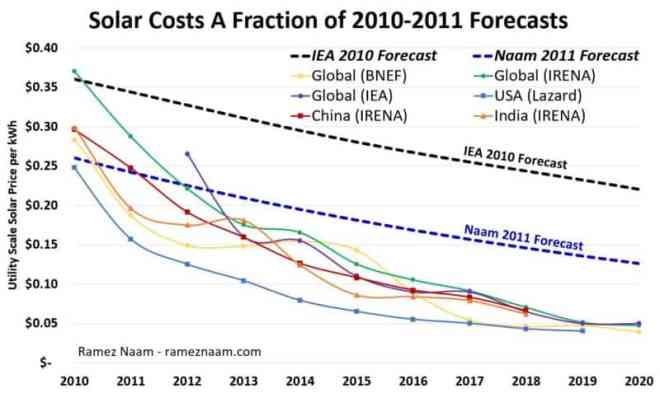
1. Solar cost dropped 5x over the course of the last decade – that was a whopping 25% of what the International Energy Agency forecast in 2010. It was also 50% less than his own optimistic forecast from 2011

2. To understand this drop, we must understand Wright’s law – the cost of a technology drops exponentially as a function of cumulative scale of production. So, as we produce more of a certain technology, we learn how to better optimize its production.

In solar energy’s case, every doubling of cumulative production has resulted in a 30%-40% decline in prices.

3. Even with very conservative forecasts, it is likely that even medium cost solar plants will be cheaper than the cheapest fossil power plants within a decade.

This doesn’t mean the journey will be straightforward – but, we continue to make progress at a pace that exceeds any previous expectation.

4. Of course, the presence of cheap solar energy isn’t going to be a panacea until we make significant progress on cheap energy storage. We will need to combine solar with the likes of wind, hydro, and nuclear power to de-carbonize places that get little in the way of sunlight. And, we’ll need all the solar we can get as we transition toward Electric vehicles.

But, we’re making a lot of progress and there are plenty of reasons to remain optimistic.