COVID-19 #4: Flatten the curve optimism/roller coaster

Update since I wrote the note below on Friday evening: This turned out to be a false dawn. In fact, it turned out to be a calm before a storm – we followed a low of 7 as today’s report had 68 new cases.

As I’ve been writing a post a week over the past few weeks, I’ve been reflecting on the lessons I’ve learnt so far. And, the biggest one is that there is no “normal” for this sort of thing.

All leaders can do is act quickly, decisively, and clearly (Tomas Pueyo continues to make an important case for decisive action). But, it is important to remember that there’s no playbook for this sort of thing. All we can do is pay attention to the signs and data, act as early as possible, and hope for a bit of luck.

Here’s to that. Stay safe, stay optimistic. We’re living through a period that is undoubtedly going to be an important point in our history as a species. And, we’ll get through this.


While it is very helpful from a productivity standpoint to avoid news websites/Twitter (see Seth’s powerful post on the topic) save for a few mins every day, one Twitter stream I’ve been monitoring at least twice everyday has been from our local county.

Every day, county officials – who’ve been working tirelessly to help those in need while implementing a strong and important cross-county shelter-at-home directive – share an update on the number of cases.

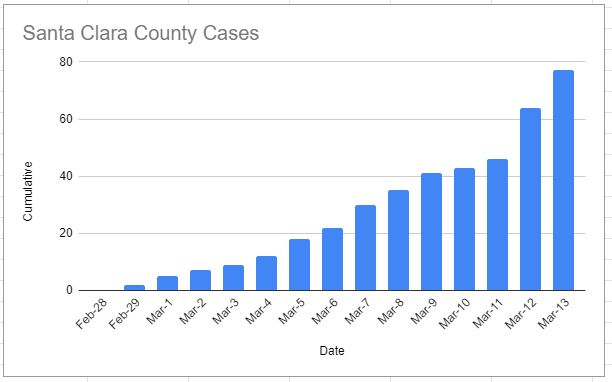
While I wish we had more data and transparency around total numbers tested, the early signs from efforts to flatten the curve are encouraging. As you can see from this graph, the number of new cases has been trending downward over the past 3 days.

As symptoms only show after 5-7 days, this is hopefully a result of major companies enforcing work-from-home 2 weeks ago. And, if so, this underscores why the tougher shelter-in-place/school closures were important steps to take this week.

The true test, again in the absence of testing data, will be if the change in the new case rate continues to remain at these levels (or decreases) in a week as we’ll see the full impact of the shut down.

If these trends continue, it would be really really really positive and will hopefully help further underscore the importance of acting early. Fingers crossed.

Previous posts: #1#2, #3

No one can explain why planes stay up in the air

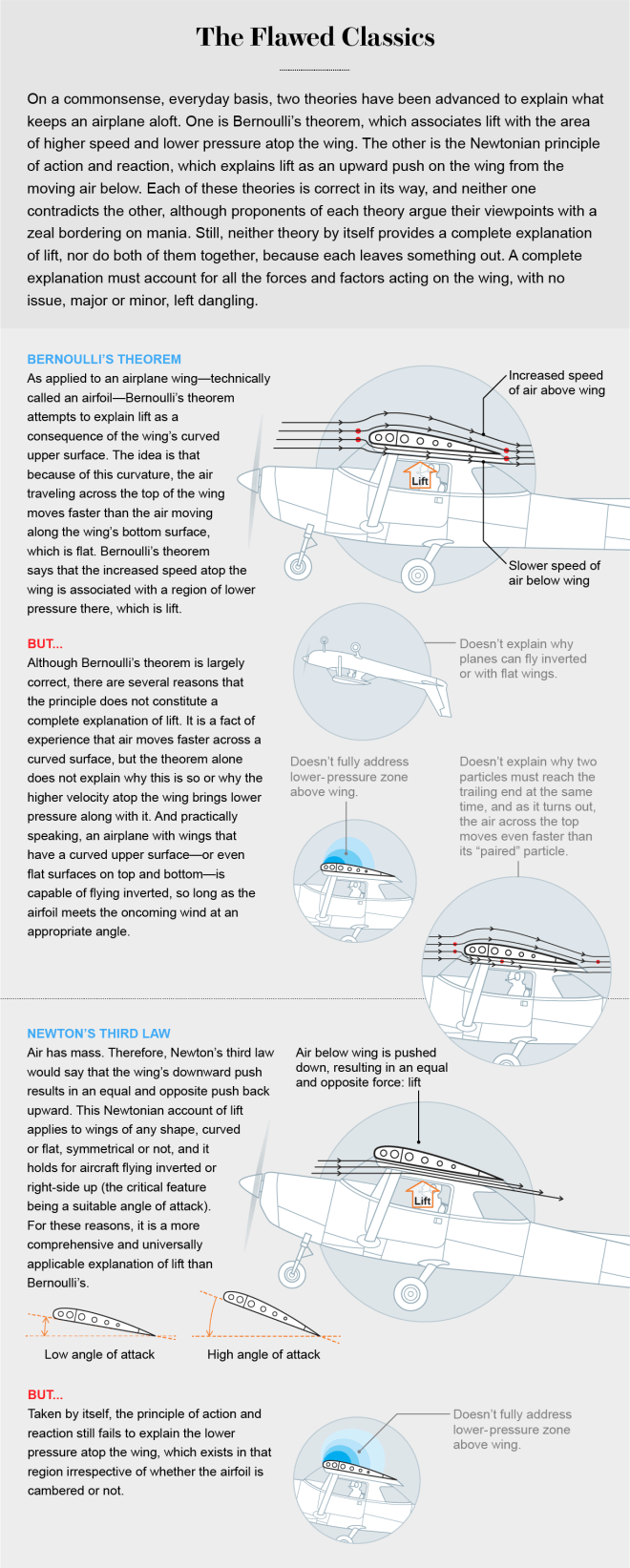
Scientific American has a fascinating, albeit geeky, article with a story that lives up to the title – “No one can explain why planes stay up in the air.”

There are two classical theories that attempt to explain why planes stay up in the air. But, they each have their drawbacks and don’t provide complete explanations.

Even with multiple modern attempts, scientists acknowledge we don’t yet have a one line answer that does justice.

I found myself chuckling as I read the article as I was reminded of a Rory Sutherland idea from Alchemy – Just because it makes sense doesn’t mean it should work. And, just because it works doesn’t mean it makes sense. :-)

Science is fascinating.

Replace social distance with physical distance and social closeness

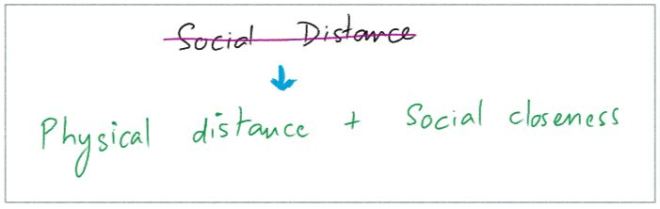
Let’s replace “social distance” with “physical distance and social closeness.”

Adam Gazzaley, a Professor of Neurology and Psychiatry at UCSF, made a great point about replacing “social distance” with the more accurate “physical distance” as our go to term for our efforts to flatten the Coronavirus curve.

At a time when feelings of loneliness and a lack of community have spiked – especially among the elderly – we need to combine physical distance with social closeness more than ever before.

What this means for us: make the time to give friends who’re working by themselves a call from time to time, send a quick check in text to anyone who crosses our mind, send lots of positive notes to our teams, and over communicate.

In times like this, all of us have plenty of reasons to be wrapped up in our own problems. So, it is also okay if we don’t have the time. But, perhaps, every time we hear the word “social distance,” we can begin to flip that to “physical distance and social closeness” in our mind.

Powerful things happen when we change language.

v31

The word I’m thinking most about right now as I release version 31 is focus.

I hesitate to call it a learning because it isn’t yet a part of how I operate – at least not to the degree I’d like for it to be. And, since to know and not to do is not to learn, I still think of my notes on focus as reminders to myself.

As the years pass, I’ve become more aware of the fact that the time and energy I have on this planet are finite. And, with that awareness comes the real need to thoughtfully spend time on the things that matter. That’s where learning to focus is a game changer – by pushing me to be aware of the priorities at any given moment, it elevates the signal and dulls the noise.

The second word I’m thinking about is gratitude. In this very disruptive and turbulent time, my heart goes out to the many many incredible people who are on the front lines in hospitals and grocery stores risking illness to ensure we’re able to deal effectively with a global pandemic.

Many of these folks are forced to do so because the lack of pay check would affect their sustenance.

Thanks to large doses of luck at critical moments and a lot of privilege, I am able to spend time on my work and family without worrying about my health, getting food on the table, or having money in the bank. Instead, I get to deal with all sorts of first world problems while working in a job that was the stuff of dreams not too long ago.

I also have the privilege of writing on this blog – and sharing in this journey with you.

A friend asked me recently as to who I speak to when I need a pep talk.

“I write” – I wrote back.

That’s not entirely true. Thanks to you, these notes often become conversations. And, as I’ve gotten to exchange notes with many of you over the course of many years, there’s a sense of friendship and community that comes with many association of writing here.

So, I just want to say thank you. For being there. I hope you are staying safe.. and well.

I also want to express my gratitude to the many many people who helped me learn, grow, love, and laugh over the years. And, also to the universe for working its magic along the way.

In sum, much to do – with more focus. :-) Much to be grateful for.

Here’s to making it meaningful, making it count.

(Past birthday notes: 30, 29282726252423)

2 drivers to developing and mastering a skill

I’ve observed only two leading indicators of someone developing and then mastering a skill –

i) Obsession: Obsession is driven by a combination of a) an intrinsic desire to get better at the craft and b) commitment. I’ve found intrinsic aptitude to be highly correlated to obsession and that obsession makes it easy to put in the hours required to hone our skills. Long hours don’t feel long when you are obsessed about something.

ii) A willingness to adapt based on quality feedback: The quicker the response to quality feedback, the steeper the learning curve.

Applies to developing our skills in building products, playing a sport, or even parenting kids.

What you see and what you get

I woke up yesterday to a weather forecast that predicted rain for most of the next week.

Great, I thought. The one outlet I was relying on during the Coronavirus lockdown was to go out on hikes over the weekend. This is going to suck.

And it did – in my head at least.

My attitude through most of the day would have received a C. I plodded through the day, reacted to a few things, and made my way to the end.

What we see is what we get.

Luckily for our kids, they have another parent who embodied exemplary attitude and managed to see the situation as a puzzle that could be solved with some creativity and thoughtfulness.

I could have chosen to see what she saw, of course. I could have also chosen to see so many other things I took for granted – good health, shelter, reliable electricity and water, job security, and so many other gifts that I’ve been bestowed with.

If I’d seen all of that, I would have earned a day full of gratitude and opportunity.

What we see is what we get.

It wasn’t to be.

But, I have an opportunity to start afresh today.

So, here’s to that.

COVID-19 #3: Mar 13 notes

First up, I have to acknowledge that I didn’t plan for my blog to become a COVID-19 update blog. But, this blog reflects what I’m learning and thinking about. And, this pandemic is definitely taking more mindshare than ever. So, I’d expect a few more posts in the coming weeks.

I had 5 notes about the virus today.

1. The White House’s overdue emergency declaration is a critical step forward. The White House At long last, the White House has declared an emergency. I am hugely grateful to the millions of traders/financiers who collectively moved the markets and spurred a response. We can finally do away from the nonsense about this being similar to the flu and move on to the work that needs to get done.

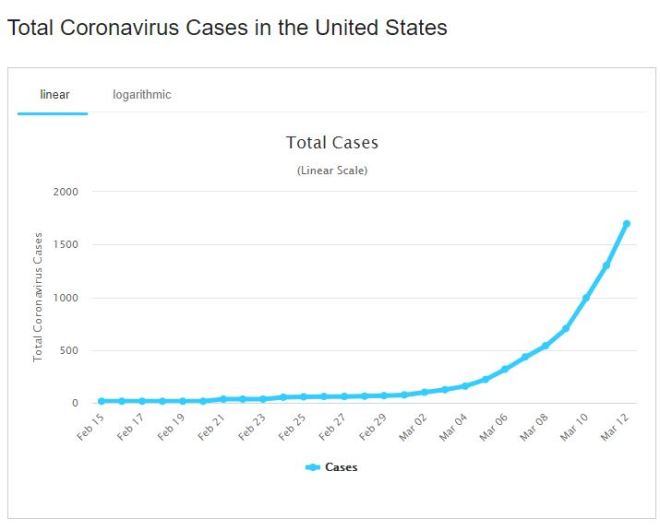
As the graph below shows, we are well into exponential growth territory in the US. The key question right now is – how quickly can we flatten this curve?

2. When this passes, I am hopeful Representative Katie Porter is celebrated as the heroine she is. If you haven’t see the video yet, you should.

She gets at the root of the biggest problem – the cost, without isolation, for a single individual without insurance to get tested are $1331. For a family, that can go up to $3000-$5000. A lot of front-line workers would be worried about these costs. And, yet, staying at home would only make things worse for the community.

To top it all, it takes five days for symptoms to show. So, who knows what’s happening already?

This is why she pushed the CDC to make testing free. This is also why the state of emergency is critical – it unlocks immediate funds for widespread testing. Until we test, we won’t know what the reality is. And, it is key to understand reality to then deal with it.

3. We moved into lock down where we are in Santa Clara County. The inevitability of exponential growth means this should ideally have happened a week ago.

But, as things stand, we’re currently looking at this familiar looking graph. The key, again, will be how the lock down + increased testing shapes this graph. We’ll have a better sense in 3 weeks.

4. Lock down measures are important because people can be daft. If you haven’t heard about the genius who took a flight from New York to Miami knowing he might have the COVID-19 virus, it is worth a read for a simple reminder of how dangerous daft behavior can be.

The result of such behavior is that we have several others who are likely to be carrying the virus without symptoms over the next 5 days to different parts of the country/world.

5. If early drastic measures work, they look overly cautious. It’s been fascinating having a few conversations with family members in India. The initial reactions have been one of relative indifference. The challenge, of course, is the case curve in India isn’t all that different from the one I shared above for Santa Clara (in reality, a few days behind).

So, it doesn’t feel serious. But, from what we know about this virus, this is exactly the time to act. But, how do you act when it doesn’t feel serious?

This has been a fascinating insight into human behavior and gets to exactly why every climate crisis advocate has found it hard to make meaningful progress in the past year.


End note: Needless to say – avoid crowds and common areas, forget travel, wash your hands, avoid touching your face, etc. I’m having particular difficulty with the “don’t touch your face” part after getting a 3 year old’s elbow (accidentally) jam into my eye two days ago. So, maybe the message is – do the best you can. :-)

Also, while we’re at it, if someone can explain the rationale of stocking up on toilet paper, I’d appreciate that.

Posts: #1, #2

You only need one to work out

During a time when I was simultaneously in need of a break and losing hope that any of my shots would work, a friend pulled me aside and said – “Keep working the process and don’t lose hope. You only need one to work out.”

Every once a while, you hear a timely piece of perspective that changes everything for you.

That line did it for me. It completely shifted my perspective.

Over time, I’ve come to appreciate the importance of this perspective through the lens of many a friend and acquaintance’s job seeking journeys. That one thing rarely works out on schedule. But, given time, space, irrational optimism, iterative learning, and some dumb luck, it does.

For those seeking opportunities right now, those timelines have likely been lengthened given the pandemic. Hope you’re able to keep working the process.

All it takes is for one to work out.


PS: Closing the loop on the Premium subscriptions – if you filled that form, you should have heard back from me by Sunday night PT/Monday morning in Asia (and some time in between elsewhere). If you haven’t, please just send me a note on rohan at rohanrajiv dot com. Thanks!

7 notes on COVID-19

I shared a Coronavirus PSA a few days back. A lot more data has been gathered since and I thought I’d share 7 things I’ve taken away from what I’ve read.

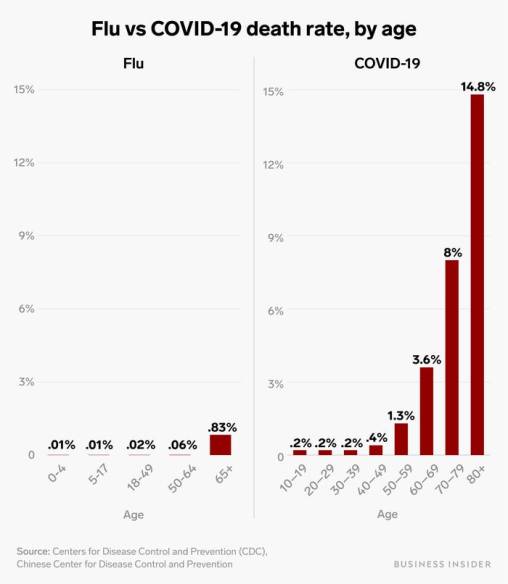
1. COVID-19 is a pandemic – do not compare it with the flu. The World Health Organization has declared COVID as a pandemic. A pandemic is a world wide spread of a new disease whose impact tends to be higher due to the lack of pre-existing immunity.

Here’s a simple chart comparing the death rates of both from a week ago. While new data is coming in every day, we are looking at an illness that is ~20x more likely to cause death.
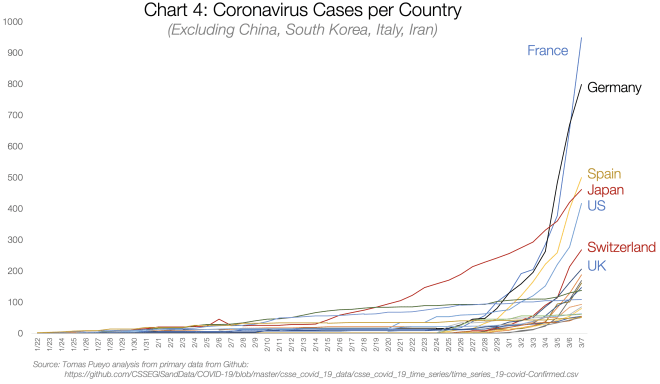
2. It is growing exponentially. Every person who contracts with the virus passes it to more than 2 on average. This means it is spreading more rapidly than most folks can comprehend. The main question to ask is – how long is it taking for the number of cases in your area to double?

In most places, the answer is 3. Let’s imagine a country has 500 cases today. In 1 month, these 500 cases will become  1 million. And, within the next month, it would hit a billion people (assuming there are a billion to infect). (More on Our World in Data)

Tomas Pueyo shared an excellent post compiling data we have so far. Here’s a chart of what exponential growth looks like outside the 4 most affected countries.
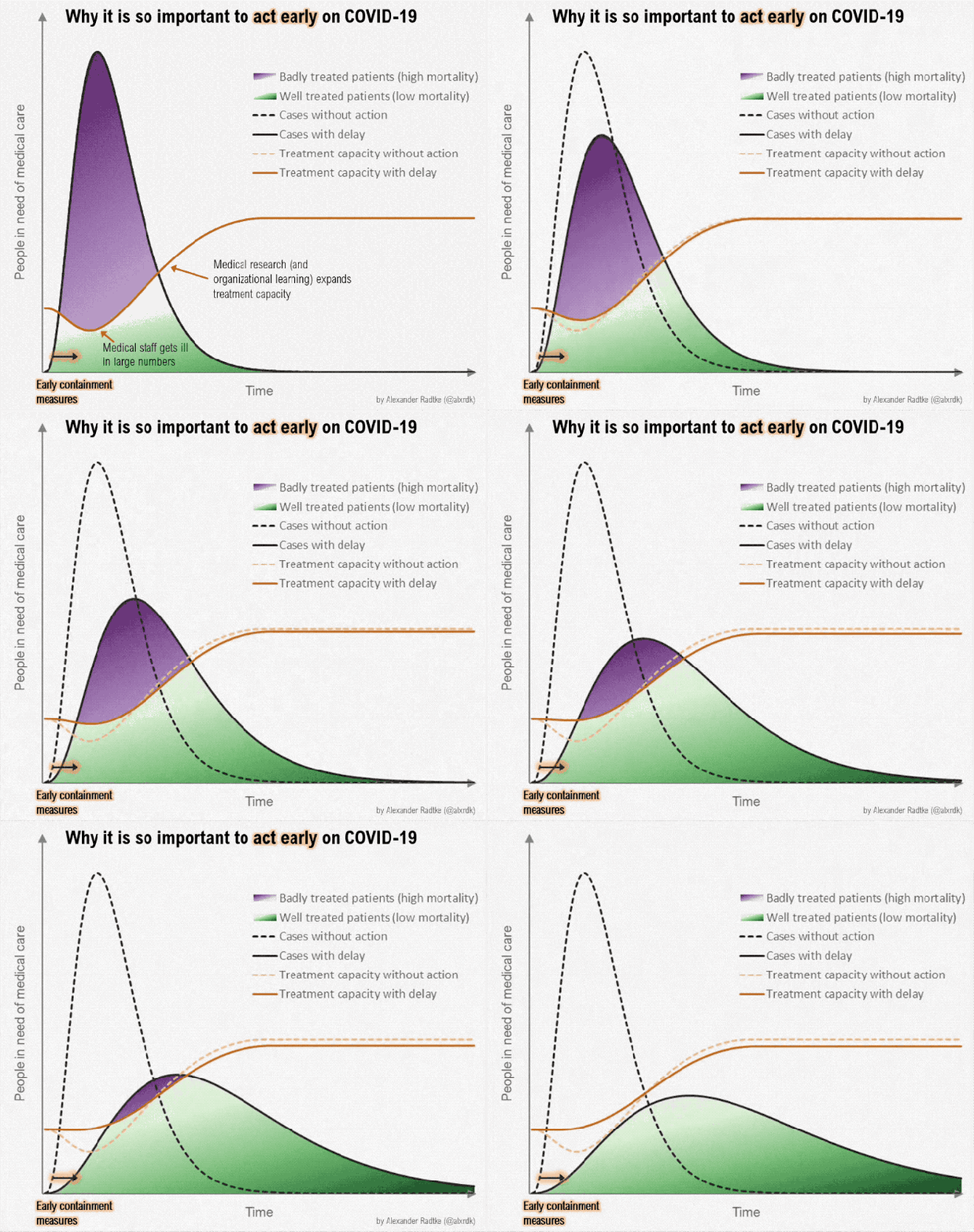
3. The only reasonable strategy we have is to flatten the growth curve. As is the case with viral infections, we will all get it in time. 80% of us will only experience non critical symptoms. But, 20% will need medical care.

If this spread happens too quickly and before we have a cure (as is the case right now), the numbers will overwhelm any healthcare system – only worsening the situation in the absence of a vaccine/cure. So, it becomes critical to act early.

The earlier we take drastic action – effectively shutting down the country (workplaces, schools, etc.), the better the long term situation. The short term trade-offs are very real – specifically, a hit to the economy – but the long term effects make this the best strategy by a distance.
4. Japan, Hong Kong, and Singapore did just that. Learning from the SARS epidemic, all 3 countries acted really early and their growth curves look very different from the rest.

5. Countries that didn’t act quickly have had to take drastic measures to ramp up testing. South Korea has been at the forefront of this. The relative length of the bar on the left vs. the right is a leading indicator of the amount of trouble that lies ahead.
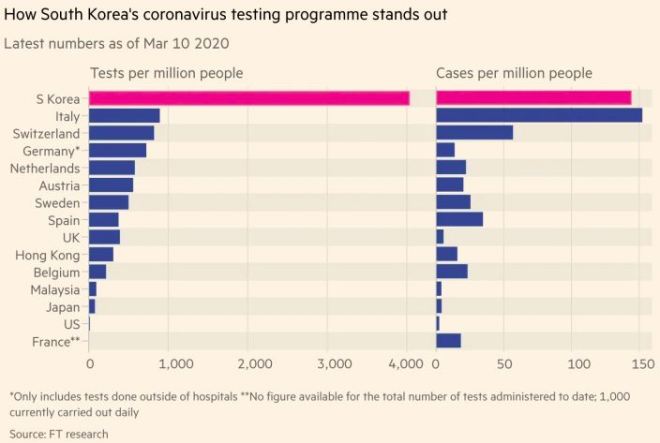
This is particularly important in the case of the Coronavirus because it takes a 5 days for symptoms to show. So, making tests easily available and, thus, enabling testing early and often is the best way to prevent further infection. Just as acting late makes it exponentially worse, acting early is exponentially better.

Thanks to a combination of rapid testing and widespread lock down, South Korea bent the epidemic curve – see the decline in new cases as of March 10.
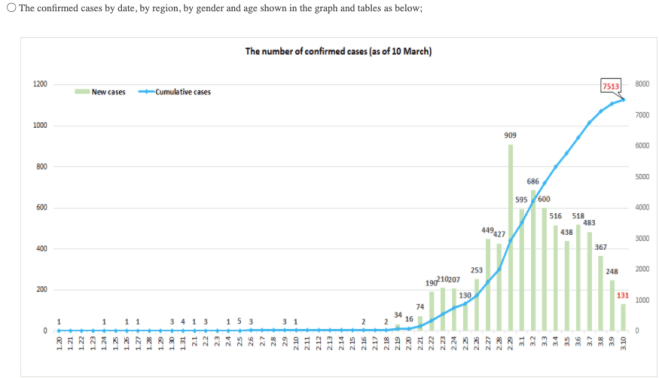
6. The most dangerous places with COVID-19 on the planet today – particularly if you are over 50 years – are places which are neither acting early nor ramping up on testing. Sadly for those of us here, the United States squarely falls in that bucket. There are many good pieces of coverage that outline just how poorly the administration and the CDC have handled this situation.

Instead of focusing on that, I’d like to call attention to an incredible thread on Twitter from Trevor Bedford of the (excellent) Seattle Flu Study team on March 1. The 3 bullet version of this story is –

    • The Seattle Flu study team attempted to begin testing for the Coronavirus in the end of January. But, they were blocked by the CDC. As they grasped the seriousness of the situation given the events in Wuhan, they ran the tests anyway and informed the health officials. The response from the CDC, FDA, and the Federal Government was to cease and desist.
    • As a result of this, we are grossly under-testing in the United States and the flu study team estimates we are underestimating the actual number of cases by an order of magnitude. Tomas’ model suggests the real number of cases is at least 5x more.
    • When the CDC finally decided to act, it attempted to create its own test – however, these tests didn’t work.

As a result, we are left with these sorts of numbers as of 3 days ago.

And, the story emerging from clinics all around is identical – there aren’t enough test kits.

7. We can do our part. Trevor Bedford’s thread and revelations alone led to a chain of events that sparked a response across Washington and California – including companies working from home, canceled conferences/sports events, and so on.

We may soon look back at this thread and the Seattle Flu Study team’s bravery as a defining moment toward dealing with the Coronavirus in the US. Ben Thompson of Stratechery had an excellent article outlining why this thread matters in the broader context of technology and bureaucratic gatekeepers.

Over to what we can do – Flatten the curve is an excellent resource for the things we can do during this time – wash your hands, don’t touch your face, cancel travel, work remotely if you can, avoid large groups, and so on.

A final note: Reading and synthesizing this information reminded me of the final notes from the excellent HBO series – Chernobyl.

“To be a scientist is to be naive. We are so focused on our search for truth, we fail to consider how few actually want us to find it. But it is always there, whether we see it or not, whether we choose to or not. The truth doesn’t care about our needs or wants. It doesn’t care about our governments, our ideologies, our religions. It will lie in wait for all time. And this, at last, is the gift of Chernobyl. Where I once would fear the cost of truth, now I only ask: “What is the cost of lies?”

When I first heard these lines, I thought it was very applicable to the dialog on climate change. Sadly, it is just as applicable in the face of a pandemic.

In times like this, we come to realize the true cost of a lack of science/fact based and dynamic (i.e. open to learning from others/new data) leadership. Whether it is repeatedly comparing COVID-19 to the flu or attempting to downplay its risks, the effects of denial and delayed response have been, are, and will continue to be lethal.